
TL;DR

Get business pricing on garage and car supplies
- Business-only prices and quantity discounts
- Tax-exempt purchasing
- Multiple users, one account, clear invoices
A Charged EVs report by Avery Dennison authors Max VanRaaphorst and Avery Dennison presents a three-part pressure-sensitive adhesive tape strategy for battery-pack thermal management. It describes approaches for heat transfer, thermal barriers and venting, but the supplied source excerpt does not establish independent test results or provide full performance details for every part of the strategy.
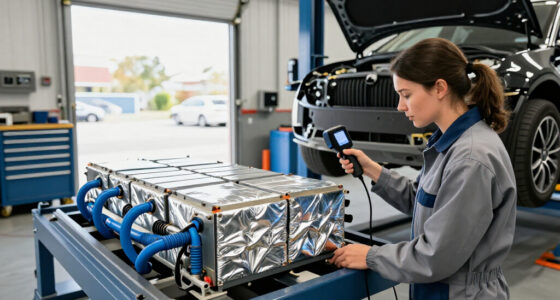
A report published by Charged EVs outlines how pressure-sensitive adhesive (PSA) tapes could help battery-pack designers manage heat, isolate cells during thermal runaway and control vented gases and flames. The report, by Max VanRaaphorst and Avery Dennison, describes a three-part materials strategy as battery makers pursue higher energy density and faster charging.
The report identifies three related engineering problems: moving heat from cells to cooling components while preserving electrical insulation, slowing heat transfer between cells during a failure, and managing the hot gases, flames and particulates released when a cell vents. It argues that battery packs leave limited space for thick barriers or air gaps, while added materials also need to be lightweight and compatible with production.
For heat transfer, the authors describe dielectric-film tapes with acrylic adhesive for bonding cells, modules and cooling components. They compare an 85-micrometre PSA tape with thermosetting dielectric powder coatings that typically require 250 micrometres for coverage. The report says the thinner tape can provide comparable or better breakdown voltage and, assuming comparable thermal conductivity, reduce conductive thermal resistance by about 66%. It says this could allow heat to move nearly three times faster from a cell casing to cooling fluid. Those figures are claims in the report, not independently verified results in the supplied source.
For cell-to-cell protection, the report proposes laminating low-thermal-conductivity tape with materials such as mica, aerogel or ceramic paper. The combination is intended to provide insulation with more mechanical strength and easier handling than a fragile barrier alone. The authors also describe adhesive formulations said to withstand temperatures approaching 500°C for short periods, as well as low-release liners intended to support automated assembly.
Materials for Safer Battery Packs
The proposed approach addresses a practical constraint in electric-vehicle battery design: engineers need to remove heat during ordinary operation without creating an electrical hazard, yet also limit the spread of heat if a cell fails. Thin, die-cut tapes that can be applied on manual or automated lines may offer manufacturers a way to add functions without taking up as much space as bulkier components.
The safety stakes are significant because an unmanaged cell failure can affect neighboring cells and raise pressure inside a pack. The report presents tapes as one layer of a broader engineering response, not as a substitute for pack-level safety systems. Its relevance will depend on whether the described materials perform under real pack conditions, including heat, mechanical stress, chemical exposure and manufacturing variation.
thermal management PSA tapes for batteries
As an affiliate, we earn on qualifying purchases.
As an affiliate, we earn on qualifying purchases.
Why Tape Features in Pack Design
PSA tapes use adhesives that bond when pressure is applied, without requiring a separate curing step. According to the report, they can be made thin, customized and die-cut to fit battery designs, and laminated with materials that add functions such as flame resistance or electrical insulation. The authors list existing battery uses including cell connections, wrapping, compression padding, gasketing, sealing and wire management.
The report frames demand for thermal-management materials against batteries that are becoming denser and are expected to charge faster. Those trends can intensify the consequences of faults, while compact pack layouts constrain the room available for barriers and cooling pathways. The document is authored by Avery Dennison personnel and discusses the company’s Volt Tough™ products, so its product and performance descriptions should be understood as material from the manufacturer rather than independent certification.
“The report says engineers need materials that balance thermal conductivity with dielectric performance without sacrificing manufacturability.”
— Max VanRaaphorst and Avery Dennison, authors of the Charged EVs report
pressure-sensitive adhesive battery cooling tape
As an affiliate, we earn on qualifying purchases.
As an affiliate, we earn on qualifying purchases.
Performance Evidence Still Needed
The supplied report excerpt does not provide independent laboratory data, named test protocols, sample sizes or results from full battery-pack trials. It is also unclear how the stated thermal and dielectric performance changes across different cell formats, pack layouts, operating conditions and aging cycles. The source excerpt ends during its discussion of anisotropic venting tapes, so it does not establish their detailed construction, venting performance or test results.
The report presents product capabilities and potential benefits, but does not show whether the proposed combination prevents thermal runaway or guarantees that a cell failure will remain isolated. No independent regulator or safety-testing body is cited in the supplied material. Those distinctions matter: thermal-management materials may reduce certain risks, but a product description alone cannot confirm pack-level safety outcomes.
high temperature resistant PSA tapes for EV batteries
As an affiliate, we earn on qualifying purchases.
As an affiliate, we earn on qualifying purchases.
Validation in Battery Systems
The next step for the claims described in the report would be publication of detailed test methods and results, followed by evaluation in representative battery modules and packs. That evidence would need to address electrical insulation, heat transfer, flame and gas exposure, mechanical durability, aging and compatibility with automated production.
The supplied source does not announce a testing schedule, customer deployment, regulatory decision or upcoming product milestone. Until further evidence is available, the strategy is best understood as a manufacturer-authored proposal for integrating tapes into battery thermal management, with its real-world performance still to be established.
battery cell insulation adhesive tapes
As an affiliate, we earn on qualifying purchases.
As an affiliate, we earn on qualifying purchases.
Key Questions
What does the report propose PSA tapes can do in a battery pack?
It describes tapes for heat transfer with electrical insulation, barriers intended to slow heat spreading between cells, and management of gases and flames vented during a cell failure.
What is the reported 66% reduction based on?
The authors compare an 85-micrometre dielectric PSA tape with a thermosetting dielectric powder coating described as typically 250 micrometres thick. The claimed reduction in conductive thermal resistance assumes comparable thermal conductivity and is not independently verified in the supplied material.
Does the report prove the tapes prevent thermal runaway?
No. It presents a proposed materials strategy and manufacturer claims. The supplied excerpt does not provide independent test evidence showing that the products prevent thermal runaway or guarantee that a failure will remain contained.
What evidence remains unclear?
The excerpt does not include detailed test protocols, independent results, full-pack trials or complete performance details for the venting tapes. Performance across battery designs and long-term operating conditions is also not established in the supplied material.
Source: rss
Halloween Picks
halloween
As an affiliate, we earn on qualifying purchases.