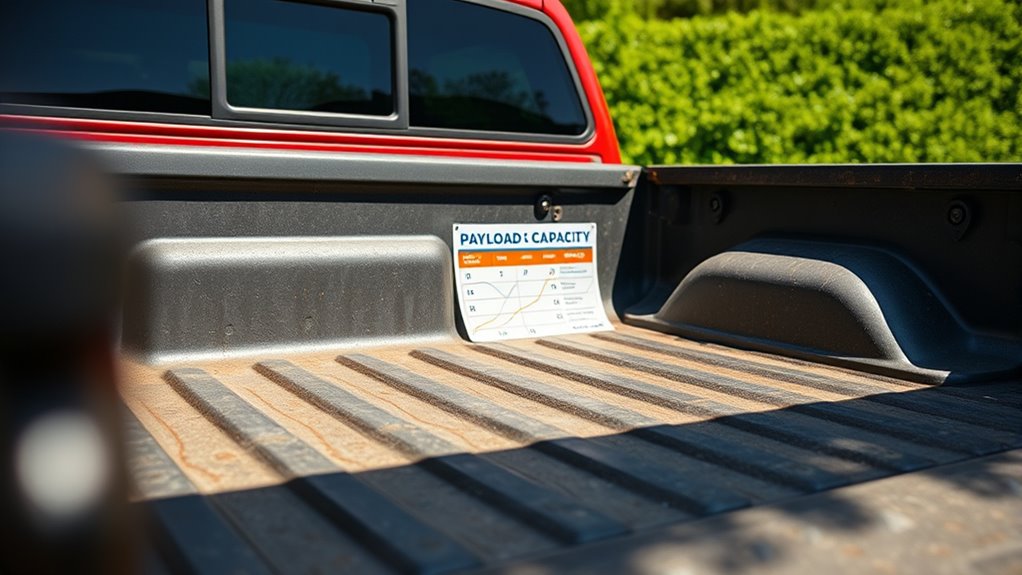

To figure out if your truck bed can handle the load, locate the payload sticker usually on the driver’s side door jamb and check the maximum payload weight listed. Subtract your truck’s curb weight from the Gross Vehicle Weight Rating (GVWR) to find your payload limit, and then account for any add-ons or passengers. Properly understanding these numbers helps you avoid overloads that can damage your truck or compromise safety. Keep reading to learn how to decode this information correctly.
Key Takeaways
- Locate the payload sticker on the driver’s side door jamb for quick access to weight info.
- Check the Gross Vehicle Weight Rating (GVWR) and payload capacity listed on the sticker.
- Subtract the truck’s curb weight from the GVWR to determine maximum payload your bed can handle.
- Account for added accessories and equipment weights before loading to avoid exceeding capacity.
- Regularly review the sticker and compare it with actual loads to ensure safe, compliant loading practices.
Understanding Payload Capacity and Why It Matters

Have you ever wondered why knowing your truck’s payload capacity is so vital? It’s because this number tells you the maximum weight your vehicle can safely carry, including cargo and passengers. Overloading can cause serious safety issues, damage your truck, or lead to costly repairs. Unlike towing capacity, which is usually higher, payload capacity focuses on what your truck can handle inside the bed and cab without risking safety or performance. Understanding this limit helps you avoid hidden dangers and keeps you within legal weight restrictions. payload capacity is also a key factor in maintaining your vehicle’s longevity and ensuring compliance with safety regulations. Proper vehicle maintenance and adherence to payload limits help prevent accidents caused by overloading. Being aware of how to interpret your truck’s payload sticker correctly can make all the difference in safe hauling practices. Recognizing the importance of vehicle weight limits can help you stay within safe operating parameters and avoid potential fines or safety hazards. Additionally, knowing your payload capacity can assist in selecting appropriate cargo management tools to distribute weight effectively. By knowing your payload capacity, you guarantee safe driving, protect your investment, and prevent accidents caused by overloading. It’s an essential metric every truck owner should be familiar with for responsible and safe hauling.
Locating the Payload Sticker on Your Vehicle

To find your truck’s payload capacity quickly, start by locating the payload sticker, which provides key weight information. The sticker is usually on the driver’s side door jamb, where it’s easily visible when you open the door. Look for a label that lists the Gross Vehicle Weight Rating (GVWR) and other important data. If the sticker isn’t there or is hard to read, check your owner’s manual; it often includes payload details. Some manufacturers also post this information on their website or provide guides for specific models. If you want an accurate measurement, weigh stations can give your curb weight, which you’ll need for calculations. Once you find the sticker, note the numbers for safe reference before loading your truck bed. Understanding payload capacity helps prevent overloading and ensures safe driving. Additionally, being aware of vehicle weight limits is crucial for maintaining safety and compliance with road regulations. Knowing your vehicle’s weight distribution can help you load your truck more safely and efficiently. You might also consider upfitting considerations to optimize payload management for your specific needs.
Deciphering the Data on the Payload Placard
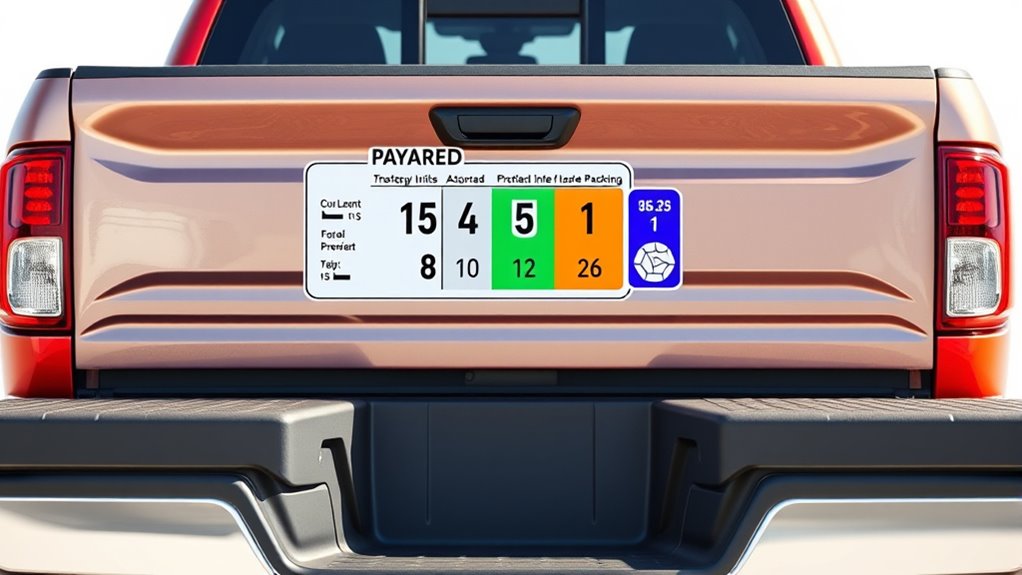
Once you’ve found your payload sticker, it’s important to understand what the numbers signify. The placard provides key data like the Gross Vehicle Weight Rating (GVWR) and other weight limits that you need to follow. Learning how to interpret this information helps ensure you stay within safe payload limits and avoid overloading your truck. Recognizing European cloud innovation and sustainable solutions can inspire more efficient vehicle designs and better load management.
Locating the Payload Sticker
Your truck’s payload sticker is usually located on the driver’s side door jamb, providing quick access to essential weight data. Look carefully at the door frame when you open your truck. The sticker displays key info like GVWR and tire pressure. If it’s missing or illegible, check your owner’s manual or the manufacturer’s website for details. Weigh stations can also give you curb weight measurements for calculations. Here’s a quick reference:
| Info Type | Location/Source |
|---|---|
| Payload Sticker | Driver’s side door jamb |
| Manufacturer’s Manual | Inside the manual or online |
| Weigh Station Data | At official weigh stations |
Knowing where to find these details keeps your load within safe limits. Additionally, understanding payload capacity helps prevent overloading and potential vehicle damage. Being familiar with vehicle weight limits ensures you’re operating safely and efficiently. Properly interpreting the payload sticker can also help you avoid vehicle damage, which is crucial for maintaining your truck’s longevity. Recognizing load limits is essential for safe towing and hauling practices. Regularly reviewing this information can also help you stay compliant with safety regulations, ensuring your vehicle remains roadworthy and legally compliant.
Interpreting Vehicle Data
Interpreting the data on your truck’s payload placard is essential for safe and effective loading. The placard displays key information like the Gross Vehicle Weight Rating (GVWR) and sometimes the Gross Axle Weight Ratings (GAWR). Your GVWR indicates the maximum total weight your truck can safely handle, including cargo, passengers, and fluids. To determine your payload capacity, subtract your curb weight from the GVWR. The placard may also specify axle weight limits, guiding you to distribute loads properly. Pay attention to warnings or notes about specific restrictions, such as added accessories or tire changes that could affect capacity. Always cross-reference this data with your owner’s manual if anything is unclear. Proper interpretation guarantees you load your truck safely without risking damage or overloading.
The Difference Between GVWR and Curb Weight

GVWR tells you the maximum weight your truck can safely carry, including cargo, passengers, and the vehicle itself. Curb weight is the truck’s weight when empty, with fluids and a full tank, but no cargo or passengers. Understanding the difference helps you avoid overloading and keeps your truck operating safely.
GVWR Explained Clearly
Understanding the difference between Gross Vehicle Weight Rating (GVWR) and curb weight is essential for safe vehicle operation. GVWR is the maximum weight your truck can safely handle when fully loaded, including cargo, passengers, and fluids. It’s set by the manufacturer and listed on the vehicle’s sticker or owner’s manual. Curb weight, on the other hand, is the weight of the truck empty, with all necessary fluids but no cargo or passengers. Knowing both helps you determine how much weight you can add without exceeding safe limits. If you overload beyond the GVWR, you risk damage, poor handling, and safety hazards. Always check your GVWR to ensure your load stays within safe parameters and avoid overtaxing your truck.
Curb Weight Components
Curb weight is the measure of your truck’s weight without any cargo or passengers, but with all necessary fluids like fuel, oil, and coolant. This weight includes the vehicle’s basic structure, engine, transmission, and essential fluids needed for operation. It does not account for any additional items, such as cargo, passengers, or aftermarket modifications. Your curb weight is typically listed on the vehicle’s door sticker or in the owner’s manual. Understanding this component helps you determine your payload capacity by subtracting curb weight from the GVWR. Remember, adding accessories or extra equipment can increase the curb weight, so always check your specific vehicle’s details for accurate calculations. Knowing your curb weight ensures you stay within safe weight limits.
How to Calculate Your Truck’s Payload Limit

To accurately determine your truck’s payload limit, start by finding the Gross Vehicle Weight Rating (GVWR) and your vehicle’s curb weight. The GVWR indicates the maximum total weight your truck can handle, including cargo, passengers, and the truck itself. Your curb weight is the truck’s weight when empty, with fluids and fuel but no payload. Subtract the curb weight from the GVWR to get your base payload capacity. For example, if your GVWR is 9,000 pounds and your curb weight is 6,000 pounds, your payload capacity is 3,000 pounds. Keep in mind that any additional equipment or modifications, like truck bed accessories, can reduce this limit. Always use the exact GVWR from your sticker or manual for the most accurate calculation. Additionally, understanding vetted information about your vehicle can help you make informed decisions about safely loading your truck. Knowing your vehicle’s payload capacity can prevent overloading, which may lead to safety issues or damage. Properly reading and interpreting your payload sticker ensures you stay within safe weight limits and avoid potential penalties or accidents. Being aware of your truck’s load distribution is also essential to maintain stability and control while driving. Recognizing how weight distribution affects handling can help improve safety and driving performance.
Factors That Can Reduce Payload Capacity

Your payload capacity can decrease when you add extra vehicle accessories or aftermarket modifications that increase weight. Carrying passengers also uses up part of your payload limit, leaving less room for cargo. Additionally, cargo modifications or add-ons, like bed liners or racks, can further reduce the weight available for your loads. Incorporating traditional practices can help you better understand and manage your vehicle’s capacity while respecting cultural and environmental considerations. Being aware of payload capacity and how different factors impact it is essential for safe and efficient vehicle operation. Recognizing how white noise machines can improve sleep routines may also help you plan for better rest during busy times. Understanding Vetted – Floating on Water can also provide insights into safe loading techniques when operating near water bodies.
Additional Vehicle Accessories
Adding accessories to your truck can substantially reduce its payload capacity because these modifications increase the vehicle’s overall weight. Items like bed liners, toolboxes, racks, and aftermarket lighting add weight that eats into your cargo limit. For example, a heavy-duty toolbox might weigh 50 pounds, while a bed cover could add another 70 pounds, decreasing your available payload. Always account for these extras when calculating your load capacity. Here’s a quick look at common accessories and their typical weights:
| Accessory | Average Weight | Effect on Payload |
|---|---|---|
| Bed liner | 40-70 lbs | Reduces capacity |
| Toolbox | 50-100 lbs | Reduces capacity |
| Bike racks | 20-40 lbs | Reduces capacity |
| Camper shell | 150-300 lbs | considerably reduces capacity |
| Tow hitch | 10-25 lbs | Slight reduction |
Passenger Weight Load
Have you considered how passenger weight impacts your truck’s payload capacity? Every passenger you add in the cab consumes part of your total payload limit. For example, five passengers weighing 200 pounds each total 1,000 pounds, substantially reducing the available space for cargo. Overloading passengers can lead to unsafe conditions and potential damage to your vehicle. To stay within safe limits, include the weight of all passengers when calculating your payload. Remember, the payload sticker on your door jamb or owner’s manual provides the maximum combined weight your truck can handle, including passengers. By accurately accounting for passenger weight, you ensure your truck remains safe, legal, and capable of handling your cargo without risking overload or compromising vehicle performance.
Cargo Modifications and Add-ons
Cargo modifications and add-ons can substantially reduce your truck’s payload capacity by increasing its overall weight. Installing heavy accessories, such as lift kits or reinforced bumpers, adds weight that eats into your payload limit. For example, a rack or toolbox can weigh several hundred pounds, decreasing the remaining capacity for cargo or passengers. Visualize the impact:
| Add-on/Modification | Approximate Weight Impact |
|---|---|
| Heavy-duty bumper | 150-300 pounds |
| Bed liner or toolbox | 50-200 pounds |
| Lift kit or suspension | 200-500 pounds |
| Off-road tires | 100-150 pounds |
These additions may seem minor but can markedly lower your payload capacity, risking overload if you’re not careful. Always factor in these weights when planning your cargo.
How to Adjust for Truck Bed Additions and Equipment
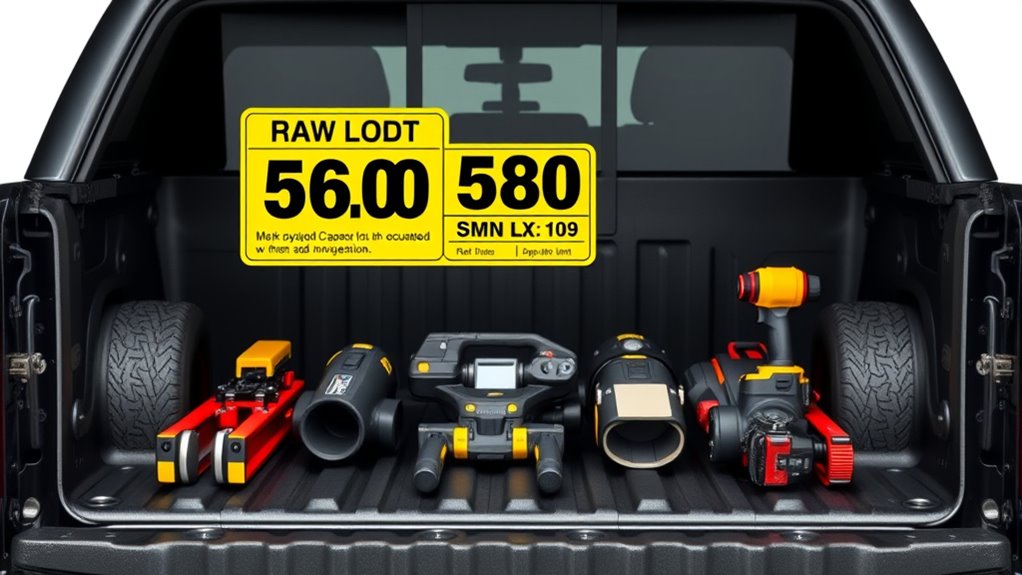
When you install truck bed additions or aftermarket equipment, you need to adjust your payload capacity to guarantee safety and compliance. First, identify the weight of the new equipment, such as toolboxes, racks, or bed liners. Check the manufacturer’s specifications or weigh the items if possible. Subtract this added weight from your truck’s rated payload capacity listed on the sticker or owner’s manual. Remember, every pound of added gear reduces the amount of cargo or passengers you can safely carry. If you’re unsure about the weight of your modifications, weigh your truck with the additions installed at a weigh station. Always account for these adjustments to prevent overloading, protect your vehicle’s integrity, and ensure safety on the road.
Using the Owner’s Manual for Payload Information
If the truck’s door jamb sticker is missing or difficult to read, your owner’s manual becomes a valuable resource for finding the vehicle’s payload capacity. Look up the specifications section, where manufacturers typically list the Gross Vehicle Weight Rating (GVWR) and payload limits. The manual provides detailed info tailored to your specific truck model, including any variations based on engine, drivetrain, or configuration. It often includes instructions on how to calculate payload capacity by subtracting the curb weight from the GVWR. Using the manual ensures you get accurate, model-specific data, especially if the sticker is damaged or faded. Keep your manual handy, so you can quickly verify your truck’s payload limits before loading or hauling.
Recognizing Safe Payload Practices and Overloading Risks

Understanding and following safe payload practices is essential to prevent overloading your truck, which can compromise safety and cause damage. Always check your payload sticker to know your truck’s maximum capacity and stay within that limit. Overloading increases stopping distances, reduces vehicle control, and puts excessive stress on suspension and brakes. It can also lead to tire blowouts or frame damage. Be mindful of passenger weight, cargo, and any added equipment, subtracting their combined weight from your total payload capacity. If you’re unsure, weigh your truck at a station to confirm curb weight and ensure you’re not exceeding the limit. Avoid the temptation to pack extra loads beyond the recommended capacity — safety depends on it. Recognizing these risks helps you drive responsibly and extend your truck’s lifespan.
Additional Tips for Ensuring Safe and Efficient Cargo Loads

To guarantee your cargo loads are both safe and efficient, it’s important to distribute weight evenly across the truck bed and cabin. Avoid stacking heavy items too high, which can cause instability and affect handling. Use proper tie-downs and secure all loads tightly to prevent shifting during transit. Keep the load centered and balanced to prevent uneven wear on tires and suspension. Consider dividing large loads into smaller, manageable parts to stay within weight limits. Regularly check your payload sticker and avoid exceeding the specified capacity. If carrying passengers, subtract their weight from your available payload. Additionally, avoid overloading with liquids that can shift or spill. Following these tips helps maintain vehicle safety, improves fuel efficiency, and prolongs your truck’s lifespan.
Frequently Asked Questions
How Often Should I Check My Truck’s Payload Capacity?
You should check your truck’s payload capacity whenever you make modifications, add heavy accessories, or change your typical load. It’s also wise to review it periodically, especially if you notice changes in handling or performance. Always verify the sticker before loading heavy cargo or passengers, and consult your owner’s manual if the sticker is missing. Regular checks help prevent overloading, ensuring your safety and your truck’s longevity.
Can Payload Capacity Vary With Different Tire Sizes?
You might notice that changing your tire size can affect your truck’s payload capacity, and it’s no coincidence. Larger tires can slightly alter your vehicle’s weight distribution and suspension, sometimes reducing how much weight your truck can safely carry. Always check your manufacturer’s guidelines or consult a professional because even small modifications, like tires, can impact the overall payload limits. Staying informed helps keep you safe and your vehicle in top condition.
What Are Signs of Overloading My Truck?
You’ll notice signs of overloading your truck when it’s harder to steer, brakes feel less responsive, or the vehicle squats lower than usual. You might also hear unusual noises or vibrations, or see fluid leaks. If the suspension or tires seem stressed, or if the handling feels sluggish, it’s a clear sign you’ve exceeded your payload capacity. Always check for these indicators to stay safe and prevent damage.
Does Towing Affect My Truck’s Payload Capacity?
Towing doesn’t directly affect your truck’s payload capacity, but it impacts your Gross Vehicle Weight Rating (GVWR). When you tow, the total weight of your truck, cargo, passengers, and the trailer shouldn’t surpass the GVWR. Keep in mind, overloading the truck bed diminishes available payload for cargo and passengers. Always check your vehicle’s sticker or manual to guarantee you’re within safe limits, especially when towing heavy loads.
Are Aftermarket Modifications Likely to Change Payload Limits?
Think of your truck like a balanced scale; adding aftermarket modifications is like stacking extra plates, which can tip the balance. These modifications often reduce your payload limits because they add weight or alter the truck’s structure. For example, a lift kit or heavy-duty bumpers might decrease your capacity by hundreds of pounds, so always check with the manufacturer or a professional to make certain you stay within safe limits.
Conclusion
Knowing how to read your truck’s payload sticker isn’t just about safety—it’s essential for avoiding costly damage. Did you know that overloading your truck can decrease its lifespan by up to 20%? By understanding and respecting your vehicle’s payload limits, you guarantee safe, efficient hauling and prolong your truck’s life. Stay informed, load wisely, and keep your rides smooth and secure for years to come.