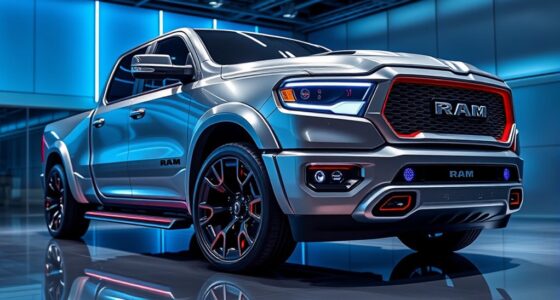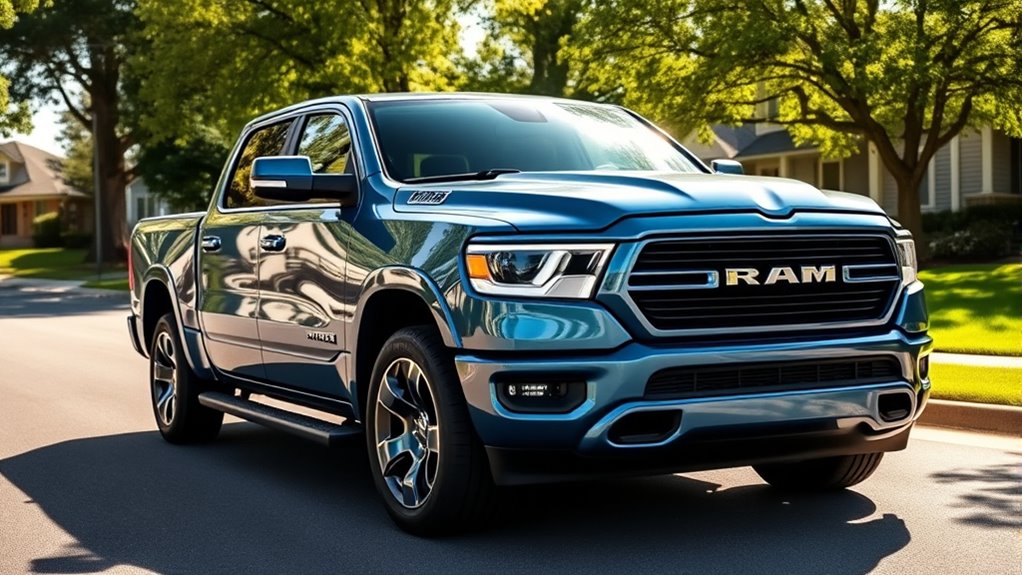

Ram’s eTorque mild hybrid system can boost fuel efficiency, especially in stop-and-go city driving, by providing torque assist and regenerative braking. However, real-world savings are usually modest—around 1-2 mpg—often falling short of EPA estimates. You might notice smoother starts and better responsiveness, but the actual fuel economy depends on driving style and conditions. To find out how much eTorque could save you in everyday driving, there’s more to explore ahead.
Key Takeaways
- eTorque provides torque boost and regenerative braking, improving responsiveness and fuel efficiency mainly in stop-and-go city driving.
- Real-world fuel savings are modest, typically around 1-2 mpg, often falling below official EPA estimates.
- Benefits are most noticeable during urban driving; highway fuel economy shows minimal improvement.
- Factors like terrain, load, driving style, and weather influence actual fuel savings from eTorque.
- Overall, eTorque offers smoother operation and some fuel economy benefits, but the savings are relatively modest.

RYC Automotive AC Compressor and A/C Clutch AFG362 (Fits Ram 1500 5.7L eTorque Mild Hybrid 2019, 2020, 2021, 2022)
Premium Quality Reman Automotive AC Compressor and A/C Clutch.
As an affiliate, we earn on qualifying purchases.
As an affiliate, we earn on qualifying purchases.
How the Etorque System Works to Improve Fuel Efficiency

The eTorque system improves fuel efficiency by replacing the traditional alternator with a belt-driven motor generator that operates on a 48-volt electrical system. This setup reduces the engine’s load, helping it run more efficiently. The motor generator provides up to 130 ft-lbs of torque during acceleration, giving you a torque boost without using extra fuel. It also captures energy during deceleration through regenerative braking, which recharges the small lithium-ion battery. This stored energy is then used to assist the engine at low speeds, reducing fuel consumption. Additionally, eTorque enables smoother start-stop functionality, cutting engine idle time during stops. Youngster Choice Overall, this system works seamlessly to maximize fuel savings while maintaining the performance you expect from your Ram.

NorthStar Belt-Driven Generator Head – 2,900 Surge Watts, 2,600 Rated Watts, 5 HP Required
Two 15 Amp 120V receptacles
As an affiliate, we earn on qualifying purchases.
As an affiliate, we earn on qualifying purchases.
Official Fuel Economy Ratings vs. Real-World Results
Official fuel economy ratings for Ram’s eTorque-equipped models provide a benchmark for expected efficiency, but real-world results often fall short of these numbers. While the EPA estimates around 20 mpg city and 25 mpg highway for the 3.6L V6 with eTorque, many owners see slightly lower figures in daily driving. For the 5.7L HEMI V8 with eTorque, official ratings suggest about 17 mpg city and 23 mpg highway, but actual mileage typically hovers around 14.6 mpg in mixed-use conditions. Highway economy tends to align more closely with EPA estimates, with some owners reporting 17-18 mpg. Factors like driving style, terrain, and load influence these differences, meaning your real-world fuel savings may not perfectly match official ratings.
regenerative braking system for trucks
As an affiliate, we earn on qualifying purchases.
As an affiliate, we earn on qualifying purchases.
Driving Experience and Performance Enhancements With Etorque

Installing eTorque not only improves fuel efficiency but also enhances the overall driving experience. You’ll notice smoother acceleration thanks to the torque boost that fills in low-end power gaps. The system also makes stop-and-go traffic more comfortable with seamless start-and-stop functionality. Additionally, eTorque improves responsiveness during initial acceleration, giving you a more confident feel on the road. Specifically, you experience:
Installing eTorque boosts fuel efficiency and delivers smoother, more responsive acceleration for a confident, comfortable drive.
- Quicker, more responsive launches due to torque assist.
- Smoother progression during stop-and-start driving.
- Enhanced safety features provide additional peace of mind during daily commutes.
- Consistent power delivery without added complexity.
- Maintained towing capacity and performance standards.
These enhancements result in a more refined and enjoyable drive, with less stress during daily commutes and heavier loads. The system’s integration with the truck’s electronics ensures you get a balanced mix of power, efficiency, and driving comfort.

52-7416 Hydraulic Power Brake Booster Compatible with Ram 2500 3500 4000 4500 5500 2011-2018, 4.7L 5.7L 6.4L 6.7L V8, Replace # 52013874AC, 52013874AD, 52013874AE, 52013874AF, 68144663AA
Fitment: Compatible with Ram 2500 2012-2018, Ram 3500 2012-2018, Ram 4000 2012-2014, Ram 4500 2011-2018, Ram 5500 2011-2018….
As an affiliate, we earn on qualifying purchases.
As an affiliate, we earn on qualifying purchases.
Comparing Ram 1500 Engine Options and Their Fuel Savings

When comparing Ram 1500 engine options, you’ll notice how eTorque boosts fuel efficiency across different setups. The hybrid system improves mileage in city driving and offers smoother performance without sacrificing power. Understanding these differences helps you choose the best engine for your driving habits and fuel savings. Additionally, high engine performance can influence overall fuel economy and driving experience.
Hybrid Efficiency Gains
Comparing the various engine options in the Ram 1500 lineup reveals notable differences in fuel efficiency gains, especially with the addition of eTorque mild hybrid technology. You’ll see that hybrid systems boost mileage through several mechanisms:
- They replace traditional alternators with belt-driven motor generators, reducing engine load.
- They provide torque assist during acceleration, lowering fuel demand at low RPMs.
- They enable regenerative braking, capturing energy that would otherwise be wasted.
- They support engine stop-start functions, cutting fuel use during idling.
These features combine to improve city and highway fuel economy modestly but meaningfully, especially in stop-and-go traffic. While the gains vary by engine, the addition of eTorque generally results in about 2 mpg better in city driving, making it a practical upgrade for efficiency-minded buyers.
Engine Performance Impact
The engine options in the Ram 1500 lineup deliver a range of performance levels that directly influence fuel savings and driving experience. The eTorque system boosts low-end torque and smooths out start-stop operation, helping you get better efficiency without sacrificing power. For example, the 5.7L HEMI V8 with eTorque offers more torque assist and slightly improved fuel economy compared to the standard V8. The 3.6L Pentastar V6 with eTorque balances performance with efficiency, making it a practical choice. Meanwhile, the more powerful engines, like the 6.2L supercharged HEMI, prioritize power over fuel savings. Here’s a quick comparison:
| Engine Type | Power | Torque | City MPG | Hwy MPG | Fuel Impact |
|---|---|---|---|---|---|
| 3.6L Pentastar V6 + eTorque | 305 hp | 271 lb-ft | 20 | 25 | Improved efficiency |
| 5.7L HEMI V8 + eTorque | 395 hp | 410 lb-ft | 17 | 23 | Slight fuel savings |
| 6.2L Supercharged HEMI V8 | 702 hp | 650 lb-ft | 10 | 14 | Power-focused, less efficient |
Additionally, the integration of hydrotherapy techniques in water-based recovery can enhance overall vehicle maintenance, such as cooling systems and engine components, promoting longevity and efficiency.
Real-World Fuel Results
Real-world fuel economy results for Ram 1500 owners often vary from official estimates, but they still reveal useful insights into how different engines perform in everyday driving. You’ll notice that:
- eTorque-equipped models typically deliver about a 2 mpg increase in city and combined mileage over non-hybrid versions.
- Many owners report highway mileage between 17 and 18 mpg, aligning with EPA figures.
- Actual fuel savings may fall short of official ratings, with some drivers averaging around 14.6 mpg long-term.
- The benefits of eTorque are most apparent during stop-and-go city driving, where start-stop assist and torque fill-in conserve fuel.
- Additionally, free floating designs in the engine technology can influence efficiency by reducing parasitic losses during operation.
What Owners Say About Fuel Economy Gains
Owners often notice modest fuel economy improvements with eTorque, especially in city driving. However, real-world results can vary depending on driving conditions, load, and terrain. Many report feeling the benefits in stop-and-go traffic, but actual savings may be less than official estimates. It’s also important to consider potential scam risks when researching hybrid systems and their claimed efficiencies.
Real-World MPG Results
Although official EPA ratings suggest modest gains with Ram’s eTorque mild hybrid system, actual fuel economy in daily driving often falls short. Many owners report real-world MPG around 15-18 mpg, especially in mixed driving. Here’s what they observe:
- City driving benefits are most noticeable, with gains of 1-2 mpg over non-eTorque models.
- Highway mileage tends to hover around 17-18 mpg, aligning with EPA estimates but rarely surpassing them.
- Stop-and-go traffic amplifies the hybrid’s advantages, thanks to smoother start-stop operation.
- Long-term tests often show actual MPG below 15, indicating that real savings are somewhat less impressive than official numbers.
- Driving conditions and driving style heavily influence the actual fuel savings you’ll see in everyday use.
In practice, you’ll see modest improvements, but driving style and conditions heavily influence results.
Driving Conditions Impact
Driving conditions play a significant role in determining how much fuel economy you actually see with the Ram’s eTorque system. If you mostly drive in stop-and-go city traffic, you’ll likely notice more fuel savings because the system’s start-stop and regenerative braking features work best in urban environments. On the highway, where driving is more consistent and less idling occurs, gains tend to be less noticeable, though some owners still see modest improvements. Heavy loads, steep hills, and rough terrain can diminish fuel efficiency benefits, as the system’s advantages are optimized during moderate speeds and gentle acceleration. Weather conditions like extreme cold can also reduce battery performance, impacting overall efficiency. Your driving style and environment ultimately influence how much you benefit from the eTorque’s fuel-saving features. Additionally, water resistance and durable design of running gear are crucial for maintaining performance in varying weather conditions.
Perceived Fuel Savings
Many owners notice modest fuel economy improvements with the eTorque system, especially during city driving and stop-and-go traffic. They see benefits like:
- A roughly 2 mpg increase in city and combined mileage compared to non-hybrid models.
- Consistent highway mileage around 17-18 mpg, aligning with official estimates.
- Better responsiveness during acceleration due to torque assist, leading to more efficient driving.
- Smoother stop-start operation, reducing idling fuel waste.
- Some drivers also report that the hybrid technology encourages more mindful and efficient driving habits.
While some report only slight gains, most agree that eTorque provides tangible benefits, particularly in urban environments. Real-world results vary based on driving style, terrain, and load, but owners generally perceive the hybrid system as a worthwhile upgrade for better fuel economy and a smoother driving experience.
The Actual Impact of Etorque on Your Fuel Budget
While eTorque can boost your truck’s fuel economy, the actual savings you see in your fuel budget depend on how and where you drive. Urban stop-and-go traffic benefits most, thanks to start-stop and torque assist, but highway driving shows only modest gains. Real-world tests often report around 1-2 mpg improvement, which might be less than EPA estimates. Your driving style, load, and terrain influence savings considerably. Here’s a breakdown:
| Engine Type | City MPG | Highway MPG | Typical eTorque Benefit |
|---|---|---|---|
| 3.6L Pentastar V6 + eTorque | 20 | 25 | +1-2 mpg |
| 5.7L HEMI V8 + eTorque | 17 | 23 | +2 mpg city, +1 highway |
| Non-eTorque V8 | 15 | 22 | Baseline |
| Long Highway Drives | 17-18 | — | Marginal improvements |
Additionally, the fuel-saving features of eTorque are most effective when combined with attentive driving habits and proper vehicle maintenance.
Frequently Asked Questions
How Much Does the Etorque System Add to the Vehicle’s Overall Weight?
You should know that the eTorque system adds approximately 100 to 150 pounds to your vehicle’s weight. This extra weight comes from the belt-driven motor generator and small lithium-ion battery. While it may slightly impact acceleration or handling, the added weight is managed well by Ram’s engineering to maintain performance. Overall, the benefits of improved fuel economy and smooth operation often outweigh the minor weight increase.
Does Etorque Impact the Ram 1500’s Towing Capacity or Payload?
eTorque doesn’t negatively impact your Ram 1500’s towing capacity or payload. The system adds minimal weight and is designed to work seamlessly with the truck’s existing powertrain, maintaining its strength and durability. You’ll benefit from improved efficiency and smooth power delivery without sacrificing load-carrying ability. So, whether you’re hauling or towing, eTorque helps you do it effectively, without compromising the truck’s core performance capabilities.
Are There Specific Driving Styles That Maximize Etorque Fuel Savings?
You’ll maximize eTorque fuel savings by adopting smooth, gradual acceleration and deceleration, avoiding aggressive driving. Maintaining steady speeds on highways, using the stop-start feature in city traffic, and reducing heavy loads also help. Keep your tire pressure ideal and minimize idling whenever possible. These driving habits allow eTorque to efficiently assist with torque, recapture energy, and reduce engine load, ultimately boosting your fuel economy and making the system work more effectively.
What Are the Long-Term Maintenance Costs Associated With Etorque?
You’ll likely face minimal long-term maintenance costs with eTorque, as it’s designed for durability and reliability. The system replaces some traditional components, like the alternator, reducing wear and tear. Regular maintenance still applies, such as oil changes and brake checks, but you won’t see significant additional expenses from the hybrid system itself. Keep up with routine service, and eTorque should remain trouble-free, offering consistent performance over time.
Can Etorque Be Retrofitted to Older Ram Models Without Hybrid Systems?
You can’t retrofit eTorque into older Ram models without hybrid systems. The system involves specialized components like a belt-driven motor generator and lithium-ion battery, which are integrated into the engine and electrical systems. Installing these parts requires significant modifications to the vehicle’s structure and electronics. If you’re interested in hybrid features, you’ll need to buy a Ram model originally equipped with eTorque, as retrofitting isn’t feasible or cost-effective.
Conclusion
Just like Icarus soaring too close to the sun, chasing perfect fuel savings with Etorque can be tempting but not always realistic. While it does offer improvements and a smoother drive, the true impact on your fuel budget depends on how you drive and your habits. Remember, even the brightest innovations require mindful use. So, embrace the technology but stay grounded—fuel efficiency is a journey, not a destination.