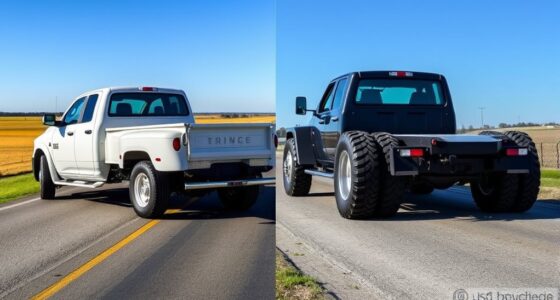
Pickup trucks often get a bad rap for safety, but they have both risks and advantages. Their large size and high impact can protect occupants but also cause severe damage and pose pedestrian dangers, especially in rollover and single-vehicle crashes. Wearing seat belts and understanding vehicle limits helps reduce risks. To see how safety measures and technology are transforming truck safety, explore further—there’s more to learn about making these vehicles safer for everyone.
Key Takeaways
- Pickup trucks increase traffic fatalities and crash severity, especially for unbelted occupants and pedestrians, highlighting safety concerns.
- Elevated driving positions and larger sizes impair visibility, raising collision risks with pedestrians and other vehicles.
- Rollover and single-vehicle crashes are more common in pickups due to their height and center of gravity.
- Advanced safety technologies like automatic emergency braking and pedestrian detection are improving pickup safety.
- Safety varies by vehicle type; vans tend to be safer, while pickups have higher occupant and pedestrian risks.

SCITOO QG2243CAM Snow Chains for Car Pickup Trucks SUV,Universal Emergency Tire Traction Chain,Anti-Skid Thickening Tire Chains Width 275 285 295mm(22.5")- Set of 2
Superior Material – Made from thick alloy manganese steel, our snow chains help your tire get excellent traction…
As an affiliate, we earn on qualifying purchases.
As an affiliate, we earn on qualifying purchases.
The Impact of Light Truck Share on Traffic Fatalities
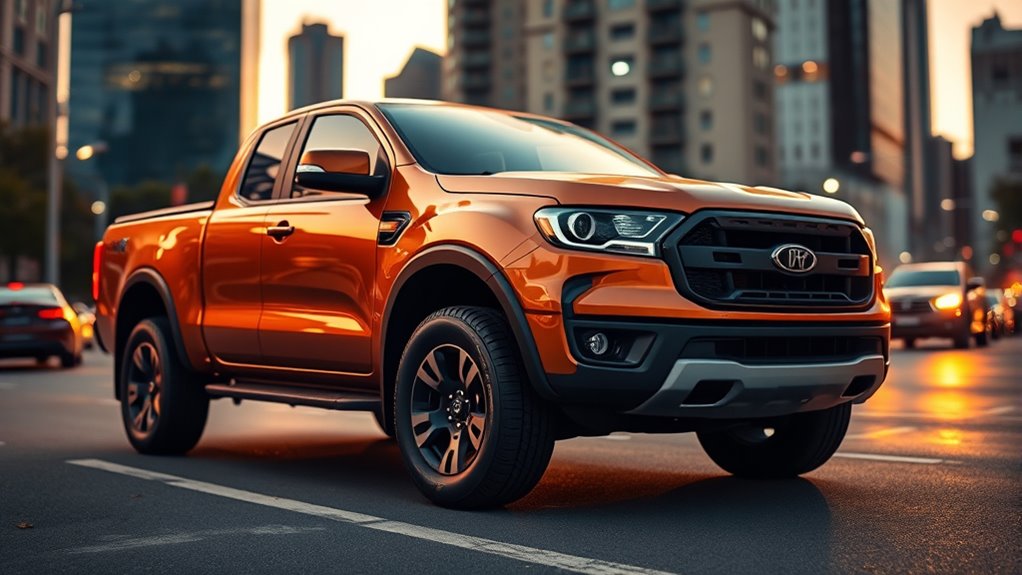
Increasing the share of light trucks on the road directly raises traffic fatalities. When more light trucks, like pickups, are driven, the risk of deadly crashes goes up. Studies show that a one percentage point increase in light truck market share leads to about 0.34 percent more deaths annually, roughly 143 extra lives lost each year. Between 1981 and 2004, the 21.8 percent rise in light truck share resulted in nearly 2,900 additional deaths. Car drivers are 1.59 times more likely to die in crashes involving pickup trucks than in crashes without them. Overall, accidents involving pickup trucks are 2.5 times more likely to cause fatal injuries. As the popularity of light trucks grows, so does the threat to all road users’ safety. Understanding vehicle safety is crucial for making informed driving choices. Additionally, factors such as vehicle design and crash compatibility play significant roles in the severity of accidents involving light trucks. Recognizing vehicle safety features can help mitigate some of these risks and promote safer roads for everyone. Moreover, advancements in smart safety technology, including collision avoidance systems, are essential tools in reducing fatalities involving light trucks. These technologies can significantly improve driver awareness and response times, further enhancing road safety.
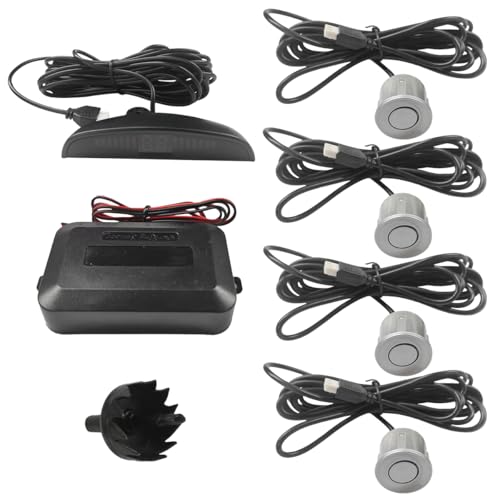
Car Parking Aid Sensor, 12V LED Display Auto Reverse Backup Sensor Kit, Vehicle Reversing Parking Radar System with 4 Sensors Alarm Buzzer Reminder & Distance Detection for Safe Driving (Silver)
【4 Sensors & Double CPU】:This car parking sensor system is equipped with 4 parking sensors and a double…
As an affiliate, we earn on qualifying purchases.
As an affiliate, we earn on qualifying purchases.
Pedestrian Risks and Visibility Challenges With Pickup Trucks
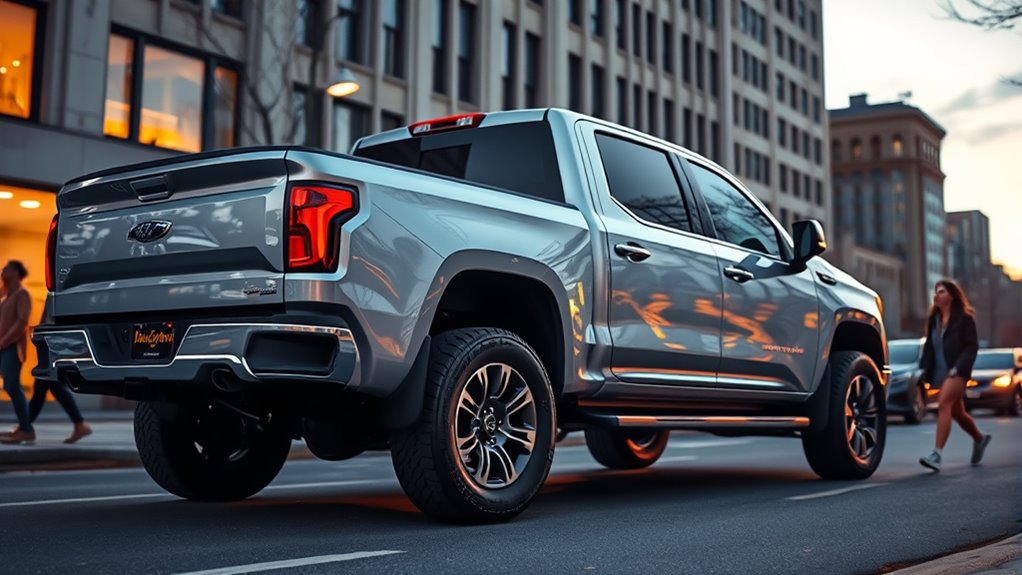
Pickup trucks pose significant pedestrian safety risks, partly because their design creates visibility challenges for drivers. The higher hood and elevated driving position make it harder to see pedestrians at crosswalks or on the sidewalk. This reduced visibility increases the chances of accidents, especially in crowded or low-light areas. You should be aware that:
- Hood heights have increased by at least 11% since 2000, worsening sightlines.
- Vehicles with hoods over 40 inches tall have a 45% higher risk of causing fatal pedestrian injuries.
- Pickup trucks’ larger size and height limit your ability to spot pedestrians or cyclists nearby.
- Visibility issues are compounded during poor weather or at night, making accidents more likely.
- Research on truck safety indicates that design modifications can improve driver visibility and pedestrian safety.
- Vehicle design improvements, such as lower hoods or advanced mirrors, can help mitigate these visibility challenges.
- Implementing advanced safety features like pedestrian detection systems can further reduce the risk of accidents involving pedestrians.
- Incorporating driver awareness technology can also assist drivers in noticing pedestrians in blind spots and adverse conditions, enhancing overall safety.
- Additionally, vehicle design considerations are crucial for optimizing driver visibility and reducing blind spots related to truck height.

ECOTRIC Hood Tilt Flip Kit Compatible with 1953-1956 Ford F-100 Truck Stainless Combo Conversion Kit
-Hood tilt flip kit Compatible with 1953-1956 Ford F-100. Please confirm whether your vehicle model is suitable before…
As an affiliate, we earn on qualifying purchases.
As an affiliate, we earn on qualifying purchases.
Safety Belt Usage and Occupant Protection Issues
Many of the safety risks associated with pickup trucks stem from occupant protection issues, particularly the low rate of seat belt usage. You’re more likely to be unrestrained in a pickup, especially in rural areas, which considerably increases your risk of fatal injury. Data shows that 68 percent of pickup truck occupant deaths in 2009 involved unbelted individuals, with rural occupants being the least restrained—over 69 percent. Wearing your seat belt reduces your chances of dying in a crash by over 45 percent. Unfortunately, many truck occupants neglect this simple safety step. Large truck occupants, in particular, have high unbelted rates—15 percent in 2022—highlighting a critical need for better seat belt adherence. Ensuring everyone in your vehicle buckles up is essential to occupant safety and reducing fatalities. Additionally, contrast ratio plays a significant role in visual clarity during driving at night or in adverse weather conditions, further emphasizing the importance of safety measures both inside and outside the vehicle. Proper filtration of the vehicle’s systems can also prevent malfunctions that might compromise safety during operation.

MirroGuard Extended Towing Mirrors, Universal Clip-On Side Mirror Extensions for Pickups, RVs, and Trailers, Tow Mirrors with Extenders (Model HA968)
Fits Most Standard Mirrors – Compatible with most standard side mirrors on pickups, SUVs, and RVs; NOT suitable…
As an affiliate, we earn on qualifying purchases.
As an affiliate, we earn on qualifying purchases.
Rollover Risks and Single-Vehicle Accident Trends
Rollover accidents pose a significant danger for vehicle occupants, especially in large trucks and pickups. These crashes are more likely to result in fatalities because the vehicle tips over, increasing the risk of severe injury or death. Pickups have a higher rollover rate due to their height, center of gravity, and handling characteristics. You should be aware that:
- Pickup trucks have a fatality rate of about 27% in rollover crashes.
- Single-vehicle crashes account for roughly 21% of all fatal large truck accidents.
- Most fatal large truck crashes involve only the truck, not other vehicles.
- In crashes, 90% of fatalities involve only one person, often not the truck driver.
- Advances in vehicle safety technology are helping to reduce the risk of rollovers and improve occupant protection.
- Proper vehicle maintenance, such as tire checks and brake inspections, also plays a crucial role in preventing rollovers and accidents. Additionally, driver awareness and training can significantly decrease the likelihood of losing control and experiencing a rollover.
- Recognizing vehicle handling characteristics and adjusting driving behavior accordingly can further mitigate rollover risks.
- Understanding the causes of rollovers can help drivers adopt safer driving practices and reduce accident likelihood.
Collision Dynamics and Impact Disparities
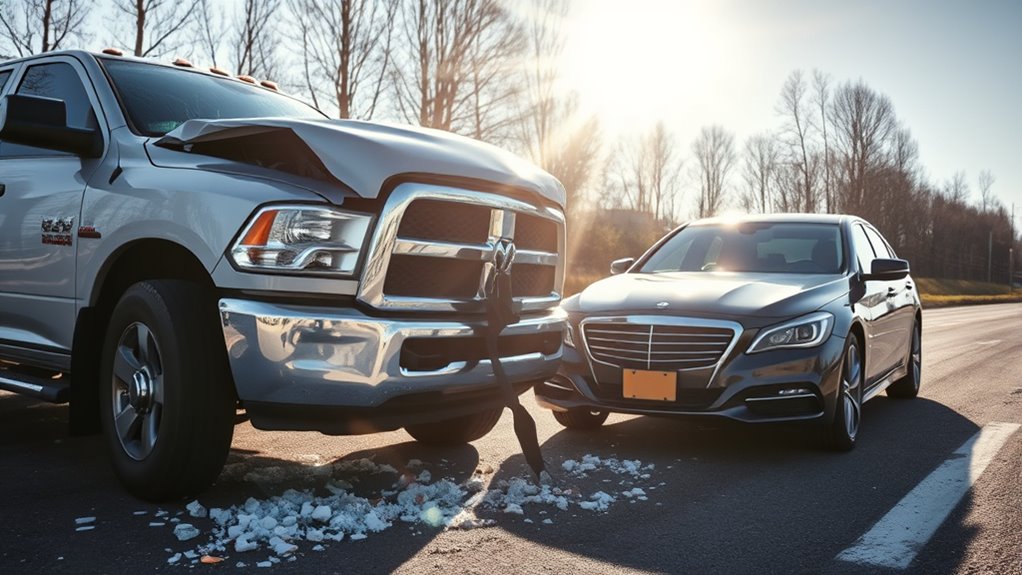
When large trucks are involved in collisions, the impact often favors the occupant of the truck over the occupant of the passenger vehicle. This disparity stems from differences in size, mass, and crash dynamics. Trucks, being much heavier, tend to cause more severe damage to smaller vehicles, increasing the risk of fatal injuries for their occupants. In many accidents, the truck strikes the passenger vehicle, often leading to disproportionate injuries, while the truck’s occupants fare better. Conversely, when the passenger vehicle hits a truck, it’s usually at a disadvantage due to the truck’s larger structure and higher hood, which reduces visibility and increases impact severity. These collision dynamics highlight the inherent safety disparities between trucks and smaller vehicles, influencing crash outcomes profoundly. Additionally, the impact forces involved in truck collisions can lead to more catastrophic damage, further explaining why the outcomes often favor truck occupants. Understanding these crash mechanics is essential for improving vehicle safety designs and reducing injury severity in accidents involving trucks. Moreover, advancements in vehicle safety technology aim to mitigate these disparities and protect all road users more effectively. Recognizing the role of vehicle size and structure in crash outcomes can help shape better safety regulations and vehicle engineering standards. A comprehensive understanding of collision physics can also contribute to more effective safety measures and emergency response strategies.
Regulatory Efforts and Technological Advancements in Truck Safety
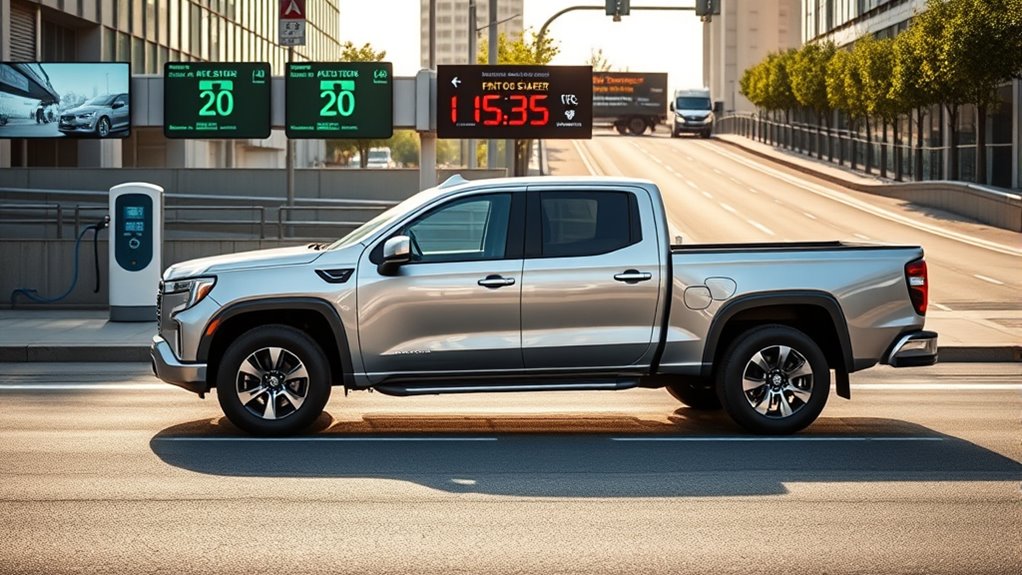
Regulatory efforts and technological advancements are shaping the future of truck safety by introducing new standards and innovations aimed at reducing crashes and injuries. These initiatives focus on improving vehicle features and tightening safety requirements to protect occupants and pedestrians alike. You’ll see automakers adopting cutting-edge tech like automatic emergency braking (AEB), which is set to be mandatory on all new models by 2029. Governments are also updating safety regulations, pushing for better crash testing and pedestrian protection standards. These changes aim to lower fatality rates and make roads safer for everyone. Understanding the importance of evidence and the role it plays in enhancing vehicle safety standards is also gaining recognition as part of comprehensive safety initiatives. Additionally, vehicle safety testing protocols are being refined to better simulate real-world crash scenarios, further improving safety outcomes.
Future truck safety relies on new standards and tech like automatic emergency braking to reduce crashes and save lives.
- AEB systems that automatically brake to prevent collisions
- Enhanced crashworthiness standards for trucks and SUVs
- Pedestrian detection and visibility features
- Stricter safety regulations for vehicle design
Comparing Safety Outcomes Across Light Truck Categories
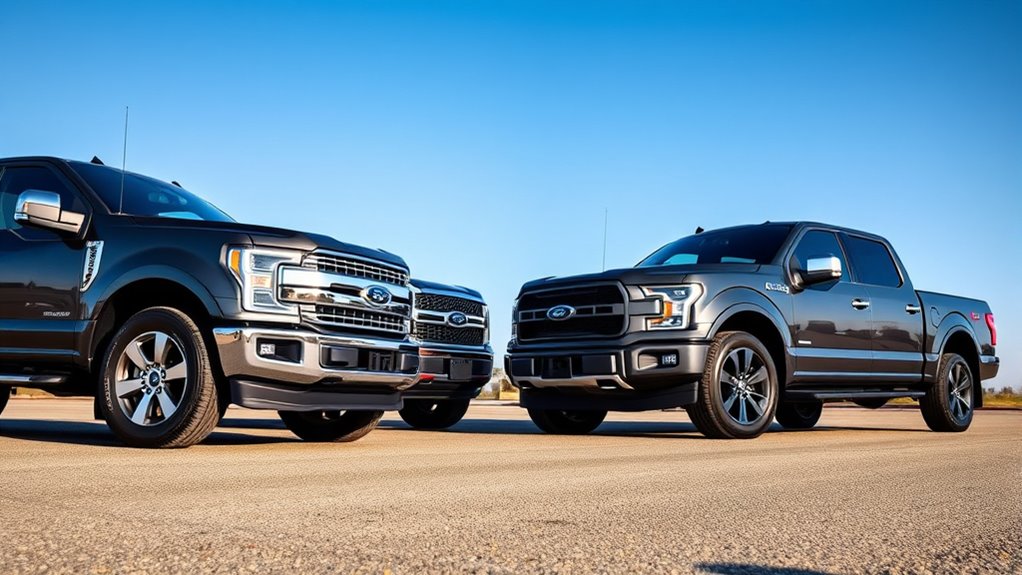
Different categories of light trucks—such as pickups, vans, and SUVs—show significant variation in safety outcomes, influenced by their design, usage, and safety features. Vans tend to have lower fatality rates, partly because they’re often used for commercial purposes and have different safety priorities. SUVs generally perform better in crash tests than pickups but still pose pedestrian risks due to increased hood height. Pickup trucks, however, have higher fatality rates for occupants and other road users, especially in rollover and single-vehicle crashes. They also tend to cause more severe injuries to pedestrians and occupants. Overall, safety outcomes are closely tied to vehicle type, with vans offering the best safety profile, followed by SUVs, and pickups often presenting higher risks.
Frequently Asked Questions
What Are the Long-Term Trends in Pickup Truck Safety Improvements?
You’ll notice long-term safety improvements in pickup trucks as regulations introduce features like automatic emergency braking, expected to save thousands of lives. Registration-based fatality rates have steadily declined since 2000, showing progress. However, risks remain, especially in rollover accidents and pedestrian injuries. While safety measures are advancing, it’s essential to stay cautious, use safety belts, and be aware of ongoing challenges that still impact pickup truck safety over the years.
How Do Driver Behaviors Influence Pickup Truck Crash Rates?
You drive recklessly or neglect safety measures, and your risk of crashing skyrockets, especially in a pickup truck. Quick lane changes, speeding, or ignoring seat belts turn your sturdy vehicle into a danger zone. While trucks are built tough, driver behaviors like distracted driving or failure to restrain amplify crash risks, often causing severe injuries or fatalities. Your choices behind the wheel directly impact safety outcomes in every journey.
Are There Specific Design Features That Enhance Pedestrian Safety in Trucks?
You can improve pedestrian safety in trucks by focusing on design features like lower hood heights and better visibility enhancements. Installing pedestrian-friendly bumpers, adding sensor systems, and using high-visibility markings also help. These features reduce the risk of fatal injuries, especially for vulnerable pedestrians like the elderly or low-income communities. By embracing such design improvements, you make trucks safer for everyone, especially pedestrians sharing the road.
What Policies Could Effectively Reduce Large Truck-Related Fatalities?
Implement stricter regulations requiring advanced safety tech like automatic emergency braking on all large trucks, which can save hundreds of lives annually. Enforce rigorous driver training and mandatory rest periods to curb fatigue-related crashes. Improve infrastructure, such as better signage and dedicated truck lanes, to reduce collisions. These policies act as a safety net, catching potential disasters before they happen, ultimately reducing large truck-related fatalities and protecting all road users.
How Does Vehicle Maintenance Impact Crash Risk and Safety Outcomes?
You should prioritize vehicle maintenance because it directly impacts your safety and crash risk. Regularly check brakes, tires, lights, and steering to prevent mechanical failures that could cause accidents. Proper maintenance ensures ideal vehicle handling, reduces brake failure, and minimizes rollover risks, especially for larger trucks and pickups. Staying on top of maintenance helps you avoid breakdowns or loss of control, ultimately protecting you and others on the road.
Conclusion
Ultimately, understanding the undeniable dangers and dazzling advancements helps you decide. While trucks can tackle tough tasks, their tumultuous tendencies pose perils on pavement. By staying savvy about safety standards, technological tweaks, and traffic trends, you can steer clear of serious setbacks. Remember, awareness and action arm you against accidents, transforming treacherous terrain into a safer, smoother journey. Stay vigilant, choose wisely, and keep your commute confident and collision-free.