
TL;DR

Get business pricing on garage and car supplies
- Business-only prices and quantity discounts
- Tax-exempt purchasing
- Multiple users, one account, clear invoices
Elonroad and three Singapore partners have signed an MOU to evaluate automatic conductive stationary charging for electric heavy vehicles. The work will examine integration into logistics operations, but no test results, schedule or commercial deployment plans have been announced.
Elonroad, NTU Singapore’s Energy Research Institute (ERI@N), ALBA W&H Smart City and Scania have signed a memorandum of understanding to evaluate automatic conductive charging for electric heavy vehicles in Singapore. The collaboration will assess how the stationary, hands-free charging technology could fit into logistics operations; the announcement does not report completed tests or a deployment decision.
The project is framed as an evaluation of Elonroad’s automatic charging system, rather than a confirmed commercial rollout. The partners say the work will examine integration with logistics operations in Singapore, where heavy vehicles could use stationary charging as part of their operating routines. The source report does not specify the location, duration or scale of the planned testing.
The partners describe separate roles. ERI@N will contribute research and compatibility testing, while ALBA W&H Smart City will provide an operational environment in which to evaluate the system. Scania will support installation on its vehicles. The announcement does not identify the vehicle models or explain the hardware installation process.
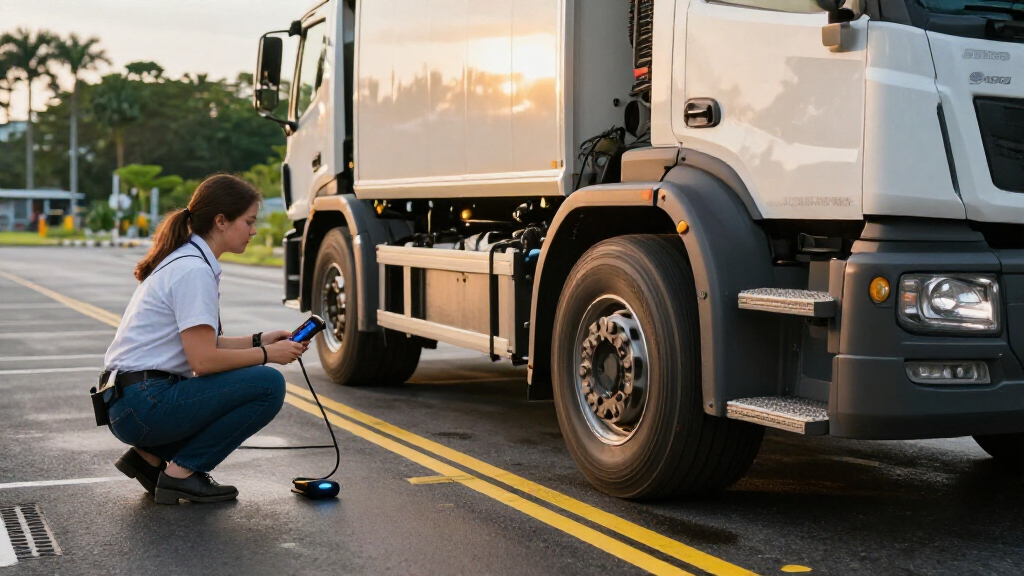
The charging method is described as automatic, conductive and stationary. In practical terms, the evaluation concerns charging through a physical electrical connection while a vehicle is stopped, without a person manually connecting the charging equipment. The source does not provide technical specifications, charging rates, cost estimates or measured performance data.
Testing Charging in Logistics Operations
For electric heavy vehicles, charging arrangements affect how vehicles are scheduled and used, not just how quickly their batteries refill. A system that can connect automatically while vehicles are stopped could, if testing supports the case, reduce the need for drivers or depot staff to handle charging connectors. That could make charging easier to incorporate into repeated logistics routines.
Those benefits remain potential outcomes, not findings from this announcement. The MOU establishes a plan to evaluate the technology; it does not show that automatic charging is faster, cheaper, more reliable or better suited to logistics than existing methods. Results from operational and compatibility testing would be needed to judge whether the approach can work with the vehicles and sites involved.
The collaboration also brings research, a potential operating environment and a vehicle manufacturer into one evaluation. That may help the partners assess practical issues that a laboratory test alone would not resolve, including how the system interacts with vehicles and daily operations. The source does not say how success will be measured or whether other fleet operators will take part.
Products Worth Considering

Autel MaxiCharger AC Home Level 2 EV Charger, 50A, Hardwired J1772, Wi-Fi, 25-Foot Cable

NOCO Boost X GBX155 4250A UltraSafe Jump Starter

Autel MaxiCheck MX808S Bidirectional OBD2 Diagnostic Scanner
As an affiliate, we earn on qualifying purchases.
Who Is Taking Part in Singapore
The announced partnership combines four organisations with different stated roles: Elonroad supplies the automated charging technology; NTU Singapore’s ERI@N contributes research and compatibility testing; ALBA W&H Smart City provides an operational setting; and Scania supports installation on its vehicles. The project’s stated focus is evaluating how the equipment could be integrated into logistics operations in Singapore.
Elonroad CEO Karin Ebbinghaus described the collaboration as bringing “research, technology and everyday operations together.” ERI@N Executive Director Professor Madhavi Srinivasan said the institute aims to test and validate charging solutions in support of Singapore’s transport electrification goals. These comments describe the partners’ aims; they are not evidence that the system has already been validated or adopted.
““Together with NTU, ALBA and Scania, we are bringing research, technology and everyday operations together in Singapore, with the ambition to make sustainable transport a more competitive choice.””
— Karin Ebbinghaus, CEO of Elonroad
Schedule, Results and Rollout Unclear
The announcement does not give a testing start date, timeline or end date, nor does it name the site or describe how many vehicles will be involved. It also offers no information about the charging system’s power, compatibility range, operating requirements or performance under real-world conditions.
There are no reported test outcomes, cost comparisons or commitments to buy or deploy the equipment. The partners have not stated what criteria will determine whether the system is suitable for logistics use, or whether the evaluation will lead to a broader trial. Until those details and results are published, the announcement confirms an agreement to evaluate the technology—not its readiness for routine use.
Compatibility Testing Comes Next
The next stated step is for the partners to carry out research, compatibility testing and operational evaluation, with Scania supporting installation on its vehicles and ALBA W&H Smart City providing the operating environment. The source report does not provide a public timetable or identify a specific next milestone.
Further updates would be needed to establish when testing begins, what vehicles and site conditions are included, and what results the partners obtain. Any decision on wider deployment, additional fleet participation or commercial availability remains unannounced.
Key Questions
What are the partners testing?
They plan to evaluate Elonroad’s automatic conductive stationary charging for electric heavy vehicles and how it could be integrated into Singapore logistics operations.
Who is involved in the evaluation?
The partners are Elonroad, NTU Singapore’s ERI@N, ALBA W&H Smart City and Scania. ERI@N will contribute research and compatibility testing, ALBA will provide an operating environment, and Scania will support vehicle installation.
Has the charging system been proven in this project?
The announcement reports an agreement to evaluate the system, not completed tests or results. No project performance findings have been published in the source material.
When will the testing begin?
No start date or testing schedule was given in the announcement.
Does the agreement mean the system will be deployed commercially?
No. The partners have agreed to assess the technology. The announcement does not confirm a commercial rollout, purchase commitment or wider deployment.
Source: chargedevs.com