TL;DR
Truck bed organizers help separate cargo, protect smaller items, and make gear easier to reach. Choose among dividers, boxes, sliding trays, or modular rail systems by matching your truck’s bed and accessories to your cargo, checking load ratings, and planning how you’ll secure each load. An organizer limits clutter and shifting, but rated tie-downs still matter.
A loose socket set can rattle all the way from the driveway to the job site, while a bag of groceries can tip over before you reach the first stoplight. Truck bed organizers help keep cargo separated and easier to reach, but the best setup depends on what you haul and how often your bed needs to change jobs.

Get business pricing on garage and car supplies
- Business-only prices and quantity discounts
- Tax-exempt purchasing
- Multiple users, one account, clear invoices
You can choose from simple dividers, storage boxes, sliding trays, and modular rail systems. Some hold small tools in place; others bring heavy gear toward the tailgate. Each adds a different balance of access, capacity, cost, and installation effort.
This guide explains how the main types work, what to measure before you buy, and why an organizer does not replace properly rated tie-downs. Think of your truck bed like a kitchen drawer: a divider can stop things from mixing, but it cannot keep a heavy pot from sliding if you slam the drawer shut.
Choose the organizer around your most common cargo, while accounting for occasional bulky loads.
Check make, model year, bed length, wheel-well clearance, liner, cover, rails, and tie-down access before ordering.
Compare the organizer’s rated capacity with the cargo you carry and keep using suitable rated tie-downs.
Treat weather-resistant seals as added protection, not proof that a box is waterproof or theft-proof.
Confirm installation needs, removal options, warranty details, and current product specifications with the manufacturer.
Choose the organizer type that fits your everyday cargo
Truck bed organizers are products that divide, contain, or reposition cargo so you can manage the bed more easily. The category includes several kinds, from simple dividers and storage boxes to sliding trays and full-length cargo-management systems. A contractor carrying hand tools has a different problem from a family carrying camping gear, so start with your most common load. The type you choose determines where the bed remains open, how quickly you can reach gear, and whether you can adapt when the load changes.
An adjustable cargo bar can section off a small area for groceries or keep a cooler from wandering across the bed. It is light and easy to reposition, but it only creates a boundary; small items can still spill around or beneath it. A lockable box holds sockets and straps together, while an over-wheel-well box leaves the middle of the bed open for lumber or a dirt bike. Boxes make small gear easier to contain and protect, but their fixed footprint can interfere with wide cargo or access to factory anchors.
A sliding tray brings gear nearer the tailgate, which can save you from climbing into the bed to reach a toolbox near the cab. That convenience is most valuable when you load heavy items often, since repeated reaching and lifting can be awkward. The platform, rails, and mechanism add weight and occupy bed space, though, and the tray’s own capacity may be lower than the truck’s payload. Check both ratings and account for the tray’s weight when considering how much cargo the truck can carry.
Modular rail systems use movable anchors, bins, or dividers that you can rearrange as the job changes. They work like a set of shelves on wheels: a setup that holds paint cans on Monday can hold camping bins on Friday. Their flexibility is useful when loads vary, but only if the rails and accessories are compatible and you are willing to spend time reconfiguring them. Bed-specific systems are shaped for particular trucks and may use factory rails, while a universal divider is easier to move between setups but can leave awkward gaps or fewer secure mounting options.
Ask yourself what you carry on an ordinary week, then name the awkward item: a long ladder, a tall cooler, or a heavy tool chest. If that item needs the full bed, a permanently mounted drawer may frustrate you even if it neatly stores everything else. The right setup should help keep cargo in order without taking over the bed’s main job.
- Tools: Look for a box or drawer that suits the tools’ size and weight. A secure, organized home can make daily access faster, but check that the storage does not consume the space needed for the materials you carry.
- Groceries and small loads: Consider a removable divider or cargo bar. It is simple to clear when you need the full bed, although you may still need bags or bins to contain loose items.
- Camping gear: Modular bins can keep sleeping bags, cooking gear, and wet equipment apart. Their benefit grows when you reuse the same arrangement, while frequent changes can make a simpler removable divider more practical.
- Frequent bed access: A sliding tray can bring heavy items closer, at the cost of bed space and added weight. Compare that daily access benefit with the floor area and payload you give up.
Products Worth Considering

DEWALT 20V MAX XR Hammer Drill and Impact Driver Combo Kit with Two 4Ah Batteries and Charger (DCK250QQ2)

Autel MaxiCharger 80A Level 2 EV Charger, Hardwired, J1772

NOCO Boost X GBX155 4250A 12V Lithium Jump Starter
As an affiliate, we earn on qualifying purchases.
Measure your truck before you buy
Measure your truck’s bed and check its existing accessories before choosing an organizer. Make and model alone are not enough: model year, bed length, rail design, and tie-down placement can change fit. A system that works in a short-bed pickup may block access to an anchor point in a longer bed, even when both trucks share a nameplate. A fit problem can do more than make installation difficult: it can prevent a cover from closing, leave gear trapped behind a box, or remove a useful tie-down location.
Measure the bed floor and the usable width between the wheel wells, then check the area beneath the tonneau cover if you have one. A box may fit the floor but sit too high for the cover to close. Bed liners can also change how clamps sit, while a spray-in liner may have different mounting needs from a thick drop-in liner. These details affect both clearance and how firmly hardware can attach, so use the manufacturer’s specified measurement points instead of relying on a rough estimate.
Suppose you often haul a four-foot-wide sheet of plywood. An over-wheel-well box may keep tools handy while preserving the center floor, but a tray that spans the bed could leave too little room for that sheet. If your truck already has factory rails, check whether the product uses them and whether its anchors leave space for your regular tie-downs. Preserving anchor access matters because a well-fitting organizer is less useful if it forces you to secure a load to a less suitable point.
Decide how much installation you’ll accept. Some organizers clamp onto rails or lift out; others require drilling or permanent mounting. A removable setup can make room for a last-minute load, while a bolted system may feel more secure and ready to use each morning. Read both the product instructions and your vehicle documentation before drilling, since installation can affect bed components or warranty coverage.
- Record the truck’s make, model, year, and bed length. These identify the exact fit variant; two trucks with similar names can have different rail and bed layouts.
- Measure the floor, wheel-well clearance, and cover height. Check at the points where the organizer will sit and where the cover needs clearance.
- Note existing rails, tie-downs, liner type, and any accessories. These can change mounting fit or block access to anchors you rely on.
- Check the manufacturer’s fit list and installation instructions. Confirm that the listed configuration matches your measurements and bed equipment.
- Confirm you can remove or reconfigure the organizer for bulky loads. This helps you decide whether the extra convenience of a fixed system is worth losing flexibility.
Compare access, capacity, and bed space
Every organizer trades some bed space, money, or carrying capacity for easier access and tidier cargo. A basic divider costs less and leaves most of the bed open, while a sliding tray can make cargo near the cab easier to reach but occupies floor area and adds weight. Compare the load rating with what you plan to carry, not just the organizer’s outside dimensions. A setup that makes a heavy tool easy to reach may still reduce how much else you can haul, so consider the whole loaded truck rather than the organizer alone.
Imagine a landscaping crew loading bags of soil and a small collection of hand tools. A cargo bar can hold the bags in a zone and keep the tools separate, while a full drawer system could eat into the room needed for soil. A weekend camper with lighter bins may value the drawer’s quick access more than the lost floor area. The same product can therefore be a poor fit for one routine and a useful one for another: frequency of access and the shape of your loads matter as much as storage volume.
Load ratings also differ by product and by how it is installed. Check the manufacturer’s stated capacity, mounting requirements, and any limits for moving or securing loads. The organizer’s rating describes what the product can carry under specified conditions; it does not raise the truck’s payload limit, which includes passengers, accessories, and cargo. An organizer can reduce sliding, but it does not replace properly rated tie-downs, especially for heavy cargo or anything hazardous. Use restraints suited to the load and follow both vehicle and product instructions.
| Type | Good for | Main tradeoff |
|---|---|---|
| Divider or cargo bar | Separating small or changing loads | Limited containment for loose, small items |
| Storage box | Tools, straps, and smaller gear | Uses a fixed area and may limit bulky cargo |
| Sliding tray | Reaching gear near the cab | Adds weight and takes up bed space |
| Modular rail system | Loads that change from trip to trip | May cost more and need compatible rails |
For example, a long tool chest can sit low and stay put, but it may block the path for plywood. If your work changes by the day, removable dividers and movable anchors can be more useful than a built-in layout. Choose for your regular cargo, while keeping a realistic plan for the odd oversized load.
Keep rain, dust, and theft in perspective
Weather-resistant construction can help protect cargo, but it does not always make a box waterproof or theft-proof. Check whether the product has seals, corrosion-resistant hardware, and a stated use rating that matches the conditions you face. Rain can creep through a lid seam, and fine dust can find its way into a box that looks solid from the outside.
Picture a plumber leaving a toolbox in the bed during a rainy week. A box with a fitted lid and weather-resistant seal offers more protection than an open crate, but the plumber should still check the product claims and inspect the seals. After a dusty job, cleaning grit from the hinge can keep the lid from grinding each time it opens.
A lockable box can deter casual access, especially when it is mounted securely and paired with a covered bed. But a lock does not make expensive tools impossible to steal. The mounting, lock quality, tailgate, and cover all shape the level of protection; avoid leaving valuable gear visible when you can store it elsewhere.
Maintenance can stay simple. Brush out dirt, rinse mud before it hardens, and check clamps, bolts, seals, and moving parts now and then. If a sliding tray starts to bind or a latch no longer closes cleanly, clear debris and consult the manufacturer’s care guidance before forcing it. A little attention helps a setup remain quiet and usable, rather than becoming another source of rattles on the road.
Weather-resistant is not the same as waterproof, and a lock is a deterrent rather than a guarantee. Match protection claims to the cargo you actually need to protect.
Use an organizer with the right restraints
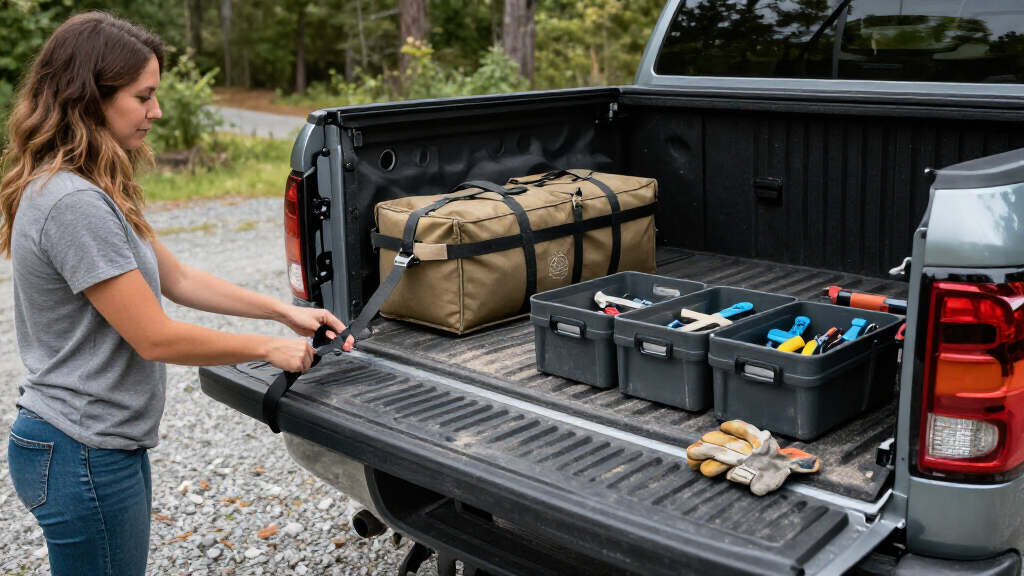
An organizer helps control where cargo sits, while rated tie-downs hold the load in place. A divider can stop a cooler from rolling into a toolbox, but it is not automatically built to restrain a heavy item during a sudden stop. Use suitable restraints for the load and follow your vehicle and organizer manufacturers’ guidance.
For instance, a bag of soil may stay within a sectioned-off area on a smooth drive, yet shift hard if you brake quickly. Secure heavy or hazardous cargo with appropriate tie-downs attached to rated points. Keep straps clear of sharp edges, and check that the organizer has not blocked the anchors you intended to use.
Think of the organizer as a fence around a garden bed: it marks the boundary, but it does not anchor a tree. This distinction matters most when a box contains heavy tools or when you carry equipment that could cause injury or damage if it moves. Don’t treat the organizer’s own load rating as a tie-down rating unless the manufacturer explicitly says it serves that purpose.
Before each trip, look at the whole load, not just the organizer. Check that lids latch, loose items cannot bounce out, straps are snug, and nothing interferes with the tailgate or cover. A two-minute check in the driveway can save you from a clatter at the first turn and keep cargo where you placed it.
- Secure heavy items with properly rated restraints.
- Use the truck’s rated tie-down points where appropriate.
- Check access to anchors before installing a permanent system.
- Recheck latches and straps whenever the load changes.
Make the buying choice with a five-point check
A good buying decision starts with your cargo and fit measurements, then checks ratings, installation, and bed flexibility. Product photos can make every organizer look roomy and universal, but the useful details sit in the measurements, compatibility list, and load instructions. Verify current prices, warranties, fit lists, and ratings with the manufacturer because product availability and specifications can change.
Say you drive a mid-size pickup with a bed liner and a folding cover, and you carry power tools during the week and camping bins on weekends. A vehicle-specific box may fit neatly under the cover, but first check whether the lid opens fully and whether the box leaves space for your weekend gear. If you occasionally carry a large appliance, a removable box or divider may save frustration.
Price the complete setup, including rails, mounting hardware, locks, and any installation work. A simple cargo bar is usually less expensive and quicker to fit than a sliding platform or drawer system. More elaborate gear can pay off if you use it daily, but added weight, cost, and installation complexity matter when your bed needs to haul bulky cargo.
- Measure the bed and identify the cargo you carry most often.
- Check compatibility with the truck year, bed length, liner, cover, rails, and tie-downs.
- Compare load ratings with the weight you intend to carry.
- Choose your installation style: permanent, clamp-on, or removable.
- Confirm room for other loads and check the current warranty and product details.
For a used organizer, inspect the frame for bends, corrosion, cracked plastic, worn seals, missing hardware, and damaged locks. Ask for the model number so you can check its fit and instructions. A bargain that lacks mounting parts or has a warped lid can turn into an expensive project.
Frequently Asked Questions
Do truck bed organizers keep cargo from moving?
They can limit sliding by dividing the bed or containing items, but they do not replace properly rated tie-downs. Secure heavy or hazardous loads with suitable restraints and follow the vehicle and product instructions. A divider helps control where cargo sits; a strap helps hold it in place.
Will an organizer fit under my tonneau cover?
Check the organizer’s height and the cover’s clearance, along with the truck’s make, model year, and bed length. Bed liners, rails, and wheel-well dimensions can also affect fit. Confirm compatibility with the manufacturer’s fit list before ordering.
Are truck bed storage boxes waterproof?
Some boxes use weather-resistant seals, but weather-resistant does not always mean waterproof. Check the manufacturer’s product claims and inspect seals and latches for damage. For sensitive gear, use extra protection suited to the cargo.
Can I remove a truck bed organizer quickly?
Some dividers and rail-mounted products clamp on or lift out, while others need permanent mounting or drilling. Read the installation instructions before buying and decide how often you need a clear bed. A removable organizer can be especially useful if you haul furniture or building materials now and then.
Will a lockable truck bed box prevent theft?
A lock can deter casual access, but it does not make tools theft-proof. Mounting strength, lock quality, and the truck’s cover and tailgate all matter. Store valuable equipment out of sight when practical.
Conclusion
Choose the organizer that solves your most frequent cargo problem and still lets your truck handle the occasional oversized load. Measure first, check the ratings, and plan how you’ll secure each item.
A tidy bed should make the next trip quieter and the next tool easier to find. Keep the straps ready, the tailgate clear, and the gear where you left it.