
TL;DR
Tesla has detailed how its Cybercab uses an “unboxed” production process: major sections are assembled and tested separately, then joined near the end of the line. The company says molded, color-infused exterior panels remove the need for a conventional paint shop, and the final assembly line has about 25 stations. Production capacity and the pace of the vehicle’s rollout remain separate questions.
Tesla has shared new details about how it builds the Cybercab at its Texas factory, using a process that assembles and tests major vehicle sections separately before joining them. The approach, which Tesla calls “unboxed” production, is intended to give workers and robots better access to components and reduce work on the final line; Tesla says that line has about 25 stations.

Get business pricing on garage and car supplies
- Business-only prices and quantity discounts
- Tax-exempt purchasing
- Multiple users, one account, clear invoices
In a video tour published by engineering firm Munro & Associates, Tesla engineering chief Lars Moravy and Cybercab lead Eric Earley described how the process differs from conventional vehicle assembly. Rather than completing a body, painting it and then fitting most of its systems and interior as it moves down one long line, Tesla builds the Cybercab’s front, rear, side and floor sections on separate lines. Those equipped sections meet at an automated framing line, where robots position and join them.
Tesla says the sections arrive with much of their wiring, hoses and interior equipment already installed. The front module includes the drive unit, suspension and thermal hardware on a positioning pallet; its structure, already fitted with the dashboard, is lowered over those components. The battery pack’s upper cover serves as the cabin floor, allowing seats and carpet to be installed before the pack is brought together with other sections. Tesla says the front module contains roughly half the vehicle’s parts and content.
Testing is also staged. Tesla says it checks individual components before they are assembled into larger modules, then tests those assemblies again. Moravy said the front module reaches the framing process with its computers connected and systems checked. The company says the line is about 78% automated. Wheels are fitted at the second-to-last station, and the Cybercab rolls off the line on its wheels near the end. Tesla says a Model Y line has about five to 10 times as many final-assembly stations.
A Shorter Route Through Final Assembly
The process shifts work away from the crowded interior of a nearly completed vehicle. Assembling smaller sections separately can give people and robots more room to fit parts, connect systems and inspect work before the sections are joined. Tesla’s stated design goal is to make automation easier and bring stations closer together; the factory tour describes the layout, but does not independently establish how much it improves production cost, speed or quality.
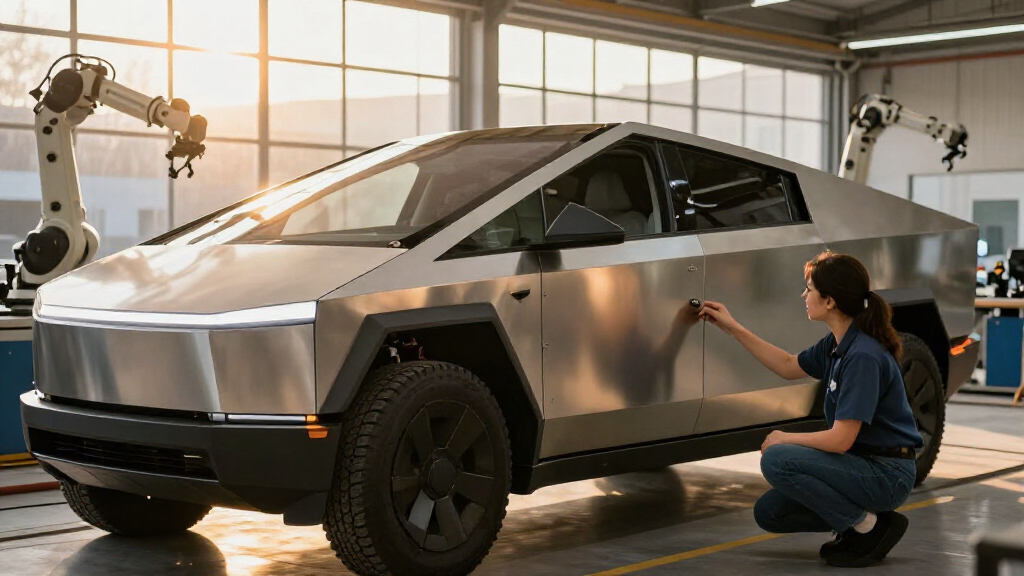
The Cybercab also avoids a conventional paint shop. Tesla says its plastic exterior panels are molded with color rather than painted afterward, removing a paint stage that would otherwise affect the factory sequence and space. The company says scratches can still be repaired in a manner similar to conventional paint. The front and rear structural modules also skip electrocoating, while the steel side structures remain coated.
These choices matter because factory design affects how quickly a vehicle can be built and how easily production could expand. Tesla says the Cybercab line could make 125,000 vehicles per year at full capacity. That is a stated capacity figure, not evidence of current output or deliveries. Tesla has said the factory does not run every day because it can make Cybercabs faster than it is deploying them, making rollout pace a key limit on near-term production.
Products Worth Considering

Chemical Guys Arsenal Builder Car Wash Kit with Foam Cannon and Carry Bag

Chemical Guys 10-Piece Car Wash Kit with Foam Gun

DEWALT 20V MAX XR 3-Speed Cordless Impact Driver Kit with Battery and Charger (DCF845P1)
As an affiliate, we earn on qualifying purchases.
Tesla’s Unboxed Plan Reaches Production
Tesla has discussed an “unboxed” approach for several years. In the video, Moravy said the idea began about six years ago, when the company was trying to automate existing vehicle designs and concluded that the design itself was making automation difficult. Dividing a vehicle into smaller sections was intended to improve access for robots and workers, rather than asking them to install equipment deep inside a largely assembled car.
The Cybercab’s process is not the only modular manufacturing effort in the industry. The source report notes that Ford is developing a similar approach for its Universal Electric Vehicle platform, calling its method an “assembly tree.” That comparison provides industry context, but does not establish that the two companies’ processes are identical. Tesla’s current disclosure focuses on the Cybercab line and the way its modules, molded panels and final assembly fit together.
“The idea began about six years ago, when Tesla was stuck trying to automate existing designs and concluded the problem was the car.”
— Lars Moravy, Tesla engineering chief, speaking in the Munro & Associates factory-tour video
Output and Repair Details Remain Open
The tour explains Tesla’s intended production layout, but it does not provide verified figures for current Cybercab output, factory uptime or the time needed to build each vehicle. Tesla’s stated annual capacity is a full-rate estimate, and the company’s account that production is running ahead of deployment does not quantify either production or the pace of rollout.
Some practical details also remain unspecified. The source does not report independent performance data comparing the process with conventional assembly, or provide cost and quality results. Tesla says molded panels can be repaired similarly to painted surfaces, but the tour does not set out repair procedures, prices or how repairs differ by type of damage. It is also unclear when the factory will run continuously or what production level Tesla expects as Cybercab deployment expands.
Deployment Will Set the Production Pace
The next measurable developments are likely to be Tesla’s Cybercab rollout and production updates: how many vehicles it deploys, how often the line operates and whether output approaches the stated 125,000-per-year capacity. Tesla has not supplied a date in the source material for reaching that rate. Until it reports operating figures, the factory tour offers a detailed account of the process, but not proof of its production results at scale.
Key Questions
What does Tesla mean by “unboxed” production?
It means Tesla builds major Cybercab sections—such as the front, rear, sides and floor—on separate lines, then joins them at an automated framing line. Much of the wiring and interior work is installed before the sections meet.
How many stations are on the Cybercab’s final assembly line?
Tesla says the final line has about 25 stations. Moravy said the Model Y line has roughly five to 10 times that number.
Does the Cybercab go through a conventional paint shop?
No conventional paint shop is described for the Cybercab. Tesla says its plastic exterior panels are molded with color, while the steel side structures are coated. The company says scratches remain repairable, but the source provides no detailed repair guidance or cost figures.
Is Tesla already making 125,000 Cybercabs a year?
No. 125,000 vehicles per year is Tesla’s stated full-capacity figure for the line, not its reported current output. The company has not provided a current production total in the source material.
Source: insideevs.com