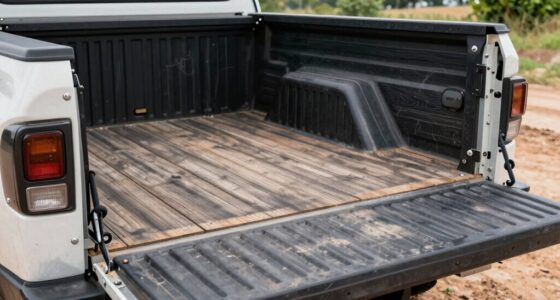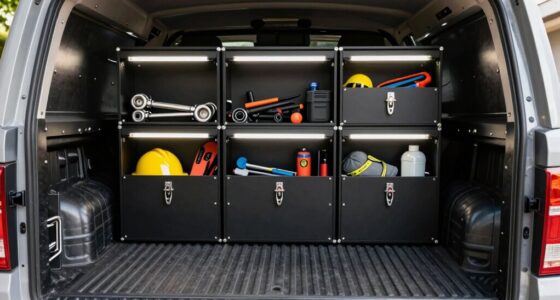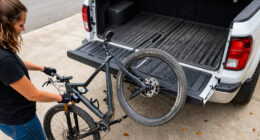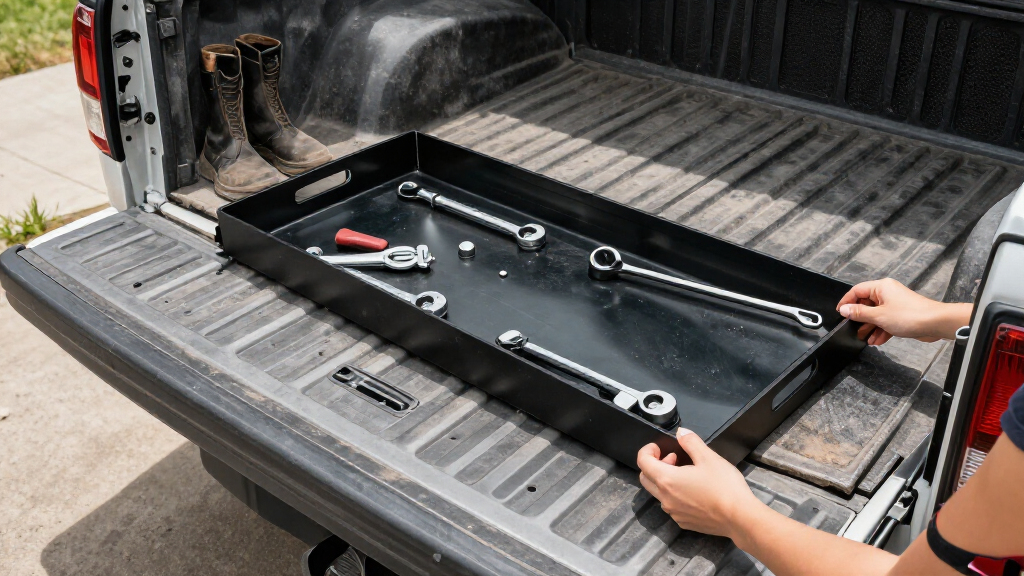

Choosing a truck bed organizer comes down to how much you value customization versus a ready-made fit. A DIY setup—using bins, dividers, cleats, or a homemade drawer—can suit a specific truck and cargo mix for less money, but the owner takes responsibility for measuring, fastening, and weather protection. A commercial organizer costs more upfront, yet typically arrives with a defined layout and mounting approach. The DIY route makes more sense for budget-conscious owners who enjoy adapting their setup; a commercial system is the stronger choice for frequent hauling, valuable tools, or anyone who wants a dependable installation without a building project.

Get business pricing on garage and car supplies
- Business-only prices and quantity discounts
- Tax-exempt purchasing
- Multiple users, one account, clear invoices

Tmat Truck Bed Organizer Storage System Slide Out Mat (Universal Fit for Short Beds 5’6" to 5’9")
- ✔ Brand: Tmat
- ✔ Model: TMAT-KIT-68X50
- ✔ Dimensions: 68 x 50 x 1 inches

Rough Country Slide-Out Truck Bed Cargo Tray – Heavy-Duty Polyethylene, UV-Protected, Fits 5’7"+ Beds
- ✔ Brand: Rough Country
- ✔ Model: 10209
- ✔ Dimensions: 62.29 x 23.6 x 4 inches

Keeper Adjustable Cargo Bar for Pickup Truck Bed, Ratcheting Cargo Bar, Black/Silver, 40"–70" Adjustable Length
- ✔ Brand: Keeper
- ✔ Model: 05059
- ✔ Adjustable length: 40 to 70 inches
At a Glance
| Criteria | DIY truck bed organizer | Commercial truck bed organizer | Winner |
|---|---|---|---|
| Upfront cost | Usually lowest; materials and hardware determine the total | Higher purchase price; premium drawer systems can cost substantially more | A |
| Fit and compatibility | Can be tailored to a specific bed, but accuracy depends on measurements | Designed for stated bed dimensions or truck fitment; verify cab, bed, and accessories | Depends |
| Installation effort | Ranges from simple bin placement to substantial building and fitting | Often straightforward, though heavy systems may need careful mounting or help | B |
| Cargo security | Depends on anchoring, lid or cover, and construction quality | Purpose-built tie-downs, locks, or enclosed storage may improve protection | B |
| Weather and durability | Materials vary; untreated wood or loose containers may wear or admit water | Product materials and seals are specified, but exposure and care still matter | B |
| Flexibility | Easy to rearrange or redesign, though permanent builds are less adaptable | Usually less adaptable to different cargo than an open DIY layout | A |
| Everyday convenience | Can be convenient when designed well; setup and maintenance are owner-managed | Ready-made access and repeatable organization can save time on regular use | B |
Tmat Truck Bed Organizer Storage System Slide Out Mat (Universal Fit for Short Beds 5’6" to 5’9")
The Tmat modular mat is our top pick for buyers who want to divide a truck bed into useful zones without adding permanent hardware. Its 68-by-50-inch plastic surface comes with six blockers, including two adjustable pieces, so boxes, tools, and recreational gear can be separated instead of collecting in one shifting pile. Since the blockers can be configured to suit the load, this approach is more adaptable than the fixed geometry of a slide-out tray.Compared with the Rough Country, Tmat covers a broad section of the bed floor and leaves gear arranged in place; it does not bring cargo toward the tailgate for retrieval. Its fit is also more specific: it is intended for short beds from 5 feet 6 inches to 5 feet 9 inches, whereas Rough Country targets beds at least 5 feet 7 inches long. The smooth surface is intended to let gear slide into position, a convenience when setting up a load but a reason to secure items with the blockers. Installation needs no tools or drilling, though optional bolt-down hardware is available for buyers who want a permanent setup. The plastic construction is lightweight, but the supplied information does not position it as a heavy-duty choice for extremely rugged use.
Pros:
- Six blockers allow multiple cargo layouts.
- No tools or drilling are required for the basic installation.
- Broad 68-by-50-inch surface organizes cargo across the bed floor.
- Lightweight plastic construction and optional bolt-down hardware support flexible setup.
Cons:
- Fit is limited to short beds from 5 feet 6 inches to 5 feet 9 inches.
- Plastic may not suit extremely rugged use as well as a heavy-duty alternative.
- Does not slide loaded cargo toward the tailgate like the Rough Country tray.
Best for: Truck owners with a compatible short bed who carry changing combinations of tools, boxes, or outdoor gear and want adjustable divisions without drilling.
Not ideal for: Owners of longer beds, people who want an enclosed pull-out storage tray, or those who need a solution specified for extremely rugged loads.
Bottom line: For compatible short beds, Tmat offers the strongest balance of customizable cargo divisions and straightforward installation.
“For compatible short beds, Tmat offers the strongest balance of customizable cargo divisions and straightforward installation.”
Rough Country Slide-Out Truck Bed Cargo Tray – Heavy-Duty Polyethylene, UV-Protected, Fits 5’7"+ Beds
When reaching cargo at the front of a long bed is the main frustration, the Rough Country slide-out tray addresses access more directly than either competitor. The package includes two high-density polyethylene trays that slide out for loading and unloading, plus tie-down straps and carabiners. Its stated capacity is 500 pounds when evenly distributed, which gives buyers a concrete load limit to consider when planning stored gear.That pull-out format is the key distinction from Tmat: Tmat provides flexible dividers across a mat, while Rough Country creates a more contained storage surface that can travel toward the tailgate. The tradeoff is fit. This system is for beds 5 feet 7 inches or longer and is described as designed primarily for trucks with a bed cover; buyers with uncovered beds should confirm suitability. Its 62.29-by-23.6-inch footprint is narrower than Tmat’s mat dimensions, and the product information does not describe adjustable compartments. Compared with Keeper’s lightweight bar, it offers a more substantial storage and access system, but it takes a more specific fit and use case to make sense. UV protection and a three-year limited warranty are listed, though neither removes the need to check vehicle and cover compatibility.
Pros:
- Two pull-out trays make cargo easier to reach from the tailgate.
- High-density polyethylene is UV-protected.
- Stated maximum capacity is 500 pounds evenly distributed.
- Includes two tie-down straps and two carabiners.
Cons:
- Requires a bed at least 5 feet 7 inches long.
- Designed primarily for use with a bed cover; uncovered-bed compatibility may vary.
- Provides less described layout flexibility than Tmat’s adjustable blockers.
Best for: Long-bed truck owners, especially those using a bed cover, who want stored cargo to slide out and value a stated evenly distributed load capacity.
Not ideal for: Short-bed owners, shoppers seeking adjustable bed-wide divisions, or anyone whose uncovered-bed setup may not match the tray’s intended fit.
Bottom line: For a compatible long bed, Rough Country is the best fit when pull-out access and defined tray storage matter more than adjustable bed-wide divisions.
“For a compatible long bed, Rough Country is the best fit when pull-out access and defined tray storage matter more than adjustable bed-wide divisions.”
Keeper Adjustable Cargo Bar for Pickup Truck Bed, Ratcheting Cargo Bar, Black/Silver, 40"–70" Adjustable Length
The Keeper ratcheting cargo bar takes the simplest approach in this group: it braces cargo against the sides of a truck bed instead of creating storage compartments. Its 40-to-70-inch adjustable span can suit a range of truck beds and other compatible spaces, while large rubber grip pads are intended to hold the bar in place. For a load that mainly needs a barrier to limit shifting, that quick, straightforward format may be all the organization required.Compared with Tmat and Rough Country, Keeper is much less of a storage system. It does not divide the bed into zones or provide a tray to pull toward the tailgate, and its supplied information lists a 75-kilogram load capacity rather than the 500-pound evenly distributed capacity stated for Rough Country’s trays. That makes it a useful complement to storage bins or other accessories, not a direct substitute for them. The baked-on silver finish is described as weatherproof, and the bar’s stated weight is 3.1 pounds. Buyers should measure their intended mounting span and make sure the grip pads can bear against suitable surfaces. Those looking to arrange small items or secure cargo in a defined enclosure will get more from the other two picks.
Pros:
- Adjusts from 40 to 70 inches for a range of mounting spans.
- Rubber grip pads are designed to hold against the bed sides.
- Ratcheting setup provides a straightforward cargo barrier.
- Baked-on silver finish is described as weatherproof.
Cons:
- Does not create compartments or provide enclosed storage.
- Requires suitable opposing surfaces for the grip pads.
- Listed capacity is 75 kilograms, below the stated Rough Country tray capacity.
Best for: Drivers who already use bins or other bed storage and want an adjustable, removable barrier to help keep a load from shifting.
Not ideal for: Buyers who need divided compartments, a pull-out tray, or a stated capacity matching the Rough Country system’s 500-pound evenly distributed rating.
Bottom line: Keeper is a practical, compact restraint for containing loose cargo, but buyers who want an organizer in the fuller sense should choose Tmat or Rough Country.
“Keeper is a practical, compact restraint for containing loose cargo, but buyers who want an organizer in the fuller sense should choose Tmat or Rough Country.”
As an Amazon Associate we earn from qualifying purchases.
Key Differences
The clearest divide is who does the design work. With DIY, you choose the layout, materials, and mounting points. That freedom can be valuable if you carry oddly shaped equipment, need removable compartments, or already own bins and hardware. It also means the result depends on careful measurement and construction. A poorly secured box or divider can shift under braking, and a design that works for one load may obstruct another.
Commercial organizers trade some flexibility for predictability. A compatible product can provide repeatable compartments, drawers, or tie-down points, and some systems add locks or weather-resistant construction. Those features matter more when tools stay in the truck or the bed is used daily. They do not make every product theft-proof or waterproof, so check mounting, seals, and fit for your exact truck.
For occasional hauling and low-cost cargo separation, DIY is often the better value. For frequent work use, quick access, or expensive gear, paying more for a commercial unit can be justified by time saved and more consistent protection. Choose based on the cargo and routine you actually have, not the most elaborate storage layout available.
Detailed Comparison
Upfront cost (DIY truck bed organizer wins — moderate)
DIY wins by a moderate margin for basic setups: a few bins, dividers, or cleats can cost far less than a fitted drawer system. A custom build can narrow that gap once quality plywood, hardware, finishes, and tools are included. Commercial organizers ask for more money upfront but bundle a designed system. If the goal is simply to stop groceries or sports gear sliding around, DIY usually delivers better value.
Fit and compatibility (moderate difference)
This is a close call, so the winner depends on the truck and the owner. A commercial organizer built for the stated bed dimensions offers a more predictable starting fit, but accessories, wheel wells, bed liners, and short or long bed variations can affect compatibility. DIY can fit unusual spaces precisely when measured and built well. For a common bed with a listed compatible product, commercial has the safer path; for a customized or irregular setup, DIY may fit better.
Installation effort (Commercial truck bed organizer wins — moderate)
Commercial systems win by a moderate margin because many are designed for a defined installation, while a DIY build can require measuring, cutting, fastening, and repeated adjustment. Some commercial drawers are heavy or need two people to position, and mounting still matters. A simple set of DIY bins takes almost no installation. For a permanent, fitted layout, the commercial route generally reduces the work and guesswork.
Cargo security (Commercial truck bed organizer wins — moderate)
Commercial systems have a moderate advantage when they include lockable drawers, enclosed compartments, or purpose-built tie-downs. Those features can keep tools less visible and reduce movement, although they do not guarantee theft prevention. DIY can be anchored securely and may use a separate locking box, but the owner must select and install those elements. If the truck regularly carries costly equipment, a well-mounted commercial unit is usually the more reliable starting point.
Weather resistance and durability (Commercial truck bed organizer wins — moderate)
Commercial systems win by a moderate margin when their construction and seals are specified for truck-bed use. DIY can also last, especially with suitable materials and finish, but exposed wood, ordinary household bins, and improvised joints can degrade or admit water. Product claims vary, and no organizer replaces a suitable bed cover in severe weather. Choose based on materials, drainage, exposure, and maintenance rather than assuming either category is fully weatherproof.
Flexibility (DIY truck bed organizer wins — major)
DIY wins by a major margin for changing cargo. Removable bins and adjustable dividers can be reconfigured, and an owner can make a layout around a particular tool or hobby. Commercial systems may offer modules, but fixed drawers and rails consume space and can constrain bulky loads. The tradeoff is that highly flexible DIY storage may be less tidy or secure. If the truck alternates between work gear and large cargo, a removable DIY layout is often preferable.
Everyday convenience (Commercial truck bed organizer wins — moderate)
Commercial systems have a moderate edge for frequent use: a fitted drawer or labeled compartment can make tools easy to find and return to the same place. DIY can be equally convenient when thoughtfully arranged, but the owner must build and maintain that system. For occasional trips, the difference is minor; for daily loading and unloading, repeatable access can save meaningful time.
DIY truck bed organizer: Pros and Cons
Pros:
- Lower cost for simple storage and cargo separation
- Can be tailored to unusual gear, bed accessories, or changing loads
- Removable layouts can preserve space for bulky cargo
- Easy to repair or modify with common materials
Cons:
- Fit, strength, and weather protection depend on design and workmanship
- Owner must measure, build, mount, and maintain the setup
- Security features may require separate hardware
- A permanent build can consume time and bed space
Commercial truck bed organizer: Pros and Cons
Pros:
- Purpose-built layouts can provide consistent access and organization
- Some products include locks, drawer slides, tie-downs, or weather-resistant construction
- Compatibility and installation details are usually documented
- Can reduce setup effort for owners who need a fitted solution
Cons:
- Higher purchase price, especially for enclosed drawer systems
- Fit depends on matching the exact truck bed and accessories
- Fixed layouts can limit space for oversized cargo
- Heavy units may take effort to install and remove
Who Should Choose What
Choose DIY truck bed organizer if:
- You want inexpensive separation for occasional hauling, groceries, camping, or sports gear.
- Your cargo is unusual or changes often, and you want a layout you can alter.
- You can measure and fasten the organizer securely, or already have useful materials.
- You need removable storage that leaves room for bulky loads.
Choose Commercial truck bed organizer if:
- You carry tools or equipment regularly and need quick, repeatable access.
- You want enclosed or lockable compartments and are willing to pay for that function.
- You prefer a defined installation and documented truck-bed compatibility.
- Your truck has a stable day-to-day cargo routine that suits a fixed layout.
Skip both if: You rarely need bed organization and a few existing tie-downs or a cargo net already keep loads controlled; avoid adding a permanent system that consumes space without solving a recurring problem.
Value for Money
DIY is the better value when basic separation is the goal and you can reuse materials or do the work yourself. Its low entry cost is real, but a custom build can become expensive after quality hardware, weather treatment, and time are counted. Commercial storage earns its premium when daily access, a fitted layout, or integrated security saves effort or protects gear. Pay more only for features you will use—such as drawers or locks—not for a complex system when a few anchored bins would do.
Final Verdict
For most occasional users, start with a simple DIY organizer: it costs less, adapts to different loads, and is easy to change. Choose a commercial system if the truck is a daily work tool, valuable equipment needs enclosed storage, or quick access matters enough to justify the higher price. The deciding factor is how often you rely on the same organized layout. If that routine is frequent, commercial is the stronger long-term choice; if cargo changes and the truck bed must stay flexible, DIY makes more sense.
Frequently Asked Questions
Are truck bed organizers worth the cost?
They are worth it when cargo shifts, equipment gets buried, or loading takes longer because items lack set places. Occasional users may solve the problem with inexpensive bins or tie-downs; frequent users can justify a fitted system through easier access and organization.
Is a DIY truck bed organizer safe?
It can be, provided it is firmly secured and does not block visibility, interfere with bed features, or allow cargo to move under braking. Use appropriate fasteners and check the setup after loading. Loose boxes and dividers can become hazards.
Do commercial organizers fit every truck bed?
No. Check the listed truck model, bed length, bed liner, wheel-well clearance, and any rails or covers. Measurements can vary even within a model line, so confirm the product’s compatibility details before buying.
Should I choose drawers or removable bins?
Drawers suit frequent access to smaller tools and gear, especially when items need consistent places. Removable bins cost less and work better when cargo changes or the bed needs to carry large items. The right choice follows your typical load.