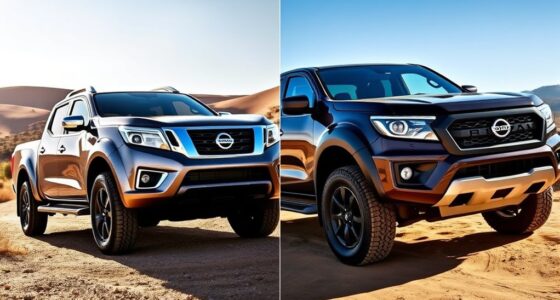
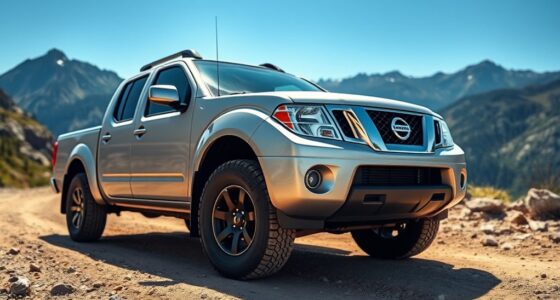
If you prioritize raw power and towing capacity, the Nissan Frontier with its 3.8L V-6 offering 310 hp and up to 7,150 lbs towing might be your best choice. For off-road adventures and better fuel economy, the Toyota Tacoma with its advanced off-road features and hybrid options could suit you better. Both trucks are versatile, but which one fits your needs best depends on your specific use. Explore further to find out more details.
Key Takeaways
- Nissan Frontier offers higher towing capacity (7,150 lbs) and more powerful V-6 engine, making it better for heavy-duty tasks.
- Toyota Tacoma provides slightly better fuel economy and a wider range of off-road features, appealing to adventure enthusiasts.
- Tacoma’s interior is rugged and durable, while Frontier offers a more modern design with comfort options like leather seats.
- Both trucks have similar starting prices, but trim and feature options can significantly affect overall cost.
- The choice depends on whether you prioritize raw power and towing (Frontier) or off-road capability and fuel efficiency (Tacoma).

Reese Towpower 44526Class 3 Trailer Hitch, 2 Inch Square Receiver, 5,000 lbs. Capacity, Compatible with 2005-2025 Nissan Frontier, 2009-2012 Suzuki Equator
VEHICLE APPLICATION: 2005-2025 Nissan Frontier, 2009-2012 Suzuki Equator.
As an affiliate, we earn on qualifying purchases.
As an affiliate, we earn on qualifying purchases.
Engine Power and Performance Comparison

When comparing engine power and performance, the 2025 Nissan Frontier stands out with its standard 3.8L V-6 engine that delivers 310 horsepower, giving it a clear edge over the Toyota Tacoma’s base 2.4L turbocharged 4-cylinder engine, which produces 278 horsepower. You’ll notice the extra power when accelerating or climbing hills, making the Frontier feel more responsive. The V-6 also provides a stronger mid-range torque of 281 lb-ft, ensuring better pulling power in everyday driving. On the other hand, the Tacoma’s turbocharged four-cylinder offers a solid 278 horsepower but falls slightly behind in raw power. The Tacoma’s available i-FORCE Max hybrid enhances performance further with 326 horsepower, but in standard form, the Frontier leads in engine output and overall performance. Additionally, understanding the engine specifications helps drivers make informed decisions based on their performance needs. Moreover, the engine technology used in these trucks influences efficiency, reliability, and overall driving experience. For example, advancements in engine innovations can significantly impact durability and fuel economy over time, especially when considering exhaust systems and other emission controls that contribute to environmental standards. Furthermore, the integration of sustainable engine designs aligns with the growing emphasis on eco-friendly driving practices.

JDMCAR Gas Cap Holder Compatible with Toyota Tacoma Accessories 2016-2023 Fuel Cap Holder, Durable Gas Cap Holder – Black
【Perfect Solution】Fuel up your 2016-2023 Tacoma 3rd Gen easily using the JDMCAR Design Holder – a convenient and…
As an affiliate, we earn on qualifying purchases.
As an affiliate, we earn on qualifying purchases.
Towing and Hauling Capabilities

When it comes to towing and hauling, you’ll find that the Nissan Frontier offers a higher maximum capacity than the Toyota Tacoma, making it a better choice for heavier loads. Payload handling varies between models, so consider how much weight you’ll regularly carry. Cargo versatility also plays a role, especially if you need space for different types of gear or equipment.
Towing Capacity Differences
The Nissan Frontier outshines the Toyota Tacoma in towing capacity, offering a maximum of 7,150 pounds compared to the Tacoma’s 6,500 pounds. This means you can handle heavier trailers or loads with the Frontier, giving you more versatility for work or recreation. Most Frontier trims surpass the Tacoma’s towing limit, especially the King Cab S 4×4 Long Bed, which reaches 7,000 pounds. In contrast, the Tacoma’s base model is limited to 3,500 pounds due to lack of transmission cooling, reducing its towing ability. If towing is a priority, the Frontier provides a notable advantage, allowing you to tow larger loads more confidently across various trim levels. This difference can substantially impact your hauling needs and overall vehicle flexibility. Additionally, the Frontier’s towing and hauling capabilities are generally considered more robust, making it a better choice for those who frequently transport heavy loads. Furthermore, the Frontier’s engine performance contributes to its superior towing capacity, ensuring reliable power when needed. For those considering long-term durability and performance, the Frontier’s engine cooling systems also play a crucial role in maintaining optimal towing operation. Moreover, the Frontier’s vehicle design emphasizes durability and strength, which supports its higher towing limits over time. Regular maintenance of these systems can help sustain the vehicle’s towing efficiency over years of use.
Payload Handling Abilities
Payload handling capabilities directly impact how much weight your vehicle can carry and tow, shaping its overall usefulness for work or recreational activities. Knowing these limits helps you plan for heavy loads and avoid overloading.
- The Nissan Frontier can tow up to 7,150 pounds, making it ideal for hauling larger trailers or equipment.
- The Toyota Tacoma offers a maximum towing capacity of 6,500 pounds, sufficient for most light-to-medium tasks.
- For payload, the Tacoma TRD Off-Road handles up to 1,610 pounds, while the Frontier’s payload capacity varies by trim but generally remains competitive.
Both trucks excel in towing and hauling, but the Frontier’s higher towing capacity gives it an edge when carrying heavier loads.
Cargo Versatility
Both the Nissan Frontier and Toyota Tacoma deliver strong towing and hauling capabilities, but the Frontier’s higher maximum towing capacity of 7,150 pounds gives it an advantage for heavier loads. With its robust 3.8L V-6 engine and a range of trim options, the Frontier can handle larger trailers, boats, and equipment with ease. Its towing capacity surpasses the Tacoma’s 6,500 pounds, especially in the King Cab S 4×4 Long Bed configuration, which reaches 7,000 pounds. The Frontier’s larger payload capacity also means you can carry more gear in the bed or trailer. While the Tacoma offers a slightly smaller towing limit, it compensates with a flexible drivetrain lineup and hybrid options for a balanced mix of power and efficiency. Overall, the Frontier’s superior towing and hauling make it the better choice for demanding cargo needs. Additionally, understanding vehicle specifications is crucial when evaluating a truck’s cargo capabilities to ensure it meets your specific needs. For example, towing capacity can vary significantly based on engine choice and configuration, so checking these details can help you select the right truck for your workload.

Tmat Midsize Truck Bed Organizer Slide Out Mat | Universal Fit
ORGANIZED CARGO, YOUR WAY – Tmat is a modular truck bed mat system with adjustable blockers designed to…
As an affiliate, we earn on qualifying purchases.
As an affiliate, we earn on qualifying purchases.
Transmission Options and Drivetrain Choices
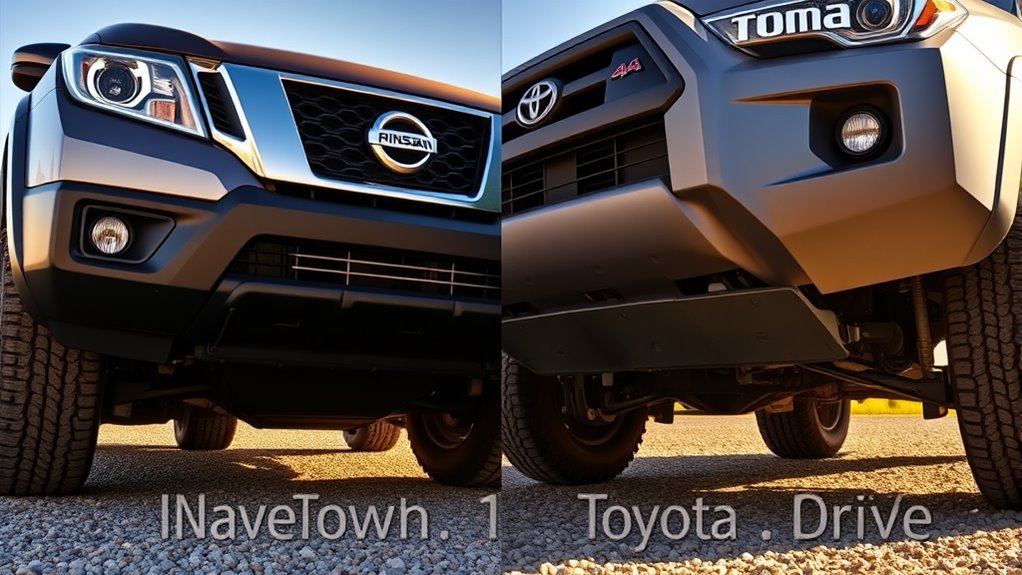
When comparing transmission options and drivetrain choices, the Nissan Frontier offers a straightforward experience with its standard 9-speed automatic transmission, providing smooth shifts and ease of driving. You won’t find a manual option here, but the automatic handles everyday driving well. The Toyota Tacoma, on the other hand, gives you a bit more control with two options: a 6-speed manual and an 8-speed automatic. Here’s what you need to know:
- The Frontier’s single automatic simplifies driving with fewer choices.
- The Tacoma appeals to enthusiasts with its manual transmission option.
- Both trucks come in rear-wheel drive or 4-wheel drive configurations, so you can choose based on your off-road needs.
This setup influences how you experience power delivery and control behind the wheel.

Huidasource Seat Covers for Nissan Frontier 2022-2025, Waterproof Leather Seat Covers for Nissan Frontier S SV PRO-X PRO-4X SL, Full Coverage Custom Fit Seat Cushion Cover(Fullset/Black&Red)
Nissan Frontier Seat Covers — Custom leather car seat covers compatible with Nissan Frontier S SV PRO-X PRO-4X…
As an affiliate, we earn on qualifying purchases.
As an affiliate, we earn on qualifying purchases.
Fuel Efficiency and Economy Metrics
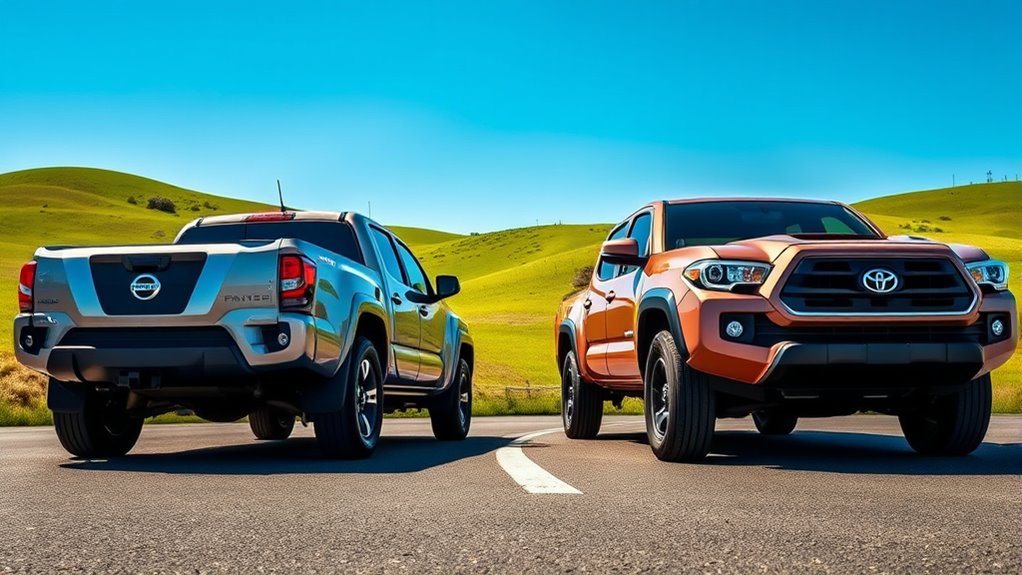
When comparing fuel efficiency, you’ll notice the Tacoma offers slightly better MPG ratings, with 19 city and 24 highway compared to the Frontier’s 17 and 21. Additionally, the Tacoma’s larger fuel tank capacity means fewer stops for refueling on long trips. These differences can influence your overall driving economy and convenience. Incorporating connected vehicle technology can further optimize fuel usage and enhance overall efficiency. Staying informed about fuel economy metrics and leveraging available smartphone apps can help you monitor and improve your vehicle’s fuel performance. Understanding essential oils for fuel efficiency may also provide insights into maintaining optimal vehicle operation.
Fuel Economy Differences
While the Nissan Frontier and Toyota Tacoma are both capable trucks, their fuel economy metrics highlight a key difference for drivers prioritizing efficiency. The Tacoma generally leads with better fuel economy, making it a smarter choice if saving on gas matters most. Here are three key points:
- The Tacoma gets an estimated 19 city/24 highway MPG, providing slightly better efficiency.
- The Frontier averages 17 city/21 highway MPG, meaning you’ll spend more at the pump.
- The Tacoma’s hybrid i-FORCE Max option boosts MPG to 22 city/24 highway, giving even more savings on fuel.
- Considering environmental considerations, choosing a more fuel-efficient model can help reduce your carbon footprint.
If you’re looking for maximum efficiency, the Tacoma’s advantage is clear. However, if fuel economy isn’t your top priority, other factors like towing and power might weigh more heavily in your decision.
Fuel Tank Capacity
The Nissan Frontier comes equipped with a 21.0-gallon fuel tank, providing a decent range for long drives and heavy-duty hauling. With this capacity, you can cover more miles between refills, especially when paired with its fuel economy of 17 city/21 highway MPG. The Toyota Tacoma has a slightly smaller tank at 18.2 gallons, which means you’ll need to refuel more often, despite its better fuel efficiency of 19 city/24 highway MPG. If you frequently take extended trips or work in areas with limited fueling stations, the Frontier’s larger tank offers an advantage. However, the Tacoma’s efficient fuel use can offset its smaller capacity, making both vehicles suitable depending on your driving habits and needs. Understanding fuel economy is essential when comparing these trucks’ overall cost-effectiveness and suitability for your lifestyle. Additionally, fuel tank capacity can influence your vehicle’s long-term operating costs and convenience during travel, especially in remote areas where fueling stations may be sparse.
Off-Road Features and Capabilities

Off-road capabilities are a key factor to contemplate when comparing the Nissan Frontier and Toyota Tacoma. You’ll find both trucks are well-equipped for off-road adventures, each with unique features.
- The Tacoma TRD Off-Road trim includes disconnecting sway bars, enhancing wheel articulation on rough terrain.
- It also offers Multi-Terrain Select and Crawl Control, giving you better control on challenging surfaces.
- The Frontier Pro-4X features steel skid plates and hydraulic steering, providing durability and stability on rugged trails.
- According to Best Home Security Systems of 2024, rugged off-road vehicles often integrate advanced features to ensure safety and durability in challenging environments.
- Additionally, off-road vehicle durability is supported by the use of high-quality materials and engineering designed to withstand tough conditions. Modern off-road vehicles frequently incorporate advanced engineering to improve resilience and performance in demanding terrains.
- The integration of these off-road technology features can significantly enhance the vehicle’s ability to handle diverse and difficult off-road conditions, especially when complemented by proper maintenance and driving techniques.
Interior Space and Comfort

When comparing the interior space and comfort of the Nissan Frontier and Toyota Tacoma, you’ll notice both trucks offer seating for five, but the design and cabin layout can impact your overall experience. The Frontier provides a modern, user-friendly dashboard with ample legroom, while the Tacoma’s interior emphasizes a more traditional feel. Your comfort depends on how these design choices align with your needs for long drives and daily use.
Cabin Comfort and Design
Both the Nissan Frontier and Toyota Tacoma deliver impressive interior space and comfort, making them suitable for everyday driving and longer trips. You’ll find that both trucks offer well-designed cabins with quality materials and user-friendly layouts.
Consider these key points:
- The Frontier’s seats provide firm support with available leather options for added luxury.
- The Tacoma’s interior emphasizes durability with rugged, easy-to-clean surfaces.
- Both trucks offer ample front legroom—41.8 inches—ensuring a comfortable ride for long hours.
While the cabin designs differ—Frontier leaning toward modern comfort, Tacoma prioritizing toughness—they both ensure a cozy, functional environment. Your choice depends on whether you prefer a more refined or rugged interior experience.
Passenger Space and Seating
Passenger space and seating in the Nissan Frontier and Toyota Tacoma focus on comfort and usability, ensuring that both drivers and passengers enjoy a pleasant ride. You’ll find that both trucks comfortably accommodate five passengers, with front legroom measuring 41.8 inches in each vehicle, providing ample space for long drives. The seats are designed for support and comfort, making daily commutes or extended trips more enjoyable. The cabin layouts prioritize accessibility and visibility, giving you a sense of spaciousness despite their mid-size classification. Though interior aesthetics differ, both trucks offer practical, user-friendly seating arrangements. Overall, whether you choose the Frontier or Tacoma, you’ll benefit from well-designed, comfortable seating that caters to both driver and passenger needs.
Payload Capacity and Utility

If payload capacity is a key factor in your decision, you’ll find that the Toyota Tacoma generally offers a higher maximum payload than the Nissan Frontier. The Tacoma’s maximum payload reaches up to 1,610 pounds, making it ideal for hauling heavier loads. In comparison, the Frontier’s payload capacity varies across trims but generally tops out around 1,460 pounds. To help you compare, consider:
For heavier loads, the Toyota Tacoma offers a higher payload capacity than the Nissan Frontier.
- Tacoma’s higher payload capacity for heavy-duty tasks and larger loads.
- Both trucks comfortably seat five passengers, maximizing utility.
- The Frontier’s utility is enhanced by its slightly better maneuverability with a turning diameter of 42.7 feet versus Tacoma’s 42.2 feet.
Ultimately, if payload is your priority, Tacoma’s higher capacity could better suit your hauling needs.
Safety and Technology Features

When considering payload capacity and utility, safety and technology features play a pivotal role in your overall driving experience. The Nissan Frontier offers advanced safety tech like ProPILOT Assist, which helps with steering, braking, and acceleration on highways. It also includes Nissan Safety Shield 360, featuring automatic emergency braking, blind-spot warning, and rear cross-traffic alert. The Toyota Tacoma emphasizes safety with Toyota Safety Sense P, which includes pre-collision systems, adaptive cruise control, and lane departure alert. Its available multi-terrain monitor enhances off-road awareness. In technology, the Frontier provides an easy-to-use infotainment system with Apple CarPlay and Android Auto compatibility. The Tacoma’s touchscreen system also supports these features, along with available premium audio options. Both trucks prioritize driver safety and connectivity, enhancing your confidence on the road.
Pricing and Trim Level Offerings
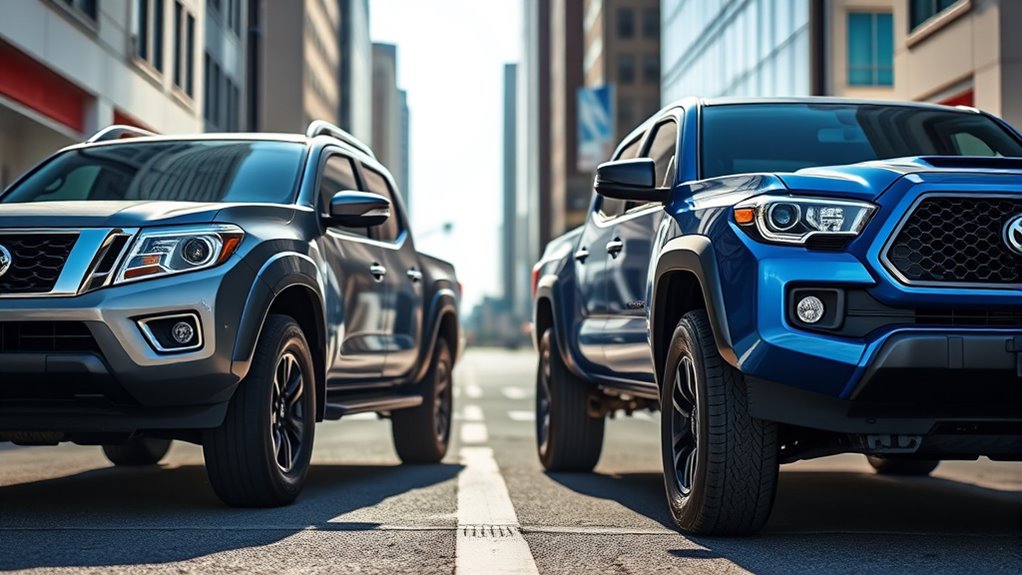
Both the Nissan Frontier and Toyota Tacoma offer a range of trim levels designed to meet different budgets and needs, making it easier for you to find a model that fits your preferences. Here’s what you can expect:
- The Frontier’s trims include S, SV, PRO-4X, and SL, offering options from basic work trucks to off-road-ready models.
- The Tacoma’s trims range from SR and SR5 to TRD Off-Road, Limited, and TRD Pro, catering to various off-road and luxury desires.
- Pricing varies, with the Frontier’s base model starting around $29,000, while the Tacoma’s base begins near $27,000. Higher trims can exceed $45,000 for both trucks.
Overall Versatility and Best Use Cases
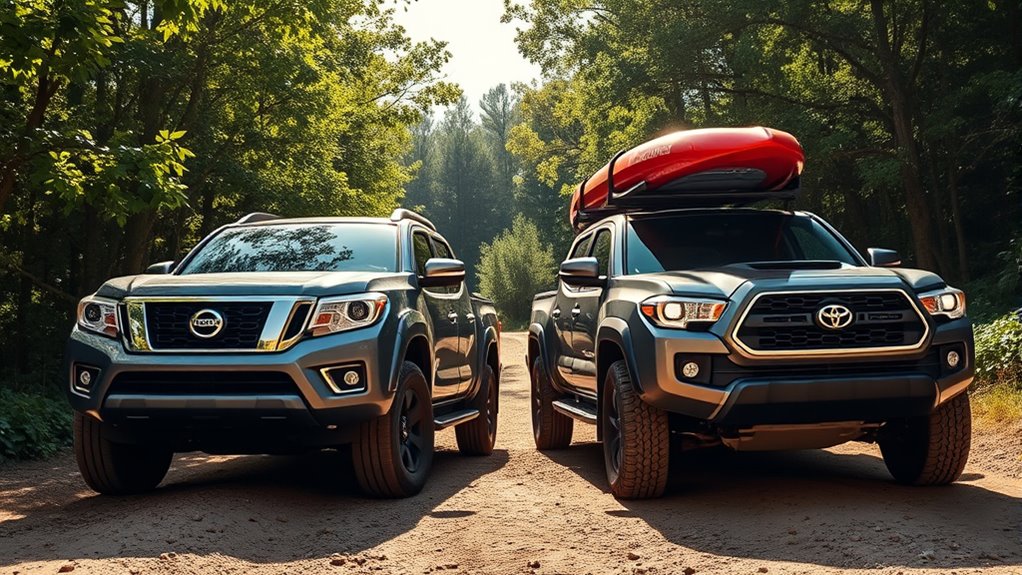
The Nissan Frontier and Toyota Tacoma each bring unique strengths to different types of drivers and tasks, making them versatile choices for a range of uses. If you’re into heavy towing and hauling, the Frontier’s higher towing capacity and robust engine options make it ideal for work or outdoor adventures. The Tacoma’s off-road features, like Multi-Terrain Select and Crawl Control, suit outdoor enthusiasts and weekend explorers. If fuel efficiency and interior comfort matter more, Tacoma’s better MPG and spacious cabin are advantageous. Both trucks handle daily driving well, with similar turning radii for city maneuvering. Your choice depends on your priorities: the Frontier offers raw power and payload capacity, while the Tacoma excels in off-road capability and fuel economy. Consider your typical tasks to determine which truck fits your lifestyle best.
Frequently Asked Questions
Which Truck Offers Better Long-Term Reliability and Durability?
You’ll find that Toyota Tacoma generally offers better long-term reliability and durability. It has a proven track record for holding up well over years of use, thanks to Toyota’s reputation for building tough, dependable trucks. While the Nissan Frontier has improved, Tacoma’s robust construction, quality components, and extensive ownership history make it a smarter choice if long-term durability matters most to you.
How Do Maintenance Costs Compare Between Nissan Frontier and Toyota Tacoma?
Maintenance costs for the Nissan Frontier are generally lower than those for the Toyota Tacoma, saving you a significant amount over time. Toyota’s reputation for reliability means fewer repairs and less frequent service, but parts and labor tend to be pricier. In contrast, Nissan offers more affordable parts and simpler maintenance routines, making it a budget-friendly choice. You’ll spend less money and have less hassle with the Frontier’s maintenance costs.
Are There Any Notable Differences in Warranty Coverage?
You’ll find that Toyota offers a longer basic warranty of 36,000 miles or 3 years, and a powertrain warranty of 60,000 miles or 5 years. Nissan’s warranty covers 36,000 miles or 3 years for basic coverage, but its powertrain warranty lasts 5 years or 60,000 miles, similar to Toyota’s. Overall, Toyota’s warranty coverage is slightly more extensive, especially for basic repairs, giving you extra peace of mind.
Which Vehicle Has More Advanced Safety and Driver-Assist Features?
You’ll find that the Tacoma has more advanced safety and driver-assist features, making it feel like a high-tech fortress on wheels. It includes Toyota Safety Sense with pre-collision systems, adaptive cruise control, lane departure alert, and automatic high beams. The Frontier offers solid safety features too, but the Tacoma’s suite of cutting-edge tech creates a safer, smarter driving experience that truly stands out, giving you peace of mind on every journey.
How Do Resale Values Differ for Nissan Frontier and Toyota Tacoma?
You’ll find that the Toyota Tacoma generally holds its resale value better than the Nissan Frontier. Toyota’s strong reputation for durability and reliability, along with high demand in the used truck market, boosts its value retention. Nissan Frontiers tend to depreciate faster, so if resale value matters to you, the Tacoma’s better standing makes it a smarter investment over time.
Conclusion
Choosing between the Nissan Frontier and Toyota Tacoma is like picking the right tool for a job—you need the one that fits your needs best. Both trucks pack impressive features, but your decision hinges on what matters most—whether it’s power, off-road prowess, or value. Think of it as finding your perfect partner in adventure, ready to tackle any terrain. Whichever you choose, you’re gearing up for a reliable ride that can handle whatever comes your way.