TL;DR
Truck bed organizers help keep cargo from sliding, shifting, or becoming difficult to reach, with choices ranging from simple dividers and portable boxes to drawers and sliding trays. Match the organizer to your truck’s bed and tie-downs, the cargo you carry, how often you need it, and the space and payload you can spare. An organizer can help organize a load, but secure heavy cargo to the truck’s tie-down points.
Match the organizer to the cargo you haul most and how often you need access.
Check model year, bed length, wheel wells, liner, rails, and cover clearance before buying.
Treat a lock or tonneau cover as added protection, not a guarantee against theft or water.
Follow both the organizer’s load limit and your truck’s payload rating.
Use appropriate tie-down points and rated straps to restrain heavy cargo; an organizer alone is not enough.

Get business pricing on garage and car supplies
- Business-only prices and quantity discounts
- Tax-exempt purchasing
- Multiple users, one account, clear invoices
Pick an organizer that fits the cargo you carry most
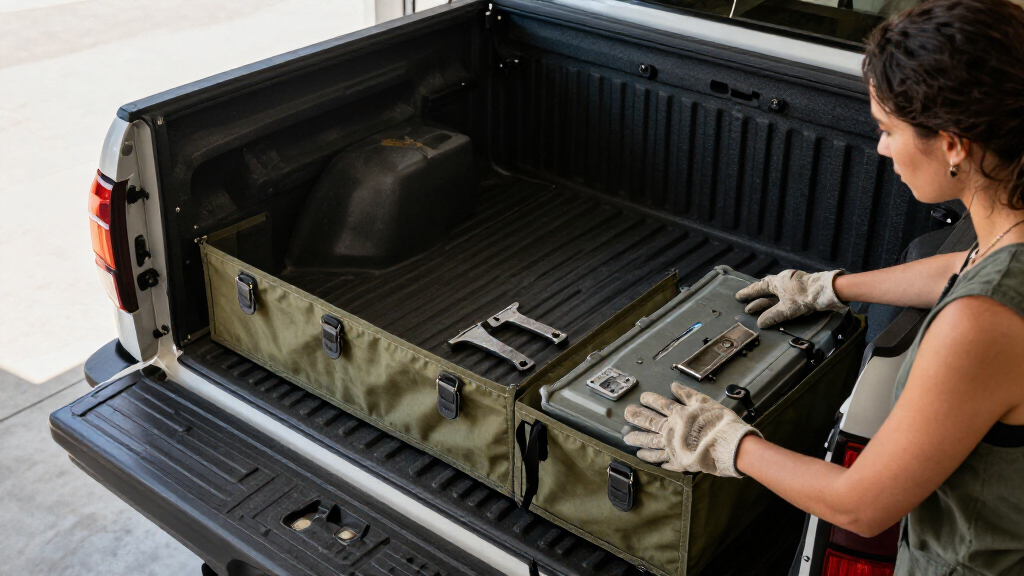
Truck bed organizers fall into a few practical groups: dividers and cargo bars separate or steady loads, boxes hold smaller gear, and drawers or sliding trays make frequent-access cargo easier to reach. Those differences matter because an organizer changes both where cargo sits and how much of the bed remains usable. A modular rail system can add flexibility by letting you reposition dividers and accessories as loads change, though that flexibility depends on compatible parts being available for your truck. [1]| Organizer type | Works well for | Main trade-off |
|---|---|---|
| Cross-bed divider or cargo bar | Keeping bags, bins, or occasional loads in place | Does not enclose items or replace straps |
| Portable storage box | Tools and smaller gear you want to lift out | Uses bed space and may need separate tie-downs |
| Bed-mounted drawer | Tools and supplies you reach for often | Adds weight and limits tall cargo clearance |
| Sliding tray | Equipment stored deep in the bed | Costs more and needs suitable clearance |
| Modular rails | Changing the layout for different kinds of cargo | Fit and accessories vary by truck |
Products Worth Considering

Nextbase 222 1080p HD Dash Cam with 140° Viewing Angle

Chemical Guys Arsenal Builder Car Wash Kit with Foam Cannon and Carry Bag

Vantrue Power JS3 3250A Car Jump Starter with 160 PSI Air Compressor
As an affiliate, we earn on qualifying purchases.
Check your truck’s bed before buying a universal organizer
A truck bed organizer fits only if its dimensions and mounting points match your truck’s bed, liner, and tie-down layout. A small mismatch can have practical consequences: a bar may slip if its feet cannot grip, or a box may block a cover or tailgate. Check the model year and bed length, then measure the bed width where the organizer will sit; the shape around the wheel wells can leave gaps even when a product is labeled universal. [1] Use this quick fit check before ordering:- Confirm your truck’s model year, bed length, and bed configuration.
- Measure the usable width and height, including the wheel-well intrusions.
- Locate the tie-downs and rails, and check whether the organizer’s mounts can reach them.
- Account for a drop-in liner, spray-in liner, tonneau cover, or rack that may change clearance.
- Read the fit list and installation instructions for any adjustment, clamp, or drilling requirements.
Choose between quick access and a wide-open bed
A drawer or sliding tray makes stored cargo easier to reach, while a removable divider or box leaves more freedom to carry large loads. Permanent systems trade open bed space and added weight for convenient access; portable gear trades some convenience for flexibility. The difference shows up over time: a system that saves a few minutes on every workday may be worthwhile, while a permanent platform can be frustrating if oversized loads are a regular part of your week. Your daily routine tells you which side of that trade matters more. [1] Imagine you keep a socket set, gloves, and a compressor in the bed. With a drawer, you can pull the tools toward the tailgate and find the right wrench without moving everything else. That can reduce repeated lifting and rummaging if you use the truck for work each day. If you haul tall furniture or building materials twice a month, the same drawer system can become an obstacle: its platform reduces vertical room, and removing it each time may erase the convenience you gained. Removable cross-bed dividers and portable boxes are easier to rearrange when a big load comes along, though gear stored in a box may be less convenient to reach than a drawer. Some rail-based systems add useful middle ground: move the accessories for a load of plants, then reposition them for cases of equipment. Before buying, picture your most awkward regular load—not just your neatest one. Check how the organizer and its contents change usable space, bed access, and truck payload, because a system that fits the bed physically can still leave too little room or capacity for its intended use. [1]Treat covers, locks, and weather seals as separate safeguards
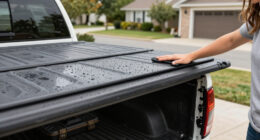
A lockable organizer can deter casual theft, and a sealed box can limit water intrusion, but neither feature guarantees that cargo stays secure and dry. Protection depends on the whole setup: the organizer’s construction, seals, drainage, cover, mounting, and exposure to weather. A tonneau cover may reduce direct rain while leaving gaps that admit windblown water or dust. [1] For a workday example, you leave a sealed tool case under a bed cover during a storm. The cover helps shield it from rain, but water may still enter at seams or collect around the tailgate. That distinction matters if the contents are sensitive: “sealed” or “covered” may describe a useful layer of protection without promising that everything inside will stay dry in every condition. Check whether the maker describes the organizer as water-resistant and how it should drain; don’t infer waterproof performance from a lid or lock. If you carry electronics or dry clothing, put them in suitable inner bags and inspect the storage after wet trips. A lock also has limits. It may make a box less tempting to someone passing by, but it does not make an uncovered bed theft-proof. The mounting matters because a locked box that can be removed as a unit offers less protection than its lock alone might suggest. Check how the organizer attaches to the truck and whether a thief could remove the whole unit. When pairing rails, racks, liners, or tonneau covers, verify that the pieces work together and do not obstruct one another. [1]Secure heavy cargo even when the organizer looks sturdy
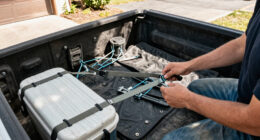
An organizer helps position cargo, but it does not automatically restrain a heavy load during a sudden stop. Follow the organizer’s stated load limit, stay within your truck’s payload rating, and secure cargo with suitable straps attached to appropriate truck tie-down points. These are separate limits and jobs: one covers the organizer, one the vehicle, and one the load’s restraint. [1] Suppose you use a divider to keep bags of potting soil near the tailgate. The divider can stop them drifting across the bed during an ordinary turn, but hard braking pushes the bags forward; a divider may not be designed to withstand that force. Use rated straps and sound tie-down points for heavy items, and distribute cargo so it does not overload one side. If the organizer itself has a weight limit, count the organizer and its contents as directed by the manufacturer. Before driving, check that straps are snug, hooks are seated, and loose items cannot roll or slide. Recheck a load after a short drive, especially if its contents can settle, such as firewood or bagged material. Settling can loosen straps, which reduces their ability to hold the load in place. A well-arranged bed is easier to use, but restraint comes from the right tie-down method—not from hoping a divider will catch everything. [1]Make installation and maintenance part of your buying decision
Installation requirements, material, and moving parts affect how an organizer works over years of use. Some systems clamp to existing rails or use factory tie-downs; others need permanent fasteners or drilling. The mounting choice affects how easily you can remove the organizer and what modifications the installation requires. Plastic, aluminum, steel, and composite parts each bring different trade-offs in weight, corrosion resistance, and exposure to sun. Read the maker’s installation and care guidance before you commit. [1] For instance, a removable box that clamps in may take only a short setup, but you’ll want to confirm that its clamps sit securely over your bedliner. A sliding tray offers convenient access, yet its moving parts need room to travel and periodic attention. If debris blocks the tracks, the tray may become harder to operate; if water has nowhere to drain, it can collect where the system meets the bed. Check drainage paths and clear debris from tracks so grit and standing water do not quietly interfere with operation. Think through the routine, not just the installation day. Can you remove or reposition the system when you need the full bed? Will a rack or cover block its handles? Does the added weight leave room within your truck’s payload for passengers, tools, or a trailer tongue load? A quick seasonal inspection of fasteners, rails, seals, and moving parts can catch looseness or wear before the next loaded trip. That small maintenance step helps preserve secure mounting and smooth access, especially for equipment exposed to dust, water, and repeated loading. [1]Use a simple checklist to match the setup to your week
The right truck bed organizer is the one that solves your regular cargo problem while still working on your busiest, messiest day. Start with the items you carry, how often you reach them, and whether you need to haul oversized loads. Then compare those needs with fit, security, installation, and capacity. This order helps you avoid paying for a feature you rarely use or choosing a system that makes your common loads harder to carry. [1] Consider a contractor who carries power tools every weekday and plywood now and then. A bed-mounted drawer keeps small tools orderly and within reach, but plywood may require enough clearance over the drawer and careful load planning. The drawer’s value depends on whether the daily time saved outweighs the space and payload it uses on plywood days. A weekend gardener who carries soil bags, a hose, and a few tools could get more value from a portable box and removable divider, leaving the bed open for shrubs or compost. Because those loads change, being able to remove or move the organizer may matter more than having the fastest access to one fixed set of tools. Use this short decision path:- If cargo mostly shifts during occasional trips, start with a divider or cargo bar.
- If you need to gather smaller items, compare portable boxes and lockable storage.
- If you reach into the bed repeatedly, consider a drawer or sliding tray and measure its space cost.
- If loads change often, look at removable or modular parts that can be rearranged.
- Before purchase, confirm fit, load limits, mounting, cover clearance, and tie-down plans.