You’ll see many trucks ditching V8 engines because tighter emissions rules, rising fuel costs, and advances in turbocharged V6 and inline-six technology make smaller, more efficient engines more appealing. Automakers are shifting toward hybrid and electric powertrains to meet environmental standards and consumer demands for better fuel economy. While V8s are still used in heavy-duty trucks, mainstream models are moving away from them. To find out how these changes affect your choices, keep exploring the trends shaping the industry.
Key Takeaways
- Stricter emissions standards and environmental regulations incentivize automakers to shift from large V8s to smaller, cleaner engines.
- Turbocharged V6 and inline-six engines now offer V8-like power with better fuel efficiency and lower operating costs.
- Advances in hybrid and electric technologies reduce reliance on traditional internal combustion engines, decreasing demand for V8s.
- Manufacturing costs for V8s are higher due to complex components, prompting manufacturers to favor more economical smaller engines.
- Industry trends focus on sustainability and innovation, making smaller, more efficient powertrains the future of truck engineering.

BFO S400SX4 T6 Turbo Turbocharger for DDC-MTU Navistar Int Harvester Truck with Series 60 Engine 2000-2008, 4.0L-6.0L Engine, 23518588 171702 171703 23518567
【Application】for DDC-MTU Truck with Series 60 Engine 2000-2008; for Navistar Truck with Series 60 Engine 2000-2008; for Int…
As an affiliate, we earn on qualifying purchases.
As an affiliate, we earn on qualifying purchases.
Shifting Market Preferences Toward Smaller, Turbocharged Engines
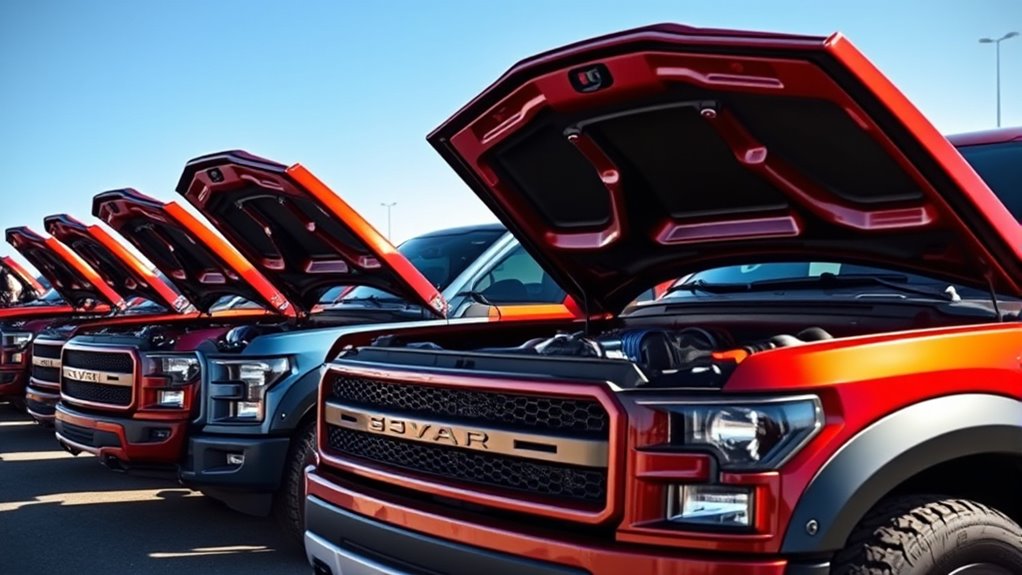
As automakers prioritize fuel efficiency and meet stricter emissions standards, there’s a clear shift toward smaller, turbocharged engines in trucks. You’ll notice more models offering turbocharged V6 and inline-six options that deliver impressive power without the fuel consumption of traditional V8s. These engines use forced induction to boost performance, matching or surpassing V8 output while notably reducing emissions. Manufacturers see the advantage of smaller engines, which cost less to produce and maintain, and appeal to consumers seeking better fuel economy. This trend is reflected in popular models like Toyota’s twin-turbo V6 and Ram’s inline-six. As a result, turbocharged engines are becoming the new standard, challenging the dominance of larger V8s and reshaping the future of truck powertrains.

Chevrolet Inline-6 Engine: How to Rebuild 1954-1962
As an affiliate, we earn on qualifying purchases.
As an affiliate, we earn on qualifying purchases.
Advances in V6 and Inline-Six Powertrain Technologies

You’ll notice that turbocharging has considerably boosted the efficiency and power density of V6 and inline-six engines. These advancements let manufacturers deliver more performance with less fuel, making them strong alternatives to V8s. As a result, these engines are becoming increasingly appealing for trucks seeking a balance of capability and efficiency. Moreover, the shift towards energy-efficient and sustainable solutions aligns with the growing emphasis on European cloud innovation to support greener transportation technologies.
Turbocharging Efficiency Gains
Have advances in turbocharging technology considerably boosted the efficiency of V6 and inline-six engines? Absolutely. Modern turbochargers now utilize variable geometry and advanced wastegate systems, optimizing boost pressure across a broad RPM range. This means you get more power when needed and better fuel economy at cruising speeds. Inline-six and V6 engines can now produce similar or even greater outputs than V8s while consuming less fuel. Manufacturers leverage lighter components, improved intercooling, and direct injection to maximize efficiency. These innovations allow smaller engines to deliver robust performance without sacrificing fuel economy or emissions standards. Additionally, engine design improvements contribute to enhanced durability and reduced maintenance costs. As a result, turbocharged V6 and inline-six engines dominate new truck offerings, providing the power you need while aligning with environmental and economic demands.
Improved Power Density
Advances in V6 and inline-six powertrain technologies have considerably boosted their power density, allowing these smaller engines to produce more power within the same or even smaller physical space. Modern turbocharging, direct injection, and variable valve timing enable these engines to deliver high horsepower and torque comparable to V8s. For instance, Ford’s 3.5-liter EcoBoost V6 matches V8 performance while occupying less space. Inline-six engines like Ram’s Hurricane provide smooth, high-output power with improved efficiency. These innovations mean manufacturers can reduce engine size without sacrificing capability, making V6 and inline-six options increasingly attractive for trucks. Additionally, the growing use of hybrid technology helps further enhance power and efficiency. As a result, you get better fuel economy, lower emissions, and more versatile engine designs, all while maintaining or surpassing traditional V8 performance standards.

Commercial Truck Powertrains: Engines, Electronics, and the Science of Heavy Work (THE MECHATRONIC FLEET REFERENCE SERIES)
As an affiliate, we earn on qualifying purchases.
As an affiliate, we earn on qualifying purchases.
Environmental Regulations Accelerate V8 Phase-Out

As environmental regulations become stricter, automakers are under pressure to improve fuel efficiency and reduce emissions. This shift favors smaller, turbocharged engines over traditional V8s, which tend to be less efficient. Consequently, the decline of V8 engines in trucks is accelerating as manufacturers adapt to these new standards.
Emission Standards Tighten
Stricter emissions standards are pushing automakers to phase out traditional V8 engines in favor of cleaner, more efficient alternatives. These regulations target reduced greenhouse gases and pollutants, forcing manufacturers to innovate. You’ll see that:
- Turbocharged V6 and inline-six engines produce similar power with lower emissions.
- Hybrid and electric powertrains are becoming more viable, meeting strict standards.
- V8 production costs rise as emissions tests become more demanding.
- Many automakers prioritize smaller, cleaner engines to avoid penalties and stay compliant.
As regulations tighten globally, the push for greener technology accelerates. You’ll notice manufacturers shifting their focus from large, high-displacement engines to sophisticated, efficient powertrains that meet evolving standards without sacrificing performance.
Fuel Efficiency Gains
Have you noticed that modern trucks are becoming more fuel-efficient despite their size and power? This shift is driven by stricter environmental regulations and consumer demand for better mileage. Manufacturers are turning to turbocharged V6 and inline-six engines that deliver comparable or greater performance than traditional V8s but use less fuel. Hybrid systems further boost efficiency, reducing reliance on large-displacement engines. Advances in direct injection and turbocharging help optimize combustion, making engines smarter and more economical. As a result, trucks now achieve impressive power while consuming less fuel, helping owners save money and reduce emissions. This focus on efficiency accelerates the decline of V8s in mainstream trucks, pushing automakers toward smaller, more advanced powertrains that meet modern environmental standards. Embracing curiosity-driven innovations in engine technology is helping manufacturers develop smarter solutions for the future.
JDMSPEED New Universal Electric Power Window Lift Regulator Conversion Kit with Switches Wiring and Hardware for 2 Door Pickup SUV Truck Van Car
An upgraded conversion assembly for your window
As an affiliate, we earn on qualifying purchases.
As an affiliate, we earn on qualifying purchases.
Consumer Demand for Better Fuel Economy
Why are more truck buyers now prioritizing fuel economy? Because fuel costs impact your budget every time you hit the road. As gas prices rise, you want a truck that saves money without sacrificing power. Manufacturers respond by offering engines that deliver efficiency alongside performance. You’ll notice:
- Smaller turbocharged engines that provide comparable power with lower fuel consumption
- Hybrid options that optimize fuel use during city driving
- Advanced transmission systems improving overall efficiency
- Better aerodynamics and lightweight materials reducing drag and weight
- Gold IRA markets are also evolving, reflecting broader consumer shifts toward smarter investments and sustainable choices.
These changes meet your demand for trucks that perform well on heavy loads yet keep fuel costs manageable. With consumers like you seeking smarter, more economical choices, the industry is shifting away from traditional V8s toward more efficient powertrains.
The Rise of Hybrid and Electric Truck Powertrains

You’re likely noticing how hybrid and electric powertrains are extending truck ranges and boosting efficiency. Manufacturers are racing to meet stricter emissions standards while improving battery tech for faster charging and longer life. These advancements are reshaping how trucks perform, making them more sustainable without sacrificing power. Additionally, smart appliance integration in vehicle systems enhances real-time diagnostics and maintenance, further optimizing performance and longevity.
Increased Range and Efficiency
As automakers prioritize fuel efficiency and longer driving ranges, hybrid and electric powertrains are rapidly transforming the truck industry. You’ll notice that these systems deliver more miles per charge or tank, reducing downtime and boosting productivity. They also optimize energy use through regenerative braking, which captures energy during deceleration. Additionally, hybrid and electric trucks often feature advanced aerodynamics and lightweight materials to extend range further. Here’s what you can expect:
- Increased driving distances on a single charge or tank
- Lower fuel costs and reduced emissions
- Faster acceleration due to instant torque
- Reduced maintenance with fewer moving parts
These innovations allow trucks to go farther and work smarter, making traditional V8 engines less essential for long-haul or heavy-duty applications.
Accelerated Emissions Compliance
Stricter emissions regulations are driving automakers to accelerate the adoption of hybrid and electric powertrains in trucks. You’ll notice manufacturers shifting away from traditional V8s to meet tighter standards, especially in urban and regional markets. Hybrid systems combine small internal combustion engines with electric motors, reducing emissions markedly. Electric powertrains eliminate tailpipe emissions altogether, making trucks cleaner and compliant with future regulations. To stay ahead, companies invest heavily in developing zero-emission models, often phasing out large V8 engines. These new powertrains not only help meet legal requirements but also appeal to consumers seeking eco-friendly options. As a result, the industry is rapidly evolving, with hybrid and electric trucks becoming increasingly common, pushing traditional V8 engine production further out of the market.
Advancements in Battery Tech
Advancements in battery technology are accelerating the adoption of hybrid and electric powertrains in trucks, reshaping the industry’s landscape. You’ll find that modern batteries deliver higher energy density, faster charging, longer lifespan, and improved safety. This progress makes electric trucks more practical for daily use and heavy-duty applications. Here’s what’s driving the change:
- *Enhanced battery chemistry* boosts range and reduces weight.
- *Fast-charging infrastructure* minimizes downtime during trips.
- *Solid-state batteries* promise even greater energy storage and safety.
- *Cost reductions* make electric and hybrid trucks more affordable for fleets.
- Free Floating features in modern electric trucks allow for more flexible design options and ease of integration into various environments.
These innovations are enabling manufacturers to produce trucks that rival traditional engines in power and endurance, all while cutting emissions and fuel costs. The future of trucking is shifting toward cleaner, smarter energy solutions.
Cost Considerations in Engine Development and Manufacturing
Developing and manufacturing engines involves significant costs that influence manufacturers’ decisions to shift away from traditional V8 designs. V8 engines require larger, more complex components, leading to higher research, tooling, and production expenses. These engines demand extensive testing to meet increasingly strict emissions standards, adding to costs. In contrast, smaller turbocharged engines like V6s or inline-sixes are cheaper to produce and easier to adapt across vehicle platforms. They benefit from economies of scale, as automakers can develop a single turbocharged platform for multiple models. Additionally, ongoing updates and emissions compliance further inflate costs for V8 development. By switching to smaller, more efficient engines, manufacturers reduce investment risks, improve profit margins, and comply with evolving regulations—all vital factors in their move away from traditional V8 engines. Cost-effective manufacturing plays a crucial role in this industry shift.
Popularity of V8 Engine Swaps and Aftermarket Alternatives

As engine manufacturers shift toward smaller, turbocharged options, many enthusiasts look to the aftermarket scene to keep the V8 flame alive. You’ll find that popular swaps like the Chevrolet LS engine remain favorites due to their reliability, affordability, and widespread availability. The LS family dominates because it’s versatile and proven in countless applications. Beyond Chevy, engines like the Ford 5.0 V8 and Toyota 2JZ-GTE are also in high demand for custom builds. Companies such as Bruiser Conversions offer ready-made swap kits, making installation easier. Enthusiasts are also exploring lightweight alternatives like Honda’s K-Series for high-revving, performance-oriented projects. These aftermarket options allow you to customize your vehicle for power, efficiency, or unique styling, keeping the V8 spirit alive despite factory shifts away from large-displacement engines. Additionally, the growing popularity of AI-driven tuning tools helps optimize these engines for performance and reliability.
Discontinuation of Traditional V8 Engine Production
Manufacturers are increasingly winding down the production of traditional V8 engines as they prioritize more efficient and modern powertrain options. This shift is driven by tightening emissions standards, which make large-displacement engines harder to justify. Many automakers are phasing out V8s in favor of turbocharged V6 and inline-six engines that deliver comparable power with better fuel economy. GM, for example, has largely halted LS engine production, focusing instead on the Gen-V LT family. Ford promotes EcoBoost V6s, and Toyota’s twin-turbo V6 now powers the Tundra exclusively. These changes reflect a broader industry move toward smaller, more efficient engines that meet regulatory demands while satisfying consumer interest in lower emissions and better fuel economy. As a result, traditional V8 production is declining markedly.
Heavy-Duty V8 Applications in Commercial and Trucking Sectors
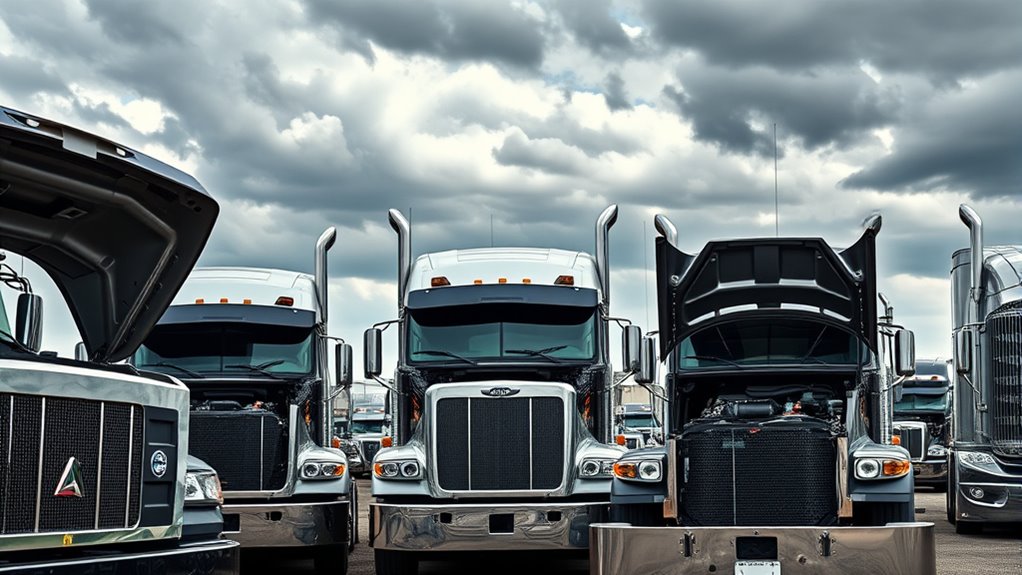
Heavy-duty trucks continue to rely heavily on V8 engines for their unmatched power and durability in demanding applications. These engines excel in providing high torque and longevity essential for heavy hauling and long-distance freight. They are favored in sectors where reliability and consistent performance are critical. You’ll find V8s powering large trucks, construction equipment, and agricultural machinery. Rendering lard knowledge underscores the importance of traditional, self-sufficient practices, which can relate to maintaining and optimizing engine performance through proper upkeep.
- Heavy-duty diesel V8s like the Scania DC16 deliver up to 730 horsepower while meeting strict Euro-6 standards
- V8 engines remain standard in long-haul trucking for their durability under constant load
- Manufacturers develop modern V8s with advanced turbocharging for efficiency and power
- Despite shifts, aftermarket V8 swaps are popular for restoring or upgrading performance in specialty applications
Future Outlook for Large-Displacement Engines in the Automotive Industry

The future of large-displacement engines in the automotive industry looks increasingly uncertain as emissions regulations tighten and fuel economy demands grow. You’ll see manufacturers shift toward turbocharged V6 and inline-six engines that deliver comparable or better performance while consuming less fuel. Hybrid and electric powertrains are gaining ground, making large V8s less relevant for everyday driving. Cost pressures also push automakers to develop smaller, more efficient engines, reducing production costs and emissions. While V8 engines still dominate heavy-duty and performance markets, their role in mainstream trucks and cars is shrinking. You can expect ongoing innovation in turbocharged and hybrid technologies, gradually phasing out traditional large-displacement engines, and reshaping the future landscape of automotive powertrains.
Frequently Asked Questions
Will V8 Engines Still Be Available for Specialized or Performance Vehicles?
Yes, you can still find V8 engines for specialized and performance vehicles. Manufacturers continue offering crate engines like GM’s LX3 for high-torque applications, and aftermarket companies supply V8 swap kits for various platforms. Heavy-duty trucks also rely on V8s for power and durability, ensuring these engines remain available for enthusiasts and commercial use. So, if you’re after a V8 for performance or custom builds, options are still out there.
How Are Aftermarket Companies Supporting V8 Engine Swaps Amid Declining Production?
Aftermarket companies support V8 engine swaps by offering specialized kits, like Bruiser Conversions’ LX3 crate engine, which is based on the modern LT platform. They also provide thorough swap kits and adapters, making it easier for you to upgrade or replace your engine. Despite declining factory production, these companies keep V8 swaps viable, ensuring you can still enjoy the power and reliability of V8 engines in your vehicle.
Are Heavy-Duty V8 Engines Still Dominant in Commercial Trucking Markets?
Heavy-duty V8 engines still dominate commercial trucking, powering some of the most demanding loads across the globe. Their raw strength and durability are unmatched, making them the backbone of long-haul freight. While emissions regulations push innovations, these engines remain crucial, especially in markets with less strict standards. You’ll still see V8s roaring in heavy-duty trucks, proving they’re as mighty and essential as ever in the trucking world.
How Might Future Emissions Regulations Impact Remaining V8 Engine Options?
Future emissions regulations will likely restrict V8 engine options, making it harder for manufacturers to produce them without costly modifications. You’ll see more focus on turbocharged V6 and inline-six engines, which meet stricter standards while offering comparable power and better fuel efficiency. This shift means V8s may become rarer, especially in consumer trucks, but they’ll still remain in heavy-duty applications where power and durability are critical.
What Are the Long-Term Prospects for Large-Displacement V8 Engines in Mainstream Trucks?
Your long-term prospects for large-displacement V8 engines in mainstream trucks look limited. Stricter emissions regulations and rising fuel efficiency demands push manufacturers toward turbocharged V6s and inline-sixes, which deliver similar or better performance with less environmental impact. While V8s still power heavy-duty trucks and specialty vehicles, their future in everyday trucks is uncertain, as automakers prioritize cleaner, more efficient engine options for the mass market.
Conclusion
As you watch trucks shift away from V8s, it’s clear change is happening fast. Did you know that sales of turbocharged V6 engines now rival traditional V8s in some markets? With stricter environmental rules and rising fuel costs, it’s no surprise many drivers are opting for smaller, smarter engines. While V8s still dominate heavy-duty work, the trend shows you’ll likely see fewer of them on the road in the near future.