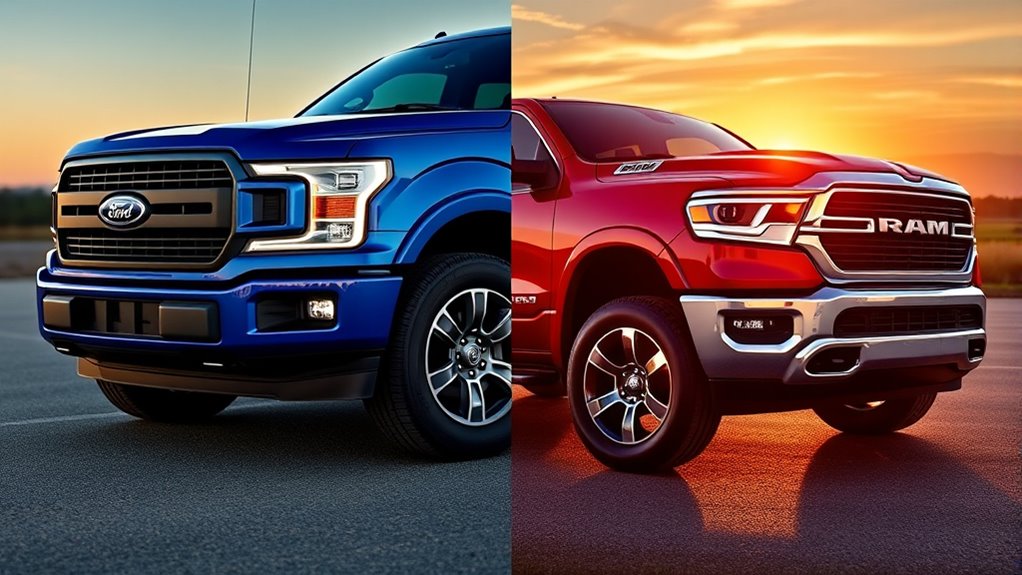

In the 2025 showdown between the Ford F-150 and Ram 1500, you’ll find the F-150 leads in towing power, with capacities up to 13,500 lbs, and offers advanced tech features like BlueCruise. Ram 1500 shines with luxury interiors and a slightly lower starting price. Both trucks offer impressive performance and safety, but if you want maximum strength and cutting-edge tech, the F-150’s got the edge. To uncover more about what makes each truck unique, keep exploring these details.
Key Takeaways
- Ford F-150 offers higher towing capacity (up to 13,500 lbs) and payload (up to 2,455 lbs) compared to Ram 1500’s capabilities.
- F-150’s hybrid PowerBoost engine delivers superior fuel efficiency and more advanced technology features like BlueCruise.
- Ram 1500 excels in interior luxury, materials, and comfort, with premium features and a softer ride.
- The F-150’s faster acceleration and 10-speed transmission provide a smoother, more responsive driving experience.
- Overall, F-150 leads in power, versatility, and tech, while Ram 1500 emphasizes interior quality and luxury for 2025.
Towing Capabilities and Hauling Strength
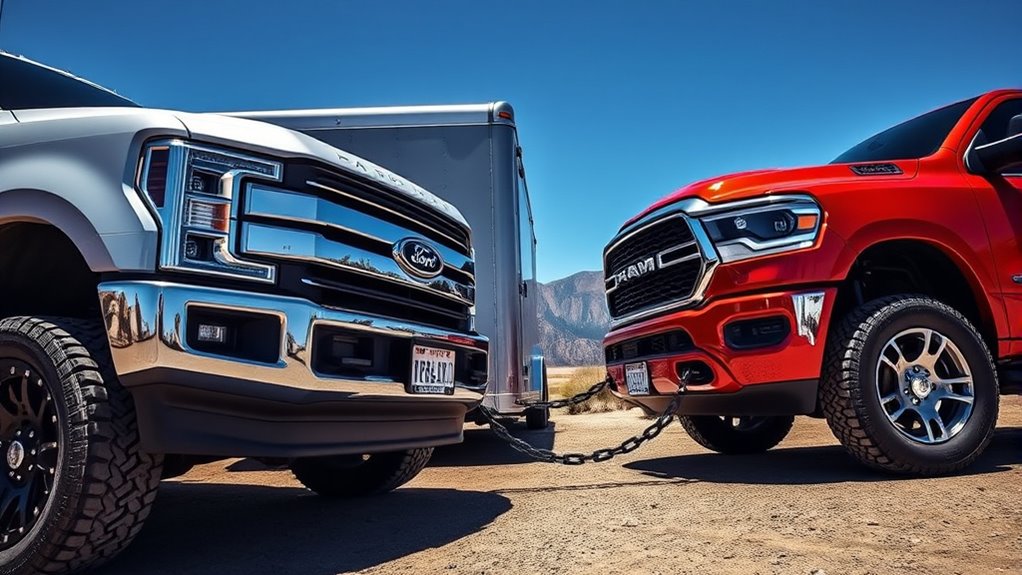
When it comes to towing and hauling, the Ford F-150 clearly outperforms the Ram 1500, making it a better choice for those who frequently tow heavy loads. The F-150’s maximum towing capacity reaches up to 13,500 pounds, surpassing the Ram 1500’s top range of around 12,750 pounds. Even with its standard engine, the F-150 can tow up to 8,400 pounds, compared to the Ram’s 8,110 pounds. This extra towing power stems from its robust engine lineup and stronger chassis, giving you more confidence when hauling trailers, boats, or heavy equipment. The F-150’s superior towing capacity guarantees you’re better equipped for demanding jobs, making it the more practical choice for heavy-duty towing needs. Additionally, understanding towing capacity ratings helps you select the right vehicle for your specific needs. Considering engine performance can further optimize your towing experience and ensure safety and efficiency. Moreover, a comprehensive understanding of vehicle durability can help you choose a truck built to last under demanding conditions. Knowing safety features is also crucial for ensuring secure towing during long hauls and challenging terrains.
Payload Ratings: How Much Can They Carry?
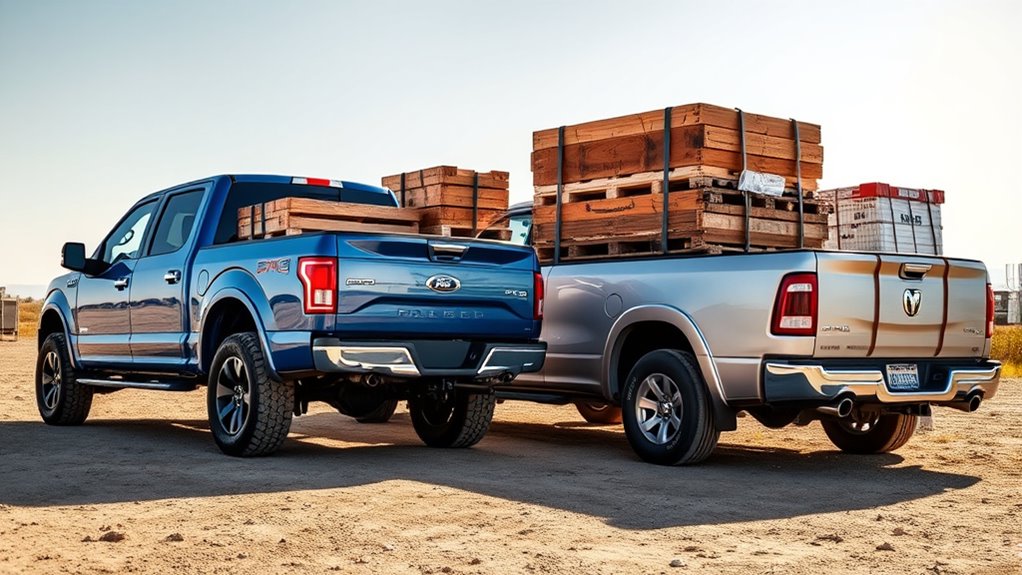
When it comes to payload capacity, you’ll find the Ford F-150 generally offers higher maximum ratings than the Ram 1500. The F-150 can carry up to 2,455 pounds, while the Ram peaks around 2,370 pounds. So, if payload is a priority, the F-150 might be the better choice for your needs. Additionally, considering the safety and maintenance features can help ensure your truck handles heavy loads reliably over time. Proper upkeep and inspections are essential for maintaining payload capacity and overall vehicle longevity. Regular vehicle maintenance can help prevent issues that might reduce payload capacity and ensure the truck performs optimally under heavy loads. Moreover, understanding load distribution is crucial to maximize payload and maintain vehicle stability during heavy hauling. Being aware of vehicle weight ratings and adhering to them can also prevent damage and ensure safe operation when carrying heavy loads.
Max Payload Differences
The Ford F-150 generally outperforms the Ram 1500 in payload capacity, making it the better choice for heavy-duty hauling. Its maximum payload ranges from 2,440 to 2,455 lbs, slightly higher than the Ram’s 2,300 to 2,370 lbs. To visualize, think of these trucks as two strong workers: one lifting more weight comfortably, the other slightly less.
| Feature | Ford F-150 | Ram 1500 |
|---|---|---|
| Max Payload | 2,440–2,455 lbs | 2,300–2,370 lbs |
| Payload (Standard) | Up to 2,440 lbs | Up to 2,370 lbs |
| Payload Difference | Slightly higher | Slightly lower |
| Payload Capacity Range | Broad, versatile | Slightly limited |
| Heavy-duty Use | Better suited | Adequate for lighter loads |
Standard Payload Capabilities
Both the Ford F-150 and Ram 1500 deliver impressive standard payload capacities, making them reliable choices for everyday hauling needs. You can count on these trucks to handle your loads efficiently right out of the gate. The F-150’s standard engine can carry up to 2,440 pounds, slightly edging out the Ram 1500’s 2,370 pounds. Here’s what you can expect:
- Ford F-150: up to 2,440 lbs payload
- Ram 1500: up to 2,370 lbs payload
- F-150 offers higher maximum payload ratings
- Payload remains consistent across various configurations
- Both trucks are suitable for tough jobs and daily tasks
Powertrain Options and Performance Metrics
Powertrain options in the Ford F-150 and Ram 1500 considerably influence their performance capabilities. The F-150 offers a variety of engines, including a 2.7L EcoBoost V6 with 325 hp, and a top-tier 3.5L PowerBoost hybrid delivering up to 700+ hp and 640 lb-ft torque. Its 10-speed automatic transmission enhances efficiency and power delivery. In contrast, the Ram 1500 features a 3.6L Pentastar V6 with 305 hp, and a Hurricane V8 option producing 540 hp and 521 lb-ft torque, paired with an 8-speed automatic. The F-150’s lighter weight and powerful engines translate into impressive acceleration and towing. Both trucks provide options tailored for work and performance, but the F-150’s engine lineup generally offers higher peak horsepower and torque, boosting overall capability and versatility. Engine options play a crucial role in determining each truck’s overall performance and suitability for various tasks. Additionally, advancements in powertrain technology contribute to enhanced fuel efficiency and environmental compliance across both models.
Transmission Systems and Acceleration Benchmarks
The way these trucks shift gears and how quickly they accelerate can substantially impact your driving experience. You’ll notice that the F-150’s 10-speed automatic offers smoother, faster shifts compared to the Ram’s 8-speed. Let’s compare their acceleration times and what that means for performance on the road. Additionally, the transmission systems in each truck are designed to optimize power delivery and efficiency, influencing overall driving dynamics.
Transmission Speed and Shifts
When it comes to transmission speed and shift responsiveness, the Ford F-150’s 10-speed automatic offers quicker, more seamless gear changes compared to the Ram 1500’s 8-speed automatic. You’ll notice smoother acceleration during daily driving and towing, with less lag between shifts. The F-150’s transmission adapts quickly to changing conditions, giving you a responsive feel. In contrast, the Ram 1500’s 8-speed shifts slightly slower, especially during abrupt throttle changes. Modern transmission systems are designed to optimize shifting performance and fuel efficiency.
Acceleration Performance Metrics
Thanks to its 10-speed automatic transmission, the Ford F-150 delivers quicker and smoother acceleration than the Ram 1500’s 8-speed. The additional gears optimize power delivery, making the F-150 feel more responsive off the line and during highway merges. In tested benchmarks, the F-150 hits 0–60 mph in about 5.9 seconds, thanks to its lighter curb weight and more advanced transmission. Meanwhile, the Ram 1500’s 8-speed shifts quickly, but its heavier build results in a slightly slower 0–60 time of around 4.7 seconds. The transmission systems directly impact acceleration, with the F-150’s gear ratios providing better acceleration feel and efficiency at various speeds. Overall, the F-150’s transmission setup offers a refined balance of power and comfort during acceleration.
Technological Features and Driver Assistance

Technological features and driver assistance systems play a crucial role in enhancing safety and convenience in modern trucks. You’ll find the Ford F-150 equipped with SYNC 4, BlueCruise for hands-free highway driving, and Pro Power Onboard for power needs on the job site. The Ram 1500 offers Uconnect, a high-quality interior, and available 360-degree cameras to improve visibility. Both trucks support over-the-air updates, keeping your tech current. F-150 also provides Pro Trailer Backup Assist, simplifying trailer maneuvering. Meanwhile, Ram emphasizes luxury and comfort with premium materials and trims. Here’s what each offers:
- Advanced driver-assistance systems
- Hands-free highway driving
- Over-the-air software updates
- Trailer assistance technology
- High-quality, customizable interior
Additionally, vehicle safety systems are continuously evolving to provide smarter, more reliable assistance features.
Fuel Efficiency and Range for Long Workdays
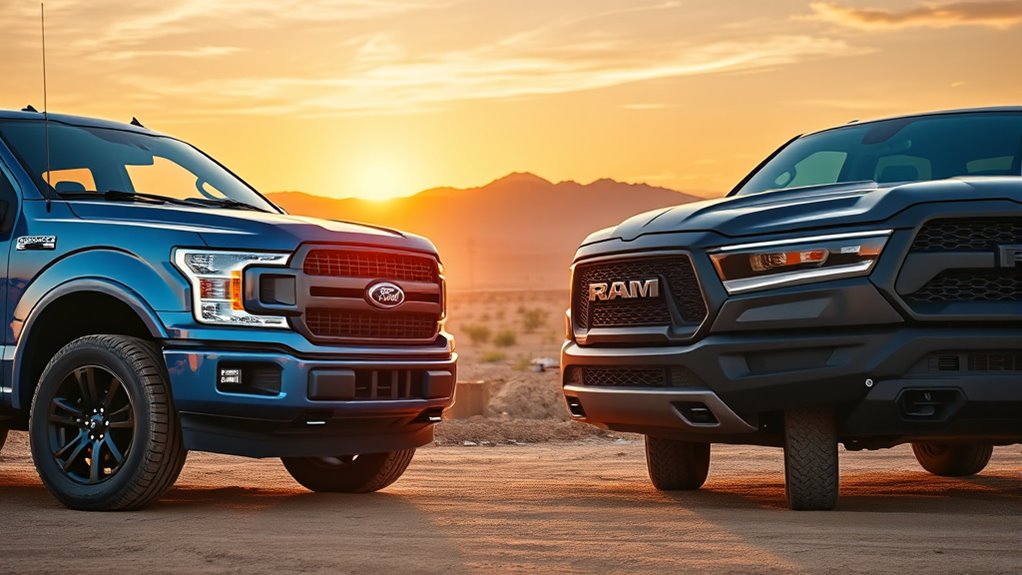
For long workdays, fuel efficiency and range are essential considerations that can impact your productivity and costs. The Ford F-150 PowerBoost Hybrid stands out with up to 25 mpg city and 26 mpg highway, giving you a longer driving range between refills. Its hybrid system provides extra job site power without sacrificing efficiency. The Ram 1500 eTorque offers up to 20 mpg city and 25 mpg highway, resulting in a slightly shorter range but still capable of covering over 500 miles with its large fuel tank. Tests show the F-150 non-hybrid achieves around 20 mpg on the highway, while the Ram hits about 18 mpg. Both trucks deliver impressive range for extended days, but the F-150’s hybrid option gives you a clear advantage on fuel savings. Additionally, considering fuel efficiency can help maximize your vehicle’s performance during long workdays. A thorough understanding of vehicle efficiency features can also contribute to better long-term cost savings and maintenance planning, especially when utilizing advanced fuel-saving technologies to optimize performance. Moreover, being aware of regenerative braking systems can further enhance overall efficiency during daily operations.
Interior Comfort and Luxury Offerings

When it comes to interior comfort and luxury, the Ram 1500 often takes the lead with its high-quality materials and upscale design, making it a standout for those seeking a premium cabin experience. You’ll notice plush leather seats, real wood accents, and thoughtful details that create a refined atmosphere. The Ram also offers advanced features like ventilated seats, a premium audio system, and customizable ambient lighting. Additionally, the use of soft-touch surfaces throughout the cabin, optional massaging front seats, a large, easy-to-use touchscreen with high-resolution display, available leather-wrapped steering wheel, and spacious rear seats with ample legroom. These elements combine to deliver a more luxurious and comfortable interior, elevating your driving experience. For enhanced interior amenities, the Ram 1500 incorporates high-end finishes and innovative features that cater to comfort and convenience. Moreover, the use of premium materials ensures durability while maintaining an upscale appearance, further enhancing the overall cabin ambiance. An emphasis on craftsmanship is evident in the precise stitching and attention to detail, providing an extra touch of sophistication. Comfort-focused features further enhance the cabin’s appeal, making every drive more relaxing.
Price Points and Value for Money
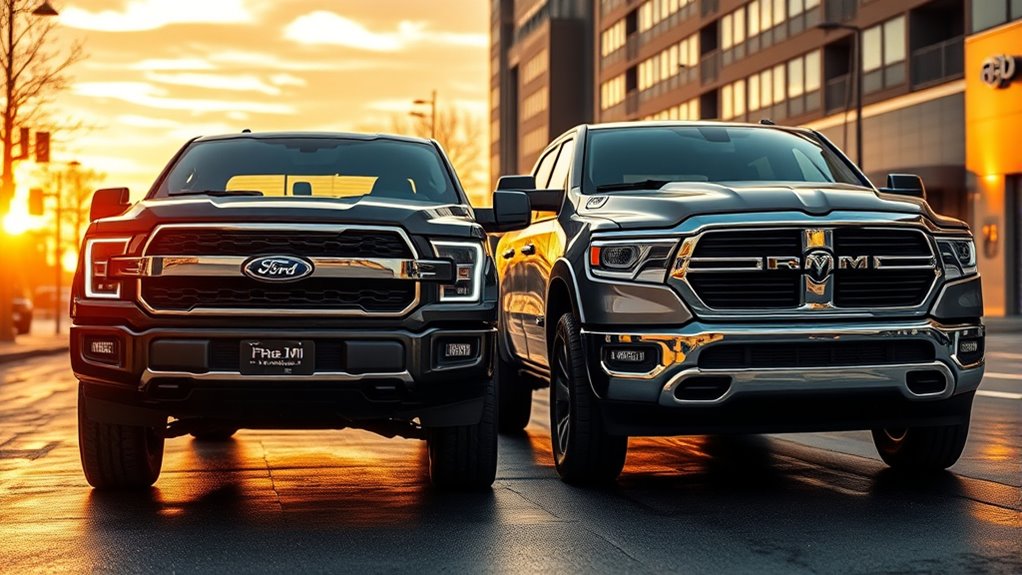
Choosing between the Ford F-150 and Ram 1500 depends heavily on your budget and what you value most in a pickup. The F-150 generally starts at a higher base price but offers more advanced features and higher towing capacity for the money. The Ram 1500’s lower starting price makes it attractive if you seek luxury or interior quality on a budget. Consider this comparison:
| Feature | F-150 | Ram 1500 | Price Range |
|---|---|---|---|
| Base Price | Slightly higher | Slightly lower | $30,000–$50,000 |
| Standard Features | Tech, towing tech | Luxury, interior quality | Varies by trim |
| Max Towing & Payload | Higher | Slightly lower | Investment in capability |
| Overall Value | More tech, power, durability | Comfort, luxury focus | Depends on your priorities |
Your choice hinges on what offers the best value for your needs. Understanding the importance of vehicle features can help you make an informed decision.
Which Truck Stands Out in 2025?
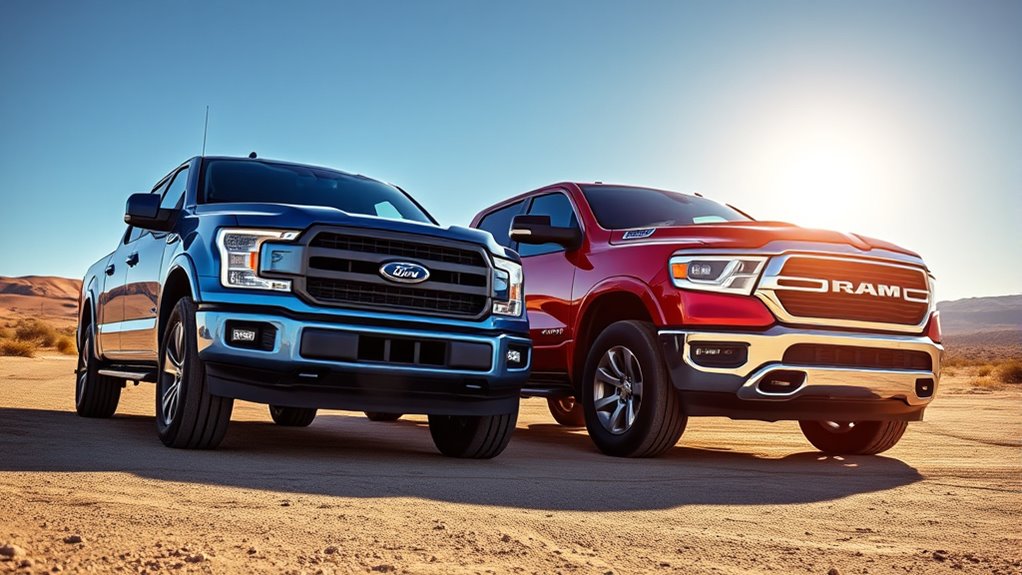
In 2025, the Ford F-150 continues to stand out as the top-performing pickup, thanks to its combination of power, technology, and versatility. You’ll notice its superior towing capacity, with a max of 13,500 lbs, and payload ratings up to 2,455 lbs, outpacing the Ram 1500. Its engine lineup offers higher peak horsepower and torque, including a 720 hp option. The F-150’s advanced tech, like BlueCruise and Pro Power Onboard, keeps it ahead in innovation. Plus, its fuel efficiency, especially the hybrid model, surpasses Ram’s. Consider these highlights:
- Highest towing capacity
- More powerful engine options
- Cutting-edge driver-assist tech
- Better payload ratings
- Superior hybrid fuel economy
Frequently Asked Questions
Which Truck Offers Better Off-Road Capabilities in 2025?
You’ll find the Ford F-150 offers better off-road capabilities in 2025. Its available Raptor models come equipped with specialized off-road features like FOX Racing shocks, skid plates, and terrain management systems, making it more capable on tough trails. While Ram 1500 has luxury and comfort, the F-150 Raptor is designed for serious off-road adventures, giving you confidence and control even in rugged conditions.
How Do Maintenance Costs Compare Between the F-150 and Ram 1500?
You’ll likely find maintenance costs are similar between the F-150 and Ram 1500, but the F-150 may be slightly cheaper to maintain due to its widespread parts availability and simpler design. Ford’s extensive dealer network makes repairs more accessible and affordable. Ram trucks might have higher costs for specialized parts or luxury trims, but overall, both trucks are comparable in maintenance expenses, especially if you keep up with regular service.
What Are the Key Differences in Their Warranty Coverage?
You’ll find that Ford offers a basic warranty with 3 years or 36,000 miles of bumper-to-bumper coverage and 5 years or 60,000 miles for powertrain. Ram provides similar bumper-to-bumper coverage for 3 years or 36,000 miles but extends its powertrain warranty to 5 years or 100,000 miles. The Ram warranty generally offers longer coverage, giving you extra peace of mind for the long haul.
Which Model Has More Customizable Options and Packages?
You’ll find the Ford F-150 offers more customizable options and packages, giving you greater flexibility to tailor your truck to your needs. It has a wider selection of trims, tech upgrades, and off-road packages, plus available features like Pro Power Onboard and BlueCruise. Ram 1500 provides luxury-focused packages and interior options, but the F-150’s broader range of customization makes it easier for you to build the perfect truck for work or leisure.
How Do Resale Values Compare for Both Trucks in 2025?
Think of resale value like a mirror reflecting a truck’s reputation. In 2025, the Ford F-150 generally holds its value better than the Ram 1500, thanks to its wider appeal, stronger brand loyalty, and proven durability. You’ll find F-150s retain more of their original price, making them a smarter investment long-term. Ram trucks, while still valuable, tend to depreciate slightly faster, but they offer luxury and comfort that some buyers prioritize.
Conclusion
In this fierce face-off, Ford’s formidable finesse meets Ram’s rugged reliability. Whether you’re after powerful payloads, premium comfort, or cutting-edge tech, both trucks deliver dazzling options. But, if you want the winning combination of workhorse might and luxury, this showdown helps you decide. Remember, your perfect pick depends on your priorities. So, choose confidently, consider carefully, and conquer confidently—because when it comes to pickups, power, performance, and prestige reign supreme!