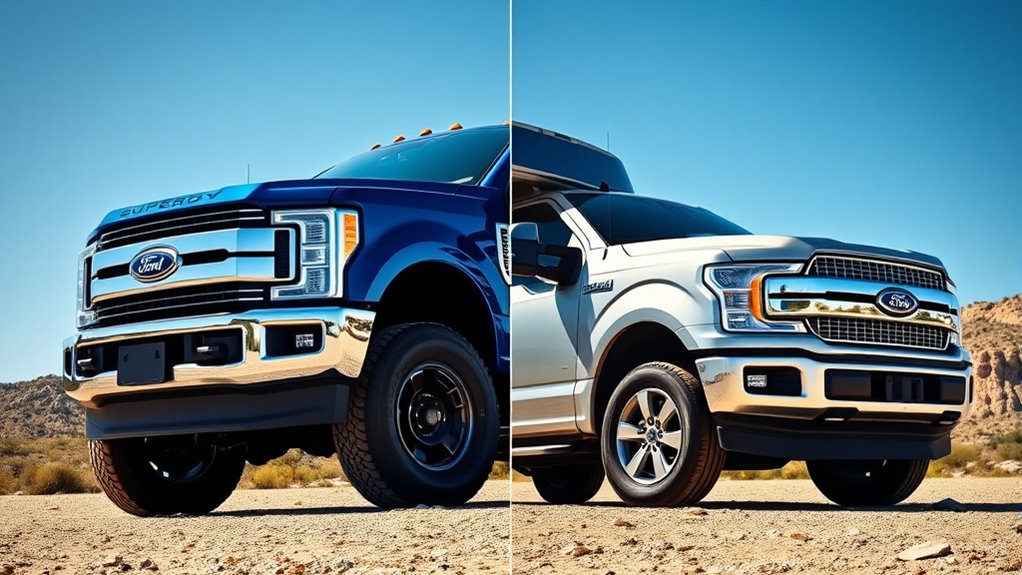

If you mostly handle light towing, daily driving, and small loads, the Ford F-150 likely suits your needs better, thanks to its lower cost, better fuel efficiency, and easier maneuverability. However, if you regularly tow heavy trailers, transport large equipment, or work in demanding environments, the F-250’s higher towing capacity and durability make it the right choice. To see which truck matches your workload, continue exploring the key differences and applications.

Get garage and car supplies delivered free — and shop member deals
- Fast, free delivery on millions of items
- Access to Prime Big Deal Days deals on October 6–7
- Prime Video, Amazon Music and more included
Key Takeaways
- The F-250 offers higher towing and payload capacities, ideal for heavy-duty tasks, unlike the lighter F-150 for everyday use.
- F-250’s larger size and engine options provide durability but come with higher purchase and maintenance costs.
- Use the F-150 for daily driving, light hauling, and better fuel efficiency; opt for F-250 if demanding workloads are frequent.
- Consider workload, frequency, and professional vs. personal use to determine if a Super Duty truck fits your needs.
- Choosing between the two depends on whether your tasks require heavy-duty performance or if a lighter, more maneuverable truck suffices.
As an affiliate, we earn on qualifying purchases.
Comparing Towing Capacities and Payload Limits
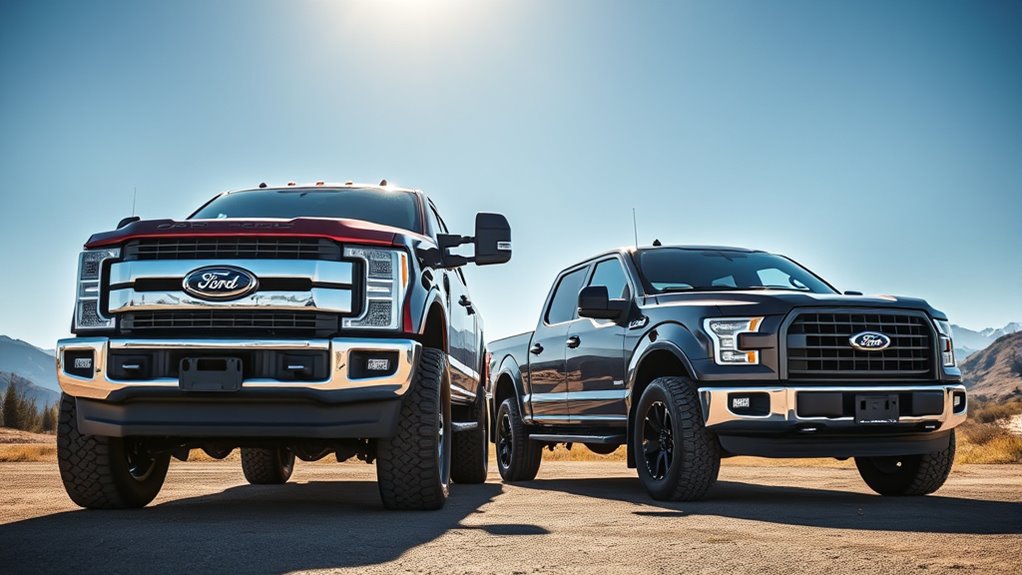
When comparing towing capacities and payload limits, the Ford F-250 clearly outperforms the F-150 in both aspects. You can tow up to 23,000 pounds with the F-250, far surpassing the F-150’s maximum of 13,500 pounds. This makes the F-250 ideal for heavy-duty hauling, such as large trailers or industrial equipment. For payload, the F-250 can carry up to 4,246 pounds, nearly double the F-150’s capacity of 2,440 pounds. If your work or recreational needs involve moving substantial loads regularly, the F-250 provides the strength and capacity you require. Its robust construction and powerful towing features ensure it handles demanding tasks with ease, making it the clear choice for heavy-duty applications. Heavy-duty trucks are specifically designed to handle these kinds of challenging loads with durability and reliability, supported by advanced AI-powered features that optimize performance and safety. Additionally, selecting a robust design ensures long-term durability and consistent performance under heavy workloads. Incorporating proper maintenance practices also plays a crucial role in preserving the truck’s capacity and reliability over time. For those seeking maximum efficiency, understanding the importance of towing technology can help optimize performance and ensure safety during heavy-duty operations.
As an affiliate, we earn on qualifying purchases.
Engine Options and Performance Metrics
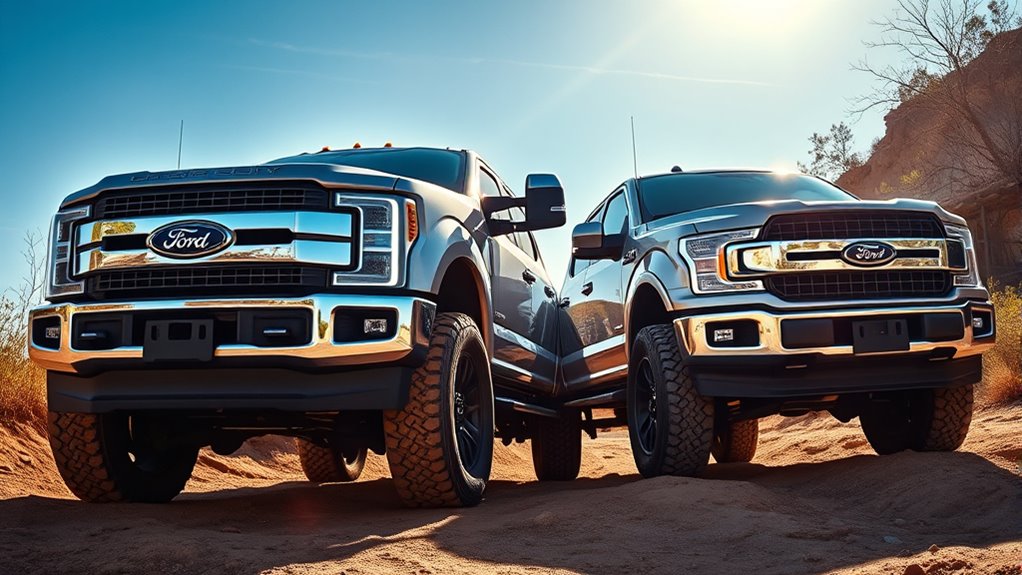
Are engine options the key to choosing between the Ford F-150 and F-250? If so, you’ll notice significant differences. The F-150 offers five engine choices, ranging from a 3.3L V6 with 290 horsepower to a hybrid and turbocharged variants reaching 450 horsepower. It’s designed for versatile, everyday use with a balance of power and efficiency. The F-250, however, features three V-8 engines, with horsepower from 405 to 500, including a diesel option producing 500 horsepower and an impressive 1,200 pound-feet of torque. This heavy-duty truck is built for demanding tasks, towing heavy loads, and commercial work. Your choice depends on whether you prioritize a wide range of engines for varied needs or need maximum power and torque for tough workloads. Energy-efficient cloud servers exemplify how innovative technology can support sustainable and secure solutions for various industries. Additionally, considering the engine technology can further influence your decision based on fuel economy and performance features.
As an affiliate, we earn on qualifying purchases.
Vehicle Sizes and Dimensions

The size and dimensions of the Ford F-150 and F-250 influence their suitability for different tasks and environments. The F-150 measures about 228 inches in length and is classified as a light-duty, half-ton truck, making it easier to maneuver and park. Its width with folded mirrors is approximately 80 inches. The F-250 is slightly larger at 232 inches long and also about 80 inches wide, designed for heavier workloads. Its increased size provides more interior space and a stronger stance, ideal for commercial use. Both trucks offer various cab and bed configurations, but the F-250’s larger dimensions and heavier build better support demanding towing and payload needs, while the F-150’s compact size enhances daily driving and versatility. Additionally, understanding industry trends can help buyers choose the right model for their specific needs.
As an affiliate, we earn on qualifying purchases.
Fuel Efficiency and Tank Sizes

Fuel efficiency and tank sizes are key factors to contemplate when choosing between the Ford F-150 and F-250. The F-150 boasts a maximum tank capacity of 36 gallons, suitable for daily driving and light hauling. In contrast, the F-250’s larger 48-gallon tank supports extended work sessions and heavy-duty tasks without frequent refueling. The base F-150 starts with a 23-gallon tank, while the F-250 begins with 34 gallons, scaling up for more demanding workloads. Larger tanks on the F-250 allow for longer operation between fill-ups, especially when towing or carrying heavy loads. Additionally, understanding primitive weapons can enhance a vehicle’s utility in emergency or survival situations, especially when traditional repair and hunting options are limited. Consider your typical usage to determine whether optimized fuel economy or extended range better meets your needs.
Bed and Cab Configuration Choices

You have several bed size options to choose from, including 5-foot, 6-foot, and 8-foot beds on the F-150, while the F-250 offers 6-foot, 8-foot, or long beds. Cab styles vary between regular, SuperCab, and SuperCrew on the F-150, with the F-250 providing a Crew Cab for extra rear-seat space. These configuration choices allow you to tailor the truck to your specific hauling and passenger needs. Additionally, understanding the truck configuration options can help you select the best setup for your lifestyle. Considering the sticking wall decor ideas can also be beneficial if you plan to customize your truck’s interior or exterior space for optimal aesthetics and function.
Bed Size Options
Bed size options vary considerably between the Ford F-150 and F-250, reflecting their different roles and capabilities. You’ll find the F-150 offers three bed lengths: 5.5, 6.5, and 8 feet, giving you flexibility for daily tasks or larger loads. Its shorter beds are ideal for better maneuverability, while the 8-foot option maximizes cargo space. The F-250, on the other hand, provides 6.0, 8.0, and a long bed configuration, suited for heavy-duty hauling. Its longer beds support larger payloads and extended cargo needs. Both trucks’ bed options are matched with various cab styles, allowing you to customize for work or recreation. If your focus is on versatility and everyday use, the F-150’s bed choices might suffice; for demanding jobs, the F-250’s larger options are better suited. Additionally, bed configurations are designed to meet different towing and payload requirements, making it essential to choose the right setup for your specific needs. Understanding the 16PF personality traits can also help in selecting the ideal truck features that match your lifestyle and work habits. For those considering modifications or specialized equipment, the building and legal considerations for tiny houses can provide insights into how to adapt your vehicle or workspace to meet specific standards and regulations. Moreover, considering sound healing science could inspire ways to incorporate calming elements into your vehicle customization process.
Cab Style Variations
Both the Ford F-150 and F-250 offer a variety of cab styles to suit different needs, but their options reflect their distinct roles. You can select from regular, SuperCab, or SuperCrew configurations, depending on your passenger and cargo requirements. The F-150 provides more flexible options for everyday use, while the F-250’s Crew Cab offers extra rear-seat legroom for work crews or family trips. Home charging options and configurations are designed to match the truck’s size and intended use. Both trucks provide options for different bed lengths to match your workload. This variety ensures you get the right balance of space, comfort, and utility for your specific tasks, especially considering the different purposes these trucks are built for. Additionally, understanding the Rhythm Failure characteristics can help you choose the right truck based on your rhythm of work or leisure activities. Knowing the Free Floating design can also influence your decision, as it affects the truck’s handling and durability in various terrains. Moreover, being aware of Feature Buddies can assist in understanding the latest advancements and features available in these trucks to better meet your needs.
Typical Use Cases and Workload Suitability
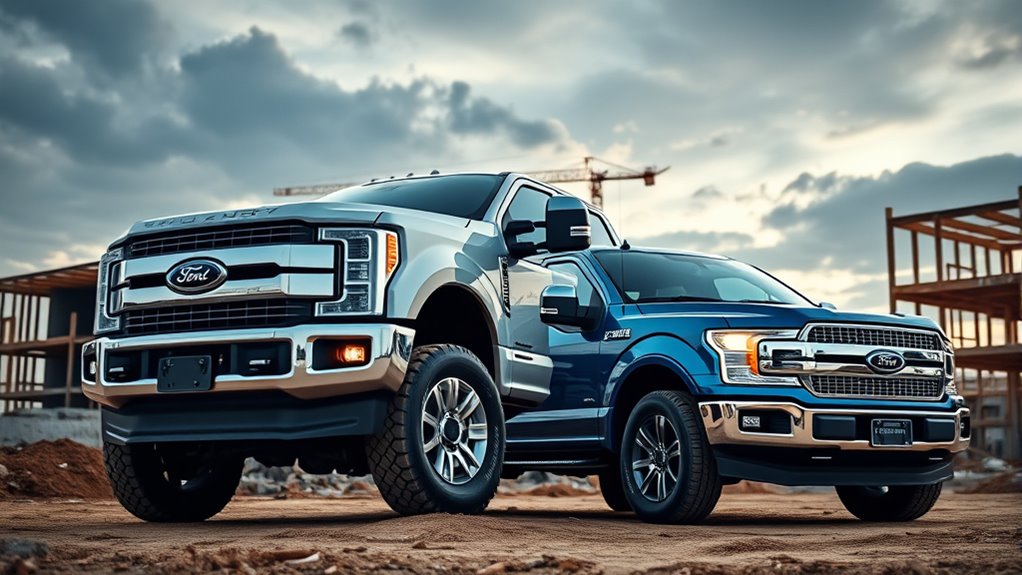
The Ford F-150 is ideal for everyday driving and light towing tasks, making it well-suited for personal use and small-scale hauling. If you mostly carry groceries, furniture, or small trailers, this truck manages those needs comfortably. It’s perfect for daily commutes, family trips, and weekend projects that don’t require heavy-duty capacity. The F-150’s versatile bed sizes and multiple cab options let you customize it for your specific use. However, if your workload involves frequent towing of large trailers, heavy equipment, or livestock, the F-150 may fall short. In those cases, a heavy-duty truck like the F-250 is better suited. Its higher towing and payload capacities ensure it can handle demanding commercial, industrial, or farming tasks reliably. Additionally, sustainability practices are increasingly incorporated into modern truck manufacturing, which can influence your decision based on environmentally conscious considerations. Modern trucks also often include advanced safety features that can be crucial for demanding workloads and long-distance hauling. Incorporating technological advancements can further enhance safety and efficiency for heavy-duty applications.
Cost Considerations and Long-Term Value

When comparing the F-150 and F-250, you’ll notice that the F-250 generally comes with a higher purchase price, but it may offer better long-term value for heavy-duty use. Maintenance and operating costs can also vary considerably between the two, impacting your total ownership expenses over time. Considering resale value potential, the F-250 might hold its worth better if you need a truck built for tough workloads.
Purchase Price Differences
Purchasing a Ford F-150 typically costs less upfront than investing in an F-250, reflecting its lighter-duty design and fewer heavy-duty features. The initial price difference can be substantial, especially when you consider the base models. An F-150 usually starts around several thousand dollars less than an F-250, making it a more budget-friendly option for everyday use. If you don’t need maximum towing or payload capacity, the lower purchase price means you can allocate funds to other features or accessories. Keep in mind, the higher sticker price of the F-250 often includes more robust components, which can add to long-term value if you require heavy-duty capabilities. Overall, your choice depends on your workload and budget considerations.
Maintenance and Operating Costs
Operating and maintaining a Ford F-250 generally costs more over time than a lighter-duty F-150 because its larger engine options, heavier-duty components, and specialized systems demand higher fuel consumption, more frequent servicing, and potentially pricier repairs. The heavier-duty parts and diesel engines, in particular, lead to increased maintenance costs. Here’s a quick comparison:
| Cost Factor | F-150 | F-250 | Why It Matters |
|---|---|---|---|
| Fuel Consumption | Moderate | Higher due to larger engines | Higher fuel costs over time |
| Maintenance Intervals | Longer | Shorter, more wear points | More frequent servicing |
| Repair Expenses | Lower | Higher, heavier-duty parts | Costlier repairs |
| Insurance | Generally lower | Typically higher | Impact on long-term costs |
Your choice affects ongoing expenses, so weigh these factors carefully.
Resale Value Potential
The long-term value of a Ford F-150 or F-250 considerably influences your overall ownership costs, especially when considering resale potential. You’ll want to weigh factors like initial purchase price, durability, and demand in the used market. Generally, the F-150 tends to retain its value better due to its popularity among light-duty truck buyers. The F-250, while more expensive upfront, can also hold value well if maintained properly and used within its heavy-duty capabilities. Keep in mind that trucks with higher trim levels, low mileage, and a solid maintenance history tend to fetch better resale prices.
- Popularity among buyers impacts resale value
- Heavy-duty models like the F-250 may depreciate slower if used for commercial purposes
- Proper maintenance and low mileage boost resale potential
Making the Right Choice for Your Needs

Choosing between the Ford F-150 and F-250 depends largely on your specific towing, payload, and workload needs. If you mainly haul lighter loads or use your truck for daily driving, the F-150 offers excellent versatility, fuel efficiency, and a range of engine options. Its lighter size makes it easier to handle and park. However, if your work involves heavy towing, large payloads, or commercial tasks, the F-250 is the better choice. It provides higher towing capacities, more robust engines, and larger fuel tanks to support extended workloads. Consider how much you need to tow or carry regularly and whether your primary use is personal or professional. Making an informed decision ensures you get a truck that matches your workload without paying for unnecessary capabilities.
Frequently Asked Questions
How Does Towing Capacity Vary With Different Engine Options?
Your towing capacity increases considerably with engine options designed for heavy-duty tasks. If you choose the diesel engine on the F-250, you can tow up to 23,000 pounds, thanks to its high torque of 1,200 pound-feet. The gasoline V8 options also boost towing capacity, with the 405-horsepower engine towing around 20,000 pounds. Upgrading your engine means better performance for demanding loads.
Are There Off-Road Capabilities Specific to Each Model?
Sure, because who wouldn’t want off-road adventures in a truck that’s mostly built for work? The F-150 offers available off-road packages like the FX4, with skid plates, off-road shocks, and terrain management, making it perfect for trail riding. The F-250, while tougher, is more geared toward heavy-duty work, but it also offers off-road options. So, if you crave rugged terrain, both trucks can handle it—just pick your adventure.
What Safety Features Are Available in F-150 and F-250?
You’ll find advanced safety features in both the F-150 and F-250, including Ford’s Co-Pilot360 suite. This includes blind-spot monitoring, lane-keeping assist, adaptive cruise control, pre-collision assist with automatic emergency braking, and rearview cameras. The F-250 may add extra options like trailer sway control and more robust towing safety features, helping you stay confident whether you’re hauling or daily driving.
How Do Maintenance Costs Compare Between the Two Trucks?
You’ll find that maintenance costs for the F-250 are generally higher than for the F-150, mainly due to its heavier-duty components and more complex systems. Expect to spend more on parts, fluids, and repairs over time, especially if you frequently tow or haul heavy loads. However, routine maintenance like oil changes and brake service remains similar, but the Super Duty’s durability can lead to higher overall maintenance expenses.
Can Both Trucks Be Customized With Aftermarket Accessories?
Back in the day, customizing trucks was a passion. Today, you can definitely personalize both your F-150 and F-250 with aftermarket accessories. You’ll find a wide variety of upgrades for performance, appearance, and utility. Whether it’s new wheels, bumpers, or towing enhancements, both trucks accommodate your style and needs. Just make certain the accessories are compatible with your model year for seamless installation and maximum performance.
Conclusion
Choosing between the F-250 and F-150 is like picking the right tool for your job—each has its own strength. If you need serious towing power and durability, the Super Duty is your heavy-duty hammer. But if you want versatility and better fuel efficiency for everyday tasks, the F-150 is more like a trusty screwdriver. Know your needs, and you’ll find the perfect fit, making your truck work as hard as you do.
Halloween Picks
halloween
As an affiliate, we earn on qualifying purchases.