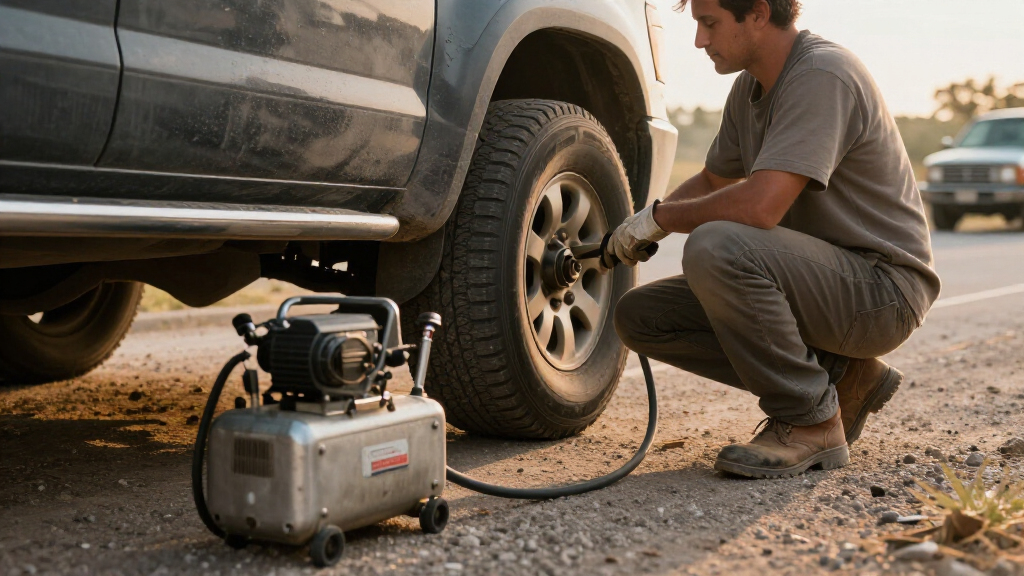

For most truck owners, I’d start with the VIAIR 88P, a 12V compressor kit built around vehicle power and a more substantial truck-tire use case. The ETENWOLF Vortex S6 stands out for cordless convenience, while the Asani 12V Dual Cylinder is a strong candidate for buyers who prioritize a twin-cylinder design. The key tradeoff is between cord-free portability and the sustained power, duty cycle, and vehicle connection a larger tire may demand. I compare all 15 options by their intended use, power setup, and practical limitations below. Read on for the full breakdown and guidance on matching a compressor to your truck and tire size.

Get business pricing on garage and car supplies
- Business-only prices and quantity discounts
- Tax-exempt purchasing
- Multiple users, one account, clear invoices
Complete the kit


Key Takeaways
- Vehicle-powered models lead for regular truck use: The VIAIR 88P, Asani, GSPSCN, and UUP use 12V power, making them more aligned with buyers who expect to inflate larger tires from a vehicle rather than rely only on a small battery.
- Cordless convenience comes with a runtime tradeoff: The ETENWOLF Vortex S6 and OlarHike battery models simplify roadside use, but buyers should check whether the battery can handle their tire size and number of tires per charge.
- Dual-cylinder designs prioritize output over compactness: Asani, UUP, GSPSCN, and the 6X model make speed a central selling point, while single-unit inflators such as the AstroAI AIRUN H are easier to store but less focused on sustained truck-tire work.
- Power flexibility separates garage-friendly picks: AstroAI’s 12V DC/120V AC model and OlarHike’s dual-power version can work across more settings than a vehicle-only compressor, at the cost of more power-source planning or bulk.
- Tool-only compatibility can change the real value: The DEWALT 20V MAX inflator makes the most sense for buyers who already own compatible batteries; those without them should compare the complete setup against a self-contained or vehicle-powered option.


| portable air compressors for truck | Maximum pressure | Airflow | Weight | Dimensions |
|---|---|---|---|---|
| AstroAI AIRUN H Tire Inflator | 100 psi | 35 L/min | 800 g | 6.8 × 3.9 × 8.4 in |
| Asani 12V Air Compressor | 150 psi | 70 L/min | 6.8 lb | 8.7 × 3.1 × 6 in |
| ETENWOLF Vortex S6 Tire Inflat | 160 psi | 42 L/min | 6 lb | — |
| GSPSCN 12V Heavy Duty Tire Inf | 150 psi | 70 L/min | 6 lb | — |
| OlarHike 12000mAh Heavy Duty T | 150 psi | 50 L/min | 3.2 lb | 7.3 × 3.8 × 2.5 in |
| UUP Portable 12V Air Compresso | 150 PSI | 70 L/min | 3 kg | 8.66 × 3.15 × 7.1 in |
| ETENWOLF Vortex S6 Tire Inflat | 160 PSI | 1.5 CFM at 0 PSI | — | — |
| Tire Inflator Portable Air Com | 150 PSI | 35 L/min | — | 4.5 × 3 × 8 in |
| AstroAI Tire Inflator Portable | 150 PSI | 350 L/min, as listed | — | 11.8 × 10.2 × 6.3 in |
| Craftsman Portable 12V Tire In | 150 PSI | — | 1.13 kg | — |
| OlarHike Tire Inflator Portabl | 51 PSI | — | 1.2 pounds | 6.5 x 2.76 x 2.17 inches |
| VIAIR 88P 12V Portable Air Com | 120 PSI | 1.47 CFM | 4.75 pounds | 9.8 x 3.2 x 5.6 inches |
| Dewalt Tire Inflator Portable | 80 PSI | — | 6.4 pounds | 12.97 x 10.22 x 5.59 inches |
| ROCGORLD R8 Tire Inflator Port | 150 PSI | 40 liters per minute | 2.2 pounds | 6.49 x 2.79 x 4.92 inches |
| Dual Cylinder 6X Fast Tire Inf | 160 PSI | 45 liters per minute | 610 grams | 5.98 x 2.09 x 2.99 inches |
More Details on Our Top Picks
AstroAI AIRUN H Tire Inflator Portable Air Compressor with Digital Pressure Gauge and LED Light
The AstroAI AIRUN H suits truck owners who want a small emergency inflator for topping up a tire, rather than a compressor for repeated heavy-duty work. At 800 g with a stated airflow of 35 L/min, it is far lighter and easier to stow than the Asani 12V double-cylinder unit, though its lower airflow and 100 psi ceiling leave less headroom for truck tires. The digital gauge and auto shut-off help make routine pressure corrections straightforward, while the LED light is useful during roadside checks after dark. It runs only from a 12V DC outlet, and extended use calls for cooling time. I would choose it for occasional tire maintenance and compact storage, but skip it if you need to inflate several large tires in succession or run equipment away from a vehicle.
Pros:- At 800 g, it is notably easier to store and carry than the 6-pound GSPSCN.
- Auto shut-off and a digital pressure gauge simplify routine inflation.
- Built-in LED light supports roadside use in low visibility.
- Multiple nozzles add flexibility for smaller tires and accessories.
Cons:- The 100 psi maximum provides less pressure headroom than the other listed truck-focused inflators.
- Requires a 12V DC vehicle outlet, limiting use away from a suitable power source.
- Needs a cooling period after extended operation.
Best for: Truck owners seeking a lightweight, glove-box-sized inflator for occasional tire top-ups and roadside emergencies.
Not ideal for: Drivers who regularly inflate large truck tires or several tires back-to-back; its 100 psi limit, modest airflow, and cooling requirement make it a less capable workhorse than the Asani or GSPSCN.
- Power:120 W
- Power source:12V DC
- Maximum pressure:100 psi
- Airflow:35 L/min
- Hose length:3 m
- Weight:800 g
- Dimensions:6.8 × 3.9 × 8.4 in
- Additional features:Auto shut-off, LED light, multiple nozzles, overheat protection
Our verdict“Choose the AstroAI AIRUN H for a compact, occasional-use truck emergency inflator, not for frequent heavy-tire work.”
Asani 12V Air Compressor, 150 PSI Portable Double Cylinder Tire Inflator
The Asani 12V double-cylinder inflator prioritizes faster tire inflation and a ready-to-go kit over cordless convenience. Its listed 70 L/min airflow and 150 psi maximum give it more capacity on paper than the compact AstroAI AIRUN H, making it a stronger fit for truck owners who need to correct pressure without carrying a larger shop compressor. The 11.5-foot hose gives more reach around a vehicle, and the included extensions, nozzles, fuse, cables, and travel bag reduce the need to assemble a kit separately. The tradeoff is dependence on a 12V power source, plus a 6.8-pound body that is less convenient to carry than the AstroAI. Its compact form also does not make it a continuous-duty compressor; I would avoid treating it as one for repeated fleet or heavy-work use.
Pros:- Listed 70 L/min airflow is higher than the AstroAI AIRUN H’s 35 L/min.
- The 11.5-foot hose offers useful reach around a truck.
- Kit includes an extension hose, nozzles, fuse, cables, and travel bag.
- 150 psi maximum gives it more pressure headroom than the AstroAI.
Cons:- Requires a 12V power source, so it cannot work independently of a vehicle or compatible supply.
- At 6.8 pounds, it is considerably heavier than the AstroAI AIRUN H.
- Compact construction may not suit extended, repeated heavy-duty inflation.
Best for: Truck and SUV owners who want a portable 12V tire inflator with a long hose and accessories included for roadside pressure corrections.
Not ideal for: Buyers who need cordless operation, sustained inflation across many tires, or pressure beyond 150 psi.
- Power source:12V
- Maximum pressure:150 psi
- Airflow:70 L/min
- Hose length:11.5 ft
- Weight:6.8 lb
- Maximum power:0.2 hp
- Dimensions:8.7 × 3.1 × 6 in
- Additional features:Double cylinder, digital functions, LED light, travel kit
Our verdict“Pick the Asani if you want a well-equipped 12V compressor with higher listed airflow than the compact AstroAI and do not need cordless power.”
ETENWOLF Vortex S6 Tire Inflator Portable Air Compressor, Cordless Air Pump
The ETENWOLF Vortex S6 is the clearest choice here for drivers who do not want to keep an inflator tethered to a truck outlet. Its 19,200 mAh battery and cordless design make it easier to reach all four tires or handle a pressure check away from the vehicle, while its 160 psi maximum exceeds the 150 psi ceilings listed for the Asani and GSPSCN. The stated 42 L/min airflow is lower than those two corded double-cylinder options, so cordless convenience does not mean it leads the group on airflow. Automatic stop and preset modes reduce guesswork, and the LED light helps with nighttime use. At six pounds, it is not featherweight, and battery runtime can vary under heavy use. I would choose it for mobility, not for a long run of demanding inflation jobs.
Pros:- Cordless operation avoids dependence on a truck outlet during use.
- The 19,200 mAh battery supports portable operation.
- 160 psi maximum is higher than the Asani and GSPSCN’s listed 150 psi.
- Automatic stop, preset modes, and LED light support easier roadside use.
Cons:- Its 42 L/min airflow is below the 70 L/min listed for the Asani and GSPSCN.
- Battery runtime may vary with heavy use, making long inflation sessions less predictable.
- At 6 pounds, it is not the lightest portable option.
Best for: Truck owners who want a cordless inflator for pressure checks at all four wheels, roadside use, or trips where outlet access is inconvenient.
Not ideal for: Drivers who routinely inflate many heavy-duty tires in one session or prefer a lighter unit; battery runtime under heavy use and its six-pound weight may be limiting.
- Power source:Battery powered, cordless
- Battery capacity:19,200 mAh
- Maximum pressure:160 psi
- Airflow:42 L/min
- Weight:6 lb
- Noise:78 dB
- Additional features:Automatic stop, preset modes, LED light
Our verdict“Choose the Vortex S6 when cordless reach matters more than maximum listed airflow or the lightest carry weight.”
GSPSCN 12V Heavy Duty Tire Inflator Metal Portable Air Compressor Pump
For drivers who favor a more substantial 12V setup over battery portability, the GSPSCN double-cylinder compressor offers a practical balance of stated airflow and metal construction. Its 70 L/min airflow matches the Asani, while the 150 psi maximum and 11.5-foot hose suit roadside tire work on trucks and other vehicles. The metal build gives it a more work-oriented character than the lightweight AstroAI AIRUN H, but that comes with a 6-pound weight and the need to connect to a 12V source. Its listed 70 dB noise level is lower than the Vortex S6’s 78 dB, though the GSPSCN gives up the ETENWOLF’s cordless convenience. I would favor it for a vehicle kit that stays with the truck; buyers wanting grab-and-go use or battery independence should look elsewhere.
Pros:- Listed 70 L/min airflow matches the Asani and exceeds the AstroAI AIRUN H.
- Metal construction suits a more work-focused vehicle kit.
- The 11.5-foot hose provides reach around a truck.
- Listed 70 dB noise is lower than the ETENWOLF Vortex S6’s 78 dB.
Cons:- Requires a 12V vehicle connection rather than offering cordless operation.
- At 6 pounds, it is less convenient to carry than the AstroAI AIRUN H or OlarHike.
- Its 150 psi maximum may not meet needs above that pressure.
Best for: Truck owners who keep a 12V compressor in the vehicle and value metal construction, a long hose, and strong listed airflow.
Not ideal for: Drivers seeking a cordless unit, a very light emergency inflator, or pressure above 150 psi.
- Power source:12V
- Maximum pressure:150 psi
- Airflow:70 L/min
- Maximum power:240 W
- Hose length:11.5 ft
- Weight:6 lb
- Noise:70 dB
- Construction:Metal
Our verdict“Choose the GSPSCN for a metal-built, 12V truck compressor with 70 L/min listed airflow, provided cordless use is not a priority.”
OlarHike 12000mAh Heavy Duty Tire Inflator Portable Air Compressor
The OlarHike 12000mAh stands out for combining battery operation with a 12V car-adapter option, giving truck owners a fallback when the battery needs recharging. At 3.2 pounds, it is easier to carry than the six-pound Asani and GSPSCN, and its 50 L/min listed airflow sits between their 70 L/min figures and the AstroAI AIRUN H’s 35 L/min. That makes it a flexible middle ground for routine tire corrections rather than the airflow leader. The 150 psi maximum, digital gauge, safety protections, and LED light add useful truck-kit features, while the 31.5-inch hose is shorter than the Asani and GSPSCN hoses. Battery capacity may limit consecutive tire fills, so I would use the 12V mode for longer sessions and keep the unit charged for cordless jobs.
Pros:- Dual battery and 12V power modes offer more flexibility than the corded Asani or GSPSCN.
- At 3.2 pounds, it is lighter than those two six-pound compressors.
- Listed 50 L/min airflow exceeds the AstroAI AIRUN H’s 35 L/min.
- Digital gauge, LED light, and safety protections support roadside use.
Cons:- Its 50 L/min airflow is below the Asani and GSPSCN’s listed 70 L/min.
- Battery life may limit consecutive tire inflation, so extended sessions may call for 12V power.
- The 31.5-inch hose is shorter than the 11.5-foot hoses on the Asani and GSPSCN.
Best for: Truck owners who want a lighter inflator that can work cordless for quick checks and switch to a 12V adapter when battery power is low.
Not ideal for: Drivers who need maximum airflow for repeated large-tire inflation or a longer hose to reach around a truck.
- Battery capacity:12,000 mAh
- Power options:Battery powered and 12V car adapter
- Maximum pressure:150 psi
- Airflow:50 L/min
- Hose length:31.5 in
- Weight:3.2 lb
- Maximum power:190 W
- Maximum current:13 A
- Dimensions:7.3 × 3.8 × 2.5 in
Our verdict“Choose the OlarHike for a lighter, flexible truck-kit inflator if you value dual power more than top-of-line airflow or hose reach.”
UUP Portable 12V Air Compressor, 150 PSI Tire Inflator with Dual Cylinders
The UUP’s dual cylinders and listed 70 L/min airflow make it a strong fit for truck owners who want quicker tire top-ups from a 12V source. Its battery clamps offer a practical alternative when a truck’s accessory outlet is not the preferred power connection, while the 3 kg body and storage bag help keep it manageable in a vehicle. Compared with the cordless ETENWOLF Vortex S6, the UUP depends on an external 12V supply rather than a rechargeable battery, so it avoids battery-runtime limits but is less convenient away from the truck. The tradeoff is hands-on pressure monitoring: it has no digital gauge or auto-stop listed. At 70 dB, it can also be loud, and it is not a household-outlet compressor.
Pros:- Dual-cylinder design and listed 70 L/min airflow support quick inflation.
- Battery clamps provide a power connection beyond a standard accessory outlet.
- Compact 3 kg design includes a storage bag for vehicle stowage.
- LED light and nozzle adapters add usefulness for nighttime checks and smaller inflatables.
Cons:- No digital pressure gauge or auto-stop is listed, so pressure needs manual monitoring.
- Requires a 12V power source and cannot plug into a household outlet.
- Listed 70 dB operating noise may be unwelcome during roadside use.
Best for: Truck owners who want a compact, clamp-powered compressor for roadside tire top-ups and value airflow over cordless operation.
Not ideal for: Drivers who want automatic shut-off, digital pressure monitoring, quiet operation, or a compressor they can use without a 12V vehicle supply.
- Power:12V; 220W
- Maximum pressure:150 PSI
- Airflow:70 L/min
- Noise:70 dB
- Weight:3 kg
- Dimensions:8.66 × 3.15 × 7.1 in
- Included components:Nozzle adapters, battery-clamp power cord, quick connector, replacement fuse, storage bag
- Warranty:2 years
Our verdict“Choose the UUP if you want a compact, fast-flowing 12V compressor and are comfortable checking tire pressure yourself.”
ETENWOLF Vortex S6 Tire Inflator Portable Air Compressor, Cordless Air Pump
For truck drivers who want to leave cords out of the setup, the ETENWOLF Vortex S6 pairs a 19,200 mAh battery with a stated 1.5 CFM airflow rate and a 100% duty cycle. The supplied data says it can inflate a 31-inch tire in one minute; that makes it the clearest cordless choice here for repeated tire work, rather than occasional light-duty top-ups. Its auto-stop function reduces the need to watch the gauge throughout inflation, while the 1,000-lumen light is useful after dark. Compared with the 12V UUP, the Vortex S6 is easier to use away from a power connection, but it depends on keeping its battery charged. It is also heavier, limited to 160 PSI, and not intended for SUPs.
Pros:- Cordless design with a high-capacity 19,200 mAh battery.
- Listed 1.5 CFM airflow and one-minute inflation claim for a 31-inch tire.
- 100% duty cycle is suited to repeated inflation sessions.
- Auto-stop and a 1,000-lumen LED light support controlled use in low light.
Cons:- Battery must be charged and can limit use if depleted away from a charging source.
- May feel heavy compared with smaller 12V inflators such as the Craftsman.
- Not suitable for SUP inflation and has a 160 PSI maximum.
Best for: Truck and SUV owners who need a rechargeable compressor for heavy-duty tires and want to inflate away from the vehicle’s power outlets.
Not ideal for: Buyers who prioritize a lighter unit, need a corded backup, or want to inflate stand-up paddleboards.
- Maximum pressure:160 PSI
- Airflow:1.5 CFM at 0 PSI
- Battery capacity:19,200 mAh
- Charging port:USB-C, 45W
- Inflation time:1 minute for a 31-inch tire, as stated
- Duty cycle:100%
- LED light:1,000 lumens
Our verdict“Pick the Vortex S6 if cordless convenience and repeated heavy-duty tire inflation matter more than minimizing weight or relying on vehicle power.”
Tire Inflator Portable Air Compressor Cordless Air Pump for Car Tires
This inflator’s main advantage for truck owners is its dual power setup: use the built-in battery for quick checks away from the cab, or connect to a 12V outlet when the battery needs support. The 35 L/min airflow, LCD display, and automatic shut-off make it a more guided option than the manual-monitoring UUP, though its listed 150 PSI maximum and compact format point toward tire top-ups rather than demanding heavy-duty work. It is also smaller than the dual-power AstroAI compressor, which is a better fit for buyers who want AC and DC operation and high-volume capability. This model is less suited to large inflatables, and its three-hour battery charge time makes advance charging part of the routine. USB-C charging is not supported.
Pros:- Built-in battery and 12V input provide two ways to power the inflator.
- Automatic shut-off and LCD display help control pressure without constant monitoring.
- Listed 35 L/min airflow supports routine tire inflation.
- Compact 4.5 × 3 × 8 in form and LED light suit emergency-kit storage.
Cons:- Not designed for large-volume inflatables such as air mattresses or paddleboards.
- Three-hour battery charging time can delay use if the unit is not ready.
- USB-C charging is not supported.
Best for: Truck owners who want a compact backup for routine tire top-ups, with battery operation plus a 12V fallback.
Not ideal for: Drivers needing a primary compressor for frequent heavy-duty truck tire work, large-volume inflatables, or fast USB-C recharging.
- Maximum pressure:150 PSI
- Airflow:35 L/min
- Power options:Built-in battery and 12V vehicle outlet
- Hose length:56 cm
- Battery charge time:3 hours
- Noise:70 dB
- Dimensions:4.5 × 3 × 8 in
- Features:Automatic shut-off, built-in gauge, LCD display, LED light
Our verdict“Choose this model as a compact, dual-power tire-top-up tool, not as the main compressor for demanding truck inflation jobs.”
AstroAI Tire Inflator Portable Air Compressor, 12V DC/120V AC Dual Power
The AstroAI stands apart from the more vehicle-focused options by accepting 12V DC and 120V AC power. That lets a buyer keep one compressor for roadside use and home tasks, without relying on a rechargeable battery. Its digital pressure display, LED light, and automatic shut-off offer more guidance than the UUP’s manual pressure monitoring. The product description also lists high-pressure and large-volume modes, though it explicitly warns against heavy-duty trucks and very large or high-pressure inflatables. That limitation matters: the cordless ETENWOLF Vortex S6 is the stronger match for heavy-duty tire work, while this AstroAI makes more sense for ordinary vehicle tires and garage use. Its 15-minute continuous-use limit means longer jobs need cooling breaks.
Pros:- 12V DC and 120V AC power support roadside and household use.
- Digital pressure display and automatic shut-off make inflation easier to monitor.
- LED light is useful for nighttime roadside checks.
- High-pressure and large-volume modes cover more than tire inflation alone.
Cons:- Product data says it is not suitable for heavy-duty trucks.
- Needs a cooling break after 15 minutes of continuous use.
- Not intended for very large or high-pressure inflatables.
Best for: Truck owners with standard tire top-up needs who also want an AC-powered compressor for garage use.
Not ideal for: Drivers inflating heavy-duty truck tires or very large, high-pressure inflatables, or anyone needing extended continuous operation.
- Power source:12V DC and 120V AC
- Maximum pressure:150 PSI
- Maximum power:120W
- Maximum current:15A
- Airflow:350 L/min, as listed
- Hose length:27.48 in, as listed
- Dimensions:11.8 × 10.2 × 6.3 in
- Continuous-use guidance:Cooling required after 15 minutes
Our verdict“Choose the AstroAI for standard truck tire maintenance split between road and garage use, but skip it for heavy-duty tires.”
Craftsman Portable 12V Tire Inflator with Digital Gauge & Auto Shut-Off
At 1.13 kg, this Craftsman is the easiest option here to keep in a truck for occasional tire checks without giving up much storage space. Its digital display and auto shut-off make target-pressure inflation less hands-on than with the UUP, while the 150 PSI maximum suits routine tire and small-item inflation. But the supplied details do not give an airflow rate or truck-specific tire inflation time, so I would treat it as an emergency and maintenance inflator rather than assume it can handle repeated heavy-duty work quickly. Compared with the dual-power AstroAI, the Craftsman is lighter and simpler to stow, but it lacks household AC operation. Its short 2.17-foot hose may also make access awkward around larger vehicles.
Pros:- Light 1.13 kg weight makes it easy to store in a truck.
- Digital gauge and automatic shut-off reduce pressure-monitoring effort.
- 150 PSI maximum supports tire, ball, and toy inflation.
- LED light helps with roadside use after dark.
Cons:- Limited to a 12V DC power source.
- The 2.17-foot hose may be short for reaching tires around larger vehicles.
- No airflow rate or truck-tire inflation time is provided in the supplied data.
Best for: Truck drivers who want a lightweight 12V emergency-kit inflator for occasional tire top-ups and value automatic pressure control.
Not ideal for: Owners seeking a high-airflow compressor for frequent heavy-duty truck tire work, household AC use, or easy reach around large vehicles.
- Power:12V DC
- Maximum pressure:150 PSI
- Hose length:2.17 ft
- Weight:1.13 kg
- Display and control:LCD display, built-in gauge, automatic shut-off
- Lighting:Built-in LED light
- Recommended uses:Tire, ball, and toy inflation
Our verdict“Choose the Craftsman for a lightweight, easy-to-stow backup for occasional truck tire top-ups, not for sustained heavy-duty inflation.”
OlarHike Tire Inflator Portable Air Compressor, Dual Power (Rechargeable Battery & 12V DC)
The OlarHike is the easiest of these five to keep ready for small roadside top-ups: at 1.2 pounds, it is far lighter than the DEWALT 20V MAX and works from either its rechargeable battery or a vehicle’s 12V outlet. That flexibility suits drivers who want to check and adjust ordinary car or light-SUV tires without handling a battery clamp setup. Its 51 PSI ceiling is the key limit for truck buyers, though; the VIAIR 88P reaches 120 PSI and is a more suitable match for larger tires or higher-pressure needs. The OlarHike’s listed car inflation time is quick, but repeated use can run down its battery, and speed varies with tire size and starting pressure. I’d choose it for portability, not demanding truck service.
Pros:- Very light and compact for stowing in a glove box or small cargo compartment.
- Battery and 12V DC power options provide cordless use with a vehicle-powered fallback.
- Auto shut-off and preset modes simplify routine pressure top-ups.
- Built-in LED flashlight is useful during roadside checks after dark.
Cons:- The 51 PSI maximum rules it out for many demanding truck-tire applications.
- Battery capacity may require recharging after repeated inflation tasks.
- Inflation speed varies by tire size and starting pressure.
Best for: Drivers of cars and light SUVs who want a small emergency inflator with cordless convenience and a 12V backup.
Not ideal for: Pickup owners with large or high-pressure tires, or anyone who needs to inflate several tires regularly; its 51 PSI maximum and limited battery endurance are restrictive.
- Power:Rechargeable battery and 12V DC car lighter
- Battery capacity:3 x 2000mAh
- Maximum pressure:51 PSI
- Listed inflation time:30 to 35 PSI in 55 seconds for a car; 2.2 minutes for an SUV
- Weight:1.2 pounds
- Dimensions:6.5 x 2.76 x 2.17 inches
- Features:Auto shut-off, LED flashlight, preset modes, multiple pressure units
Our verdict“Choose the OlarHike for compact, occasional car or light-SUV top-ups, but pick the VIAIR 88P for more capable truck-tire support.”
VIAIR 88P 12V Portable Air Compressor Kit for Car and Truck Tires
For buyers focused on truck tires rather than maximum portability, the VIAIR 88P is the strongest fit in this group. Its 120 PSI maximum and stated support for tires up to 33 inches give it a broader working range than the OlarHike, whose 51 PSI limit makes it better suited to cars and light SUVs. The 88P also arrives with a 16-foot hose, 10-foot power cord, gauge, adapters, work light, and carry bag, so it is ready for varied roadside or trail tasks. The tradeoff is how it draws power: this unit requires a direct battery connection, unlike the DEWALT’s battery, 12V, or AC options. Its 25-minute duty cycle at 30 PSI also makes it a portable tire tool, not a continuous-use shop compressor.
Pros:- 120 PSI maximum and stated support for tires up to 33 inches suit more truck applications than the lower-pressure compact inflators.
- Direct battery power avoids relying on a small built-in battery during tire inflation.
- Long power cord and air hose allow practical reach around a vehicle.
- Includes a pressure gauge, adapters, LED work light, and carry bag.
Cons:- Requires a direct battery connection rather than a simple 12V accessory outlet.
- The 25-minute duty cycle at 30 PSI limits extended or repeated work.
- At 4.75 pounds, it is heavier than the OlarHike and ROCGORLD R8.
Best for: Pickup and off-road drivers with tires up to 33 inches who want a vehicle-powered compressor and a useful accessory kit for roadside or trail use.
Not ideal for: Drivers who want a cordless, plug-and-play inflator or need to run a compressor continuously; it requires a direct battery connection and has a limited duty cycle.
- Voltage:12V
- Maximum pressure:120 PSI
- Airflow:1.47 CFM
- Duty cycle:25 minutes at 30 PSI
- Supported tire size:Up to 33 inches
- Weight:4.75 pounds
- Dimensions:9.8 x 3.2 x 5.6 inches
- Included accessories:16-foot air hose, 10-foot power cord, pressure gauge, brass tire chuck, LED work light, carry bag, inflation tips, Presta valve adapter
Our verdict“Choose the VIAIR 88P if your priority is higher-pressure truck and off-road tire capability and you are comfortable connecting it to the vehicle battery.”
Dewalt Tire Inflator Portable Air Compressor 20V MAX, Car Air Pump with Automatic Shut Off, LED Light, Tool Only
The DEWALT stands apart for power flexibility: it can run from a compatible battery, 12V DC, or 110V AC, and its high-volume mode extends its usefulness beyond tires to items such as mattresses. For a truck owner who already has compatible DEWALT batteries, that means one inflator can serve both the vehicle and camp setup. Compared with the VIAIR 88P, it offers more power-source choices but a lower 80 PSI maximum; the VIAIR is the clearer pick for larger, higher-pressure truck tires. The DEWALT also weighs 6.4 pounds and is sold as a tool only, so buyers need to account for obtaining compatible power equipment separately. Its digital gauge, automatic shutoff, and LED are practical, but its size is less convenient than the ROCGORLD R8.
Pros:- Battery, 12V DC, and 110V AC power options support use in several settings.
- Automatic shutoff and digital gauge help control tire pressure.
- High-volume mode makes it more versatile for large inflatables than tire-only designs.
- Built-in LED light helps with low-light setup.
Cons:- Battery, charger, and power adapter are sold separately.
- The 80 PSI maximum is below the VIAIR 88P’s 120 PSI rating.
- Its 6.4-pound weight and larger body take more storage space than the ROCGORLD R8.
Best for: Truck owners already invested in DEWALT 20V MAX batteries who want one inflator for tire top-ups and high-volume camping or household inflatables.
Not ideal for: Buyers seeking a complete, compact truck-tire kit or inflation above 80 PSI; the tool-only package and pressure ceiling may not fit those needs.
- Power sources:Battery, 12V DC, and 110V AC
- Battery type:Lithium-ion
- Voltage:20 volts
- Maximum pressure:80 PSI
- Weight:6.4 pounds
- Dimensions:12.97 x 10.22 x 5.59 inches
- Features:Digital gauge, automatic shutoff, LED light, high-volume inflation mode
- Warranty:3 years
Our verdict“Pick the DEWALT if you already own its battery system and value multi-source power and high-volume inflation more than a higher pressure ceiling.”
ROCGORLD R8 Tire Inflator Portable Air Compressor with Dual Digital Screen
The ROCGORLD R8 makes the most sense for drivers who want a straightforward, corded inflator with pressure information easy to read at a glance. Its dual digital screens, memory function, and auto-shutoff reduce guesswork during routine checks, while the 2.2-pound body is easier to store than the DEWALT. Its stated 150 PSI maximum exceeds the VIAIR 88P’s rating on paper, but that figure alone does not establish suitability for every truck tire; the R8 is described for cars, bikes, and sports balls, and its compact plastic construction is aimed at portable inflation rather than heavy-duty, repeated use. Unlike the cordless OlarHike, it has no internal battery and needs a 12V DC source. The two-foot hose can also make access around a large vehicle less convenient.
Pros:- Dual digital displays make pressure readings easy to monitor.
- Auto-shutoff and memory functions simplify repeat top-ups.
- At 2.2 pounds, it is lighter than the DEWALT and straightforward to stow.
- 150 PSI maximum provides a high stated pressure ceiling for a compact unit.
Cons:- Requires a 12V DC source and has no built-in battery or AC power option.
- The two-foot hose may limit reach around a truck.
- Its compact plastic build and stated use cases make it a less convincing choice for repeated heavy-duty truck inflation.
Best for: Drivers who want a compact 12V inflator with readable pressure displays for occasional tire checks and top-ups.
Not ideal for: Truck owners who need cordless operation, a long hose reach, or a compressor intended for repeated heavy-duty inflation.
- Power source:12V DC corded electric
- Maximum pressure:150 PSI
- Airflow:40 liters per minute
- Maximum current:10 A
- Hose length:2 feet
- Weight:2.2 pounds
- Dimensions:6.49 x 2.79 x 4.92 inches
- Features:Dual digital displays, auto-shutoff, memory function
- Warranty:Two years
Our verdict“Choose the ROCGORLD R8 for compact, vehicle-powered top-ups with clear digital readings, not as a cordless or heavy-duty truck compressor.”
Dual Cylinder 6X Fast Tire Inflator Portable Air Compressor
This dual-cylinder inflator is the cordless choice here for drivers who want a higher stated pressure ceiling without carrying a larger vehicle-powered compressor. Its 10400mAh rechargeable battery and 45 liters-per-minute airflow give it a more performance-focused profile than the pocket-sized OlarHike, while the 160 PSI maximum is the highest listed in this five-product group. Those numbers do not remove the battery constraint: the supplied data says a full charge supports up to 20 sedan tires, so repeated truck inflation may call for recharging sooner. The VIAIR 88P remains a more grounded option for larger tires because it is specified for tires up to 33 inches and runs from the vehicle battery. This model’s 610-gram body, presets, auto-stop, and emergency light favor portability, but valve changes require manual setup.
Pros:- Rechargeable battery allows operation without a vehicle power cord.
- Dual-cylinder design and 45 liters-per-minute airflow are aimed at faster inflation.
- 160 PSI maximum is the highest stated pressure limit among these five products.
- Lightweight body, preset modes, auto-stop, and LED emergency light suit roadside carry.
Cons:- A full charge is listed for up to 20 sedan tires, which may not cover frequent truck use.
- No supported maximum tire size is provided, making truck suitability harder to judge.
- Different valve types require manual setup.
Best for: Drivers who want a lightweight cordless inflator for occasional car or SUV tire top-ups and value a high stated pressure ceiling.
Not ideal for: Truck owners who routinely inflate multiple large tires or need a clearly specified large-tire rating; battery endurance and the lack of a stated supported tire size are limiting.
- Power source:Rechargeable battery
- Battery capacity:10400mAh
- Voltage:16 volts
- Maximum pressure:160 PSI
- Airflow:45 liters per minute
- Weight:610 grams
- Dimensions:5.98 x 2.09 x 2.99 inches
- Hose:0.9 cm diameter; 50 cm length
- Features:Dual cylinders, preset modes, automatic shutoff, LED light
Our verdict“Choose this model for cordless convenience and occasional inflation, but favor the VIAIR 88P for truck owners who need a stated large-tire fit and vehicle-powered operation.”

How We Picked
I ranked these portable air compressors for trucks around the demands of truck tires rather than treating every tire inflator as interchangeable. The main criteria were power source, stated pressure and pump design, suitability for repeated inflation, ease of connecting at a roadside stop, portability, and useful controls such as a digital gauge, auto shut-off, or lighting. I also weighed practical fit: a compact cordless model can be a better emergency companion, while a vehicle-powered or dual-cylinder unit may make more sense for regular use on larger tires.
The ranking favors options whose listed setup and design better match truck-focused use, while accounting for tradeoffs that affect ownership. A high PSI figure alone does not establish how quickly a compressor will fill a large tire, and a cordless pump’s convenience depends on battery capacity and recharge habits. Since the lineup includes repeated ETENWOLF Vortex S6 listings and several products with sparse distinguishing details, I treat duplicate listings as the same model and avoid claiming performance differences that the available product information cannot support.
Factors to Consider When Choosing Portable Air Compressors For Trucks
Before choosing, I’d match the compressor to how you’ll use it, not just its maximum pressure. The details that matter most are tire size, number of tires you may need to inflate, access to power, and how long the unit can run before cooling. These checks can prevent buying a convenient inflator that is poorly matched to your truck or paying for a heavier setup you rarely need.
Match the Compressor to Tire Size and Use
Start with the tire size and the job you expect the compressor to do: topping off one tire is different from inflating several tires after airing down. A maximum PSI rating tells you the pressure ceiling, not how fast the unit will reach your target pressure on a large tire. Look for stated inflation times, compatible tire sizes, and any duty-cycle guidance from the manufacturer. If those details are absent, avoid assuming that a high pressure figure means fast or repeated operation. Owners of larger truck tires should favor a compressor presented for heavier use over a compact emergency pump. For routine multi-tire work, a slower device can become frustrating even if it can eventually reach the desired pressure.
Choose a Power Source You Can Rely On
A 12V compressor draws power from the vehicle, so it avoids dependence on a charged internal battery but needs a suitable connection and enough cable reach. A cordless model is easier to carry around the truck and can be useful away from the vehicle, though battery charge, age, and temperature affect readiness. Dual-power designs can cover more situations, but only if you keep track of the right cable or maintain the battery. Check how the unit connects: a plug-in accessory socket and direct battery clamps are not interchangeable for every vehicle or workload. A common mistake is choosing cordless convenience without planning how to recharge after several tire fills. Another is buying a vehicle-powered model without checking that its connection works with your truck and intended use.
Check Duty Cycle Before Planning Repeated Fills
Duty cycle describes how long a compressor can run before it needs to cool, which matters when filling several truck tires in succession. A model that handles one top-off may not be suited to repeated full inflations or frequent airing up after off-road driving. Read the manual for run-time and cooling instructions rather than inferring endurance from cylinder count or advertised PSI. Twin-cylinder designs may be aimed at faster work, but their listed configuration alone does not prove a specific fill time or continuous operating capacity. If you regularly service multiple vehicles, prioritize clear duty-cycle information and a build intended for repeated use. For occasional emergency use, a shorter operating window may be an acceptable compromise for easier storage.
Balance Portability Against Setup and Storage
Compact size helps a compressor stay in the cab or a small storage compartment, but the whole kit matters: hoses, power leads, clamps, adaptors, and a carrying case all take room. A larger unit may be less convenient to carry yet easier to manage if it has longer leads or a more substantial hose. Think through where you’ll store it and whether you can reach all four tires without repositioning the truck. At roadside stops, a built-in light and a readable gauge can reduce fumbling, but they do not replace safe placement away from traffic. Avoid judging portability by the pump body alone; cable length and accessory storage can shape the experience just as much. If the compressor will live in the vehicle, secure storage also helps protect it from damage.
Compare Gauge Controls and Pressure Accuracy
Digital gauges, preset pressure, and automatic shut-off can simplify routine top-offs, especially when you need to repeat the same target across several tires. They do not remove the need to confirm pressure with a trusted gauge if accuracy is important. Tire pressure can shift with temperature, so use the vehicle or tire maker’s guidance and check tires under comparable conditions. A display that is easy to read in daylight or low light may be more useful than extra settings you rarely use. Check whether the compressor lets you select units and whether the hose connection makes it practical to check pressure without losing air. Buyers should also learn how to stop or reset a preset, rather than assuming every control works the same way.
Decide When Paying for Versatility Makes Sense
Extra power options, rechargeable batteries, and compatibility with an existing tool battery can make a compressor more useful across different settings. Those features only add value if they fit your habits: a garage user may benefit from AC operation, while a truck owner who already carries a compatible battery may prefer a tool-only inflator. Check what is included before comparing complete setups, especially batteries, chargers, clamps, and adapters. A lower-complexity 12V model can be the better choice if it will stay in the truck and run only from vehicle power. Conversely, a dual-power unit may earn its added bulk if you need to inflate tires both at home and away from the vehicle. Choose versatility for a real second use, not simply because a longer feature list sounds reassuring.
Frequently Asked Questions
Can a cordless tire inflator handle full-size truck tires?
Some cordless inflators are designed for larger tires, but battery power alone does not confirm that a model can inflate your specific tire efficiently. Check the manufacturer’s stated tire-size compatibility, inflation guidance, and capacity per charge. If you need to fill several tires or air up often, a vehicle-powered compressor may be a more dependable fit. For occasional pressure corrections, a cordless model can be easier to carry and deploy. Match the choice to your most demanding likely task, not just an emergency top-off.
Is a 150 PSI rating enough to choose a truck compressor?
Not by itself. The PSI figure is a pressure limit, while the time needed to inflate a tire depends on airflow, tire volume, starting pressure, and compressor design. Compare stated fill-time details and tire compatibility when manufacturers provide them. Also check duty-cycle guidance if you expect to inflate more than one tire in a session. A high maximum pressure can be useful, but it should not be your only measure of truck suitability.
Should I choose a 12V compressor or a cordless one for roadside use?
Choose 12V if you prefer vehicle power and expect frequent or multi-tire use, provided the connection and cable reach work for your truck. Choose cordless if quick setup, portability, and use away from the vehicle matter more, and you can keep the battery charged. Dual-power options can bridge those needs but add parts and setup choices. For a truck used on remote trips, consider which power source remains practical if the vehicle battery is weak or the compressor battery is depleted. Your likely failure scenario is as important as your everyday convenience.
Do I need a compressor with a direct battery connection?
A direct battery connection can be useful when a compressor’s intended workload draws more power than an accessory outlet is designed to supply. It also adds setup steps and requires care around the battery terminals, so follow the vehicle and compressor instructions. Do not assume every 12V model uses the same connector or can safely run from every outlet. Check the manual for the required connection and any vehicle limitations before buying. If you want the quickest setup for occasional use, a model with a compatible plug may be simpler, as long as it suits the workload.
What should I check before relying on an inflator for a long trip?
Confirm that the unit is compatible with your tire size, then inspect the hose, connector, power lead, and included accessories for damage or missing parts. Test its controls and gauge at home, and learn its cooling instructions before you need it roadside. Charge a cordless battery fully or verify that the vehicle connection works as intended. Keep a separate pressure gauge if you want an independent reading, and store the compressor where it is reachable without unloading the truck. A brief practice run can reveal cable-reach or setup problems before they matter.
Conclusion
For the strongest truck-focused starting point, I’d choose the VIAIR 88P as best overall because its vehicle-powered kit is more aligned with truck-tire use than a small convenience inflator. For best value, I’d look first at the GSPSCN 12V Heavy Duty or UUP Dual Cylinder if their listed connection and included setup fit your needs; their twin-cylinder approach emphasizes work capacity, though buyers should verify duty-cycle details. The ETENWOLF Vortex S6 is my cordless pick and a sensible premium-style choice for people who put setup freedom first, while the AstroAI AIRUN H is a straightforward beginner option for simpler top-offs rather than repeated heavy use. If you need power flexibility, compare the AstroAI 12V DC/120V AC and dual-power OlarHike; if you already own compatible batteries, the DEWALT 20V MAX may suit your kit. Choose by tire size, power access, and how many tires you expect to fill—not by PSI alone.
Fall Picks
fall essentials
As an affiliate, we earn on qualifying purchases.