Truck bed tent heaters range from compact propane radiant units to diesel heaters that need a power source and exhaust routing. My best overall pick is the VEVOR 8KW Diesel Heater with Bluetooth and a CO Alarm, which combines app control with a dedicated alarm feature. The LF Bros 5KW Diesel Heater stands out for its 110V/12V flexibility and timer, while the Mr. Heater Little Buddy suits buyers who want a small, simple propane option. The main tradeoff is between easy setup and fuel flexibility on one side, and longer-running forced-air heat with more installation and power needs on the other. Read on for the full comparison, safety considerations, and advice on matching a heater to your truck bed tent.

Get business pricing on garage and car supplies
- Business-only prices and quantity discounts
- Tax-exempt purchasing
- Multiple users, one account, clear invoices
Complete the kit


Key Takeaways
The roundup’s strongest all-around feature set belongs to the VEVOR 8KW model with Bluetooth and a CO alarm; the alarm is an added safeguard, not a substitute for ventilation or a separate working detector.
Power and control options separate the diesel picks: LF Bros lists both 110V and 12V operation with plateau mode and a timer, while several VEVOR models emphasize app or remote control.
Propane is the simpler portability route among these choices: the Mr. Heater Buddy models avoid the diesel units’ tank, exhaust routing, and electrical setup, but their radiant heat and fuel arrangement suit different needs.
Similar 8KW labels do not make the diesel heaters interchangeable. Tank layout, controls, altitude features, power input, and portability details are more useful comparison points than the wattage figure alone.
Choose for your whole setup, not the heater alone: available power, safe exhaust placement, tent ventilation, expected cold, and how much equipment you want to handle can outweigh extra controls or a larger output claim.




| truck bed tent heater | Fuel | Heat output | Fuel consumption | Heating output |
|---|---|---|---|---|
| VEVOR 8KW Diesel Heater | Diesel | 8 kW | 0.18–0.35 L/h | — |
| VEVOR 8KW Diesel Heater | Diesel | 8 kW | 0.16–0.62 L/h | — |
| LF Bros 110V/12V 5KW Diesel He | Diesel | 5 kW / 17,000 BTU/h | — | — |
| Mr. Heater 9,000 BTU Portable | Propane | 4,000 or 9,000 BTU/h | — | — |
| 8KW Toolbox Diesel Heater | Diesel | 8 kW | — | — |
| RDXTIK 5L Diesel Heater | Diesel | — | Listed as 0.18–0.53 L/h and 0.16–0.62 L/h | 8 kW |
| 8000W All-in-One Diesel Air He | Diesel | — | — | 8 kW |
| Mr. Heater 3,800 BTU Little Bu | Propane | — | — | 3,800 BTU/h |
| VEVOR 8KW Diesel Heater All in | Diesel | — | 0.18–0.36 L/h | 8 kW |
| VEVOR 8KW Diesel Heater with B | Diesel | — | 0.16–0.62 L/h | 8 kW |
More Details on Our Top Picks
VEVOR 8KW Diesel Heater, DC 12V/24V, Bluetooth APP Control, CO Alarm
For a truck-bed setup where the heater will run for long stretches, I rank this VEVOR first for its unusual combination of built-in CO alarm, overheat protection, and 12V/24V power options. Its 8kW output and stated 269-square-foot coverage are more than a typical truck tent needs, so the appeal is flexible heat for a tent plus a larger vehicle or sheltered camp space—not compactness. Bluetooth, remote, and panel controls also give it more ways to adjust settings than the LF Bros 5KW, which centers on timer control and high-altitude use. The tradeoff is that CO detection does not make it safe to operate inside a tent: exhaust and combustion equipment must be kept outside and installed with proper ventilation. At 18.6 pounds, it is also heavier than the listed LF Bros unit.
Pros:- Built-in CO alarm adds a layer of monitoring alongside overheat protection.
- 12V/24V compatibility and a power adapter offer flexible power options.
- Bluetooth app, remote, and display panel provide several control methods.
- 8kW output and stated 269-square-foot coverage suit uses beyond a truck tent.
Cons:- Its 18.6-pound weight and larger body are less convenient to pack than the LF Bros 5KW.
- The 8kW capacity may be excessive for a small truck-bed tent.
- A CO alarm does not replace safe external placement, exhaust routing, and ventilation.
Best for: Truck campers who want an all-in-one diesel heater with multiple controls, broad vehicle-voltage compatibility, and a built-in CO alert feature.
Not ideal for: Minimalist campers seeking a light, simple heater for a small tent, or anyone planning to run a combustion heater inside an enclosed tent.
- Heat output:8 kW
- Power input:DC 12V/24V; adapter also included
- Fuel:Diesel
- Heating coverage:269 sq. ft.
- Fuel consumption:0.18–0.35 L/h
- Controls:Bluetooth app, remote control, display panel
- Dimensions:16.5 x 10 x 12.2 in.
- Weight:18.6 lb
Our verdict“Choose this VEVOR if you want a feature-rich diesel heater for a truck-camping setup that may also warm larger spaces, and skip it if low weight is your priority.”
VEVOR 8KW Diesel Heater, Parking Heater with Automatic Altitude Adjustment, Max 18045 ft, Bluetooth App Control Diesel Air Heater, Remote Control and LCD, for Car SUV Trailer Camper Van Boat Garage
The standout reason I’d pick this VEVOR over the other 8kW units here is automatic altitude compensation, rated for operation up to 18,045 feet. That makes it the clearest fit for mountain trips where a heater without altitude adjustment may be less suitable. Its Bluetooth app, remote, and LCD offer flexible control, while the stated 215–269-square-foot range gives it room for uses beyond a truck-bed tent. Compared with the LF Bros 5KW, this model offers more stated heat output and a higher altitude ceiling, but it also brings a larger fuel tank and a wider stated consumption range of 0.16–0.62 L/h. That makes fuel planning less straightforward. Like every combustion heater in this roundup, it belongs outside the sleeping enclosure with safe exhaust routing.
Pros:- Automatic altitude compensation is specified up to 18,045 feet.
- Bluetooth app, remote, and LCD provide several ways to operate it.
- 10-liter tank is listed for up to 16 hours of continuous heating.
- 8kW output and stated coverage can serve larger vehicle or camp spaces.
Cons:- The stated fuel-consumption range, 0.16–0.62 L/h, is broad and complicates runtime estimates.
- Its 8kW output may be more than a small truck-bed tent requires.
- No CO alarm is specified in the supplied product details.
Best for: Truck campers who regularly sleep at high elevations and want automatic altitude adjustment rather than manual operating changes.
Not ideal for: Campers staying at low elevations who prioritize a simpler, lower-output heater or want clearly specified compact dimensions and weight.
- Heat output:8 kW
- Fuel:Diesel
- Stated heating range:215–269 sq. ft.
- Altitude capability:Up to 18,045 ft
- Fuel tank capacity:10 L
- Fuel consumption:0.16–0.62 L/h
- Controls:Bluetooth app, remote control, LCD
Our verdict“Pick this VEVOR for truck trips at high elevations where automatic altitude compensation matters more than low fuel use or a smaller heater.”
LF Bros 110V/12V 5KW Diesel Heater with Plateau Mode & Timer Controller
I’d favor the LF Bros for truck campers who want a more restrained 5kW heater and practical cold-weather details rather than the 8kW output found in both VEVOR models. Its plateau mode is described as tested at 17,000 feet, while freeze-resistant wiring and a threaded, spill-resistant tank cap suit rough, cold-weather travel. The 24-hour timer and pre-paired remote also make scheduled preheating more approachable than a setup that depends mainly on app control. The tradeoff is less output than the VEVOR 8KW heaters, which may matter when heating a larger space or seeking faster warm-up. Its listed power details include 12V and 110V, but do not state 24V support. At 15 inches long, it is still a substantial item to stow.
Pros:- Plateau mode is specified for use at altitudes tested up to 17,000 feet.
- Freeze-resistant power cords and aviation-grade plugs target extreme-cold use.
- 24-hour timer supports scheduled preheating.
- Threaded tank cap is designed to reduce fuel spills on bumpy roads.
Cons:- Its 5kW output is lower than the 8kW VEVOR models in this roundup.
- The supplied specifications list 12V and 110V but do not establish 24V support.
- The 15-inch-long body still takes meaningful storage space in a truck setup.
Best for: Cold-weather truck campers who prefer a lower-output diesel unit with timer controls, cold-rated wiring, and high-altitude capability.
Not ideal for: Campers wanting 24V compatibility, app-based control, or the higher listed output of the VEVOR 8KW models.
- Heat output:5 kW / 17,000 BTU/h
- Power:12V; product title also specifies 110V
- Fuel:Diesel
- Altitude capability:Tested at 17,000 ft
- Timer:24-hour timer with single- and multi-period settings
- Remote range:Up to 100 ft
- Dimensions:15 x 9.6 x 11.6 in.
- Safety protection:Overheat, short-circuit, overvoltage, overcurrent, reverse-connection, and surge protection
Our verdict“Choose the LF Bros if cold-weather wiring, scheduled heating, and high-altitude operation matter more than maximum output or app control.”
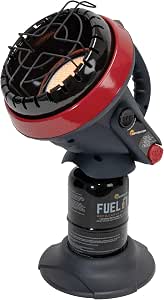
Mr. Heater 9,000 BTU Portable Buddy Midnight Series Radiant Propane Heater
Unlike the diesel air heaters in this roundup, the Mr. Heater Buddy uses radiant propane heat and needs no electricity. That makes it simpler to move around a truck campsite and useful for warming people directly when the tailgate is open or the tent is being aired out. Its 4,000/9,000 BTU settings and stated coverage up to 225 square feet give it flexibility, while tip-over shutoff and low-oxygen shutoff add safety features. But I would not treat it as a tent heater for overnight enclosed use: it burns propane in the space it heats and requires careful attention to ventilation and the manufacturer’s instructions. Compared with the VEVOR 8KW diesel heater, it avoids a battery-powered forced-air setup, but has shorter runtime on a 1-pound cylinder and no app or thermostat control.
Pros:- Radiant heat works without electrical power.
- Two heat settings allow a lower or higher output.
- Tip-over shut-down and low-oxygen shutoff are listed safety features.
- Can run up to 108 hours with a 20-pound propane cylinder and optional hose and fuel filter.
Cons:- The listed runtime on a 1-pound propane tank is up to 5.4 hours.
- Combustion occurs at the heater, so it is a poor match for enclosed tent operation.
- No remote, app, or thermostat control is specified.
Best for: Truck campers who want portable, electricity-free radiant warmth for an open, ventilated campsite rather than a heater to run inside a closed sleeping tent.
Not ideal for: People seeking overnight heat inside an enclosed truck-bed tent, extended runtime on a small fuel supply, or thermostatic remote control.
- Heat output:4,000 or 9,000 BTU/h
- Fuel:Propane
- Heating method:Radiant
- Stated coverage:Up to 225 sq. ft.
- Heat settings:2
- Runtime on 1 lb tank:Up to 5.4 hours
- Runtime on 20 lb cylinder:Up to 108 hours with optional Buddy hose and fuel filter
- Safety features:Tip-over shut-down, low-oxygen shutoff, self-extinguishing protection
Our verdict“Choose the Buddy for portable radiant warmth at a well-ventilated truck campsite, not as an overnight heater inside a closed tent.”
8KW Toolbox Diesel Heater – All in One Portable Diesel Air Heater
This toolbox-style unit is my pick for campers who move their heater between a truck, garage, and campsite: its adjustable pull handle and 17.7-pound weight make portability a central part of the design. The 6.7-liter tank is stated to provide up to 24 hours of heat, and control options include Bluetooth, remote, and LCD, with scheduled operation and temperature-offset adjustment. Compared with the VEVOR 8KW CO Alarm model, it offers a larger stated tank and a pull handle, but the supplied details do not list the same explicit CO alarm and overheat-protection combination. Its altitude limit is 9,842 feet, well below the high-altitude VEVOR 8KW, so frequent high-mountain campers should favor that model. The 8kW output may also be excessive for a small tent. Keep the heater outside the sleeping enclosure.
Pros:- Adjustable pull handle supports moving the heater between camp and vehicle setups.
- 6.7-liter tank is stated to provide up to 24 hours of heat.
- Bluetooth app, remote, and LCD controls include scheduling and temperature-offset adjustment.
- Supports 12V/24V DC and 110V AC power.
Cons:- Its 8kW output may be more than a truck-bed tent needs.
- The stated altitude ceiling of 9,842 feet is lower than the high-altitude VEVOR model’s.
- The supplied product details do not specify a CO alarm or overheat protection.
Best for: Truck campers who frequently move a self-contained diesel heater between vehicles and want a carry handle, multiple controls, and scheduled operation.
Not ideal for: High-altitude campers above 9,842 feet, or buyers who require an explicitly listed CO alarm and overheat protection.
- Heat output:8 kW
- Fuel:Diesel
- Fuel tank capacity:6.7 L
- Stated runtime:Up to 24 hours per fill
- Power input:12V/24V DC; 110V AC
- Altitude capability:Up to 9,842 ft
- Temperature range:46–97°F
- Dimensions and weight:16.14 x 11.81 x 12 in.; 17.7 lb
Our verdict“Pick this toolbox heater if easy transport and long stated tank runtime are priorities, but choose another model for higher-altitude trips or specified CO monitoring.”
RDXTIK 5L Diesel Heater, 8KW 12V/24V All-in-One with LCD Switch and Remote Control
The RDXTIK stands out for truck-bed campers who want one heater that can be used freestanding or secured to a vehicle: its package includes two metal bases for those different setups. The 12V/24V input also gives it more vehicle-power flexibility than the 12V-only VEVOR Bluetooth model. Its 5L tank is listed for up to 15 hours of operation, a useful buffer for overnight warmth, though actual runtime depends on operating conditions and the product data gives varying fuel-consumption figures. The LCD controls, remote, timer, and preheating add convenience, but the sizeable 17.32-by-8.27-by-19.29-inch unit is not a small tent accessory. Like other diesel all-in-ones, it needs a safe exhaust arrangement outside the occupied space; its heating output does not make a sealed tent safe to heat.
Pros:- Includes separate freestanding and vehicle-mounting metal bases
- Supports both 12V and 24V power
- 5L tank is specified for up to 15 hours of heating
- LCD control, remote, timer, and preheating are listed
Cons:- Large dimensions take up significant truck-bed or storage space
- Product description gives inconsistent fuel-consumption ranges
- Diesel exhaust and installation placement require careful outdoor setup
Best for: Truck-bed campers who want a diesel heater that can be set on a base or fixed to a vehicle and need 12V/24V compatibility.
Not ideal for: Minimalist tent campers seeking a light, compact heater or anyone unable to position the heater and exhaust safely outside the sleeping area.
- Heating output:8 kW
- Fuel:Diesel
- Voltage:12V/24V
- Fuel tank:5 L (1.32 gal)
- Temperature range:46.4–96.8°F (8–36°C)
- Fuel consumption:Listed as 0.18–0.53 L/h and 0.16–0.62 L/h
- Dimensions:17.32 × 8.27 × 19.29 in
- Controls and safety:LCD, remote, timer, preheating, overheat protection
Our verdict“Choose the RDXTIK if mounting flexibility and dual-voltage vehicle power matter more than a compact footprint.”
8000W All-in-One Diesel Air Heater, 110V/12V/24V with 5L Tank
This model’s clearest advantage for truck-bed heating is its unusually broad 110V/12V/24V power support. That makes it more adaptable than the 12V/24V RDXTIK when you want to run it from a household outlet at camp or use different vehicle electrical systems. The integrated 5L tank and included wiring and mounting accessories simplify transport and setup, while the LCD control and remote are useful when the heater sits outside the sleeping area. However, the listing does not give a fuel-consumption rate, runtime, dimensions, or a stated heating-area figure, so planning for a full night is less straightforward than with the VEVOR 8KW DC12-24V heater, which specifies consumption and coverage. Treat the 8KW claim as listed output, not a reason to place a combustion heater inside a tent.
Pros:- Supports household 110V AC and 12V/24V DC power
- Integrated 5L tank keeps the main components together
- Installation kit, wiring components, and mounting accessories are included
- Remote and LCD control are listed
Cons:- No fuel-consumption rate or runtime is provided
- No dimensions or specified coverage area are listed
- The listing does not detail exhaust setup or truck-bed mounting dimensions
Best for: Truck campers who may have access to household AC power as well as 12V or 24V vehicle power and want an all-in-one unit with accessories included.
Not ideal for: Buyers who need published runtime, fuel-use, or size details before fitting a heater into a compact truck-bed setup.
- Heating output:8 kW
- Fuel:Diesel
- Voltage:110V/12V/24V
- Fuel tank:5 L
- Heating method:Forced air
- Controls:LCD control and remote
- Included setup items:Mounting accessories and wiring components
- Construction:Metal and heat-resistant plastic
Our verdict“Pick this heater for power-source flexibility, but choose the VEVOR DC12-24V model if published fuel-use and coverage figures matter more.”
Mr. Heater 3,800 BTU Little Buddy Portable Radiant Propane Heater
The Little Buddy is the lineup’s compact propane choice, not a substitute for the higher-output diesel units. Its 3,800 BTU radiant heat and 8-inch stand suit a small, ventilated shelter where floor space is limited; it avoids the fuel tank and vehicle-power setup required by the RDXTIK 8KW diesel heater. One-button ignition and tip-over and low-oxygen shutoffs make the controls straightforward, but those safety features do not make an enclosed truck-bed tent safe for combustion heating. Unlike a diesel heater that can be positioned outside with heated air ducted in, this radiant heater uses propane at the heater itself, so placement and ventilation need particular care. Its 1 lb cylinder is simple to connect but means less fuel capacity than the 5L tanks on the diesel models.
Pros:- Compact 8-inch stand uses little floor space
- One-button ignition keeps operation simple
- Tip-over and low-oxygen safety shutoffs are listed
- Connects directly to a 1 lb propane cylinder
Cons:- 3,800 BTU output is far below the listed 8KW diesel heaters
- Small propane cylinder offers less fuel capacity than 5L diesel tanks
- Radiant propane heat requires careful ventilation and placement
Best for: Campers heating a small, well-ventilated shelter who prioritize a compact stand and simple propane connection over high output.
Not ideal for: Anyone seeking whole-truck-bed heating, extended runtime from a large fuel reservoir, or a heater to operate in an enclosed, unventilated tent.
- Heating output:3,800 BTU/h
- Fuel:Propane
- Heating method:Radiant
- Coverage:Up to 95 sq ft
- Fuel connection:Direct connection to one 1 lb propane cylinder
- Stand:8-inch round stand
- Ignition:One-button ignition
- Safety features:Tip-over shutoff and low-oxygen shutoff
Our verdict“Choose the Little Buddy for modest heat in a small, ventilated shelter, not for high-output truck-bed heating or enclosed use.”
VEVOR 8KW Diesel Heater All in One DC12-24V
For truck-bed campers choosing among diesel all-in-ones, this VEVOR gives a particularly useful set of practical details: a fuel gauge, leak-resistant cap, heat-insulated exhaust-pipe shield, and a ceramic igniter described for cold-weather starts. Those features address handling and startup concerns more directly than the sparse listing for the 8000W 110V/12V/24V heater, which does not provide fuel-use or coverage figures. VEVOR specifies a 5L tank, 0.18–0.36 L/h consumption, and 161–215 sq ft coverage, giving buyers more information for estimating use. The 98-foot remote and 32–104°F control range also suit preheating before climbing into the truck bed. Its tradeoff is power compatibility: it supports 12V/24V, not the household 110V option offered by that other model.
Pros:- Fuel gauge helps monitor remaining diesel
- Heat-insulated exhaust shield and leak-resistant cap are specified
- Ceramic igniter is described for cold-weather starts
- Lists 5L tank, 0.18–0.36 L/h consumption, and 161–215 sq ft coverage
Cons:- Limited to 12V/24V power, unlike the 110V-capable heater in this group
- No physical dimensions or continuous-runtime estimate are provided
- Voice announcements may be unwanted in a quiet campsite
Best for: Cold-weather truck campers who want listed fuel-use and coverage figures, a fuel gauge, and remote preheating from outside the vehicle.
Not ideal for: Campers who need household 110V operation or prefer a heater with clearly stated dimensions and tank runtime.
- Heating output:8 kW
- Fuel:Diesel
- Voltage:DC 12V/24V
- Fuel tank:5 L (1.3 gal)
- Fuel consumption:0.18–0.36 L/h
- Listed coverage:161–215 sq ft
- Temperature range:32–104°F
- Remote control range:Up to 98 ft
- Operating altitude:Under 9,843 ft
Our verdict“Choose this VEVOR when cold-weather operation and clear fuel-use information matter more than household AC compatibility.”
VEVOR 8KW Diesel Heater with Bluetooth App Control
This VEVOR earns a distinct place for truck-bed trips above the usual camping elevations: its automatic altitude compensation is specified up to 18,045 feet, well above the under-9,843-foot limit listed for the other VEVOR in this batch. Bluetooth app control, a remote with a stated 32-foot range, and an LCD give several ways to preheat or adjust the unit without reaching into a cold setup. Its listed 215–269 sq ft range is also larger than the other VEVOR’s 161–215 sq ft figure, though those coverage claims are not a guarantee of comfort in every tent. The tradeoff is 12V-only operation and a stated runtime of up to eight hours, which may not cover every overnight schedule. As with the other diesel options, it needs safe outdoor exhaust placement.
Pros:- Automatic altitude compensation specified up to 18,045 ft
- Bluetooth app, remote, and LCD provide multiple control options
- Lists a 215–269 sq ft applicable area
- 5L tank and listed fuel use support trip planning
Cons:- 12V rated voltage limits power-source flexibility
- Listed continuous heating is up to eight hours
- App and remote control features add complexity compared with simple manual controls
Best for: Truck-bed campers traveling at high elevations who want automatic altitude adjustment and phone-based preheating.
Not ideal for: People who need 24V or household AC power, or who need a stated runtime longer than the listed maximum of eight hours.
- Heating output:8 kW
- Fuel:Diesel
- Applicable area:215–269 sq ft (20–25 m²)
- Fuel tank:5 L (1.3 gal)
- Fuel consumption:0.16–0.62 L/h
- Listed runtime:Up to 8 hours
- Temperature range:46.4–96.8°F (8–36°C)
- Altitude compensation:Automatic, up to 18,045 ft
Our verdict“Pick this VEVOR for high-altitude truck-bed travel and app control, provided 12V power and an eight-hour maximum listed runtime fit your plans.”
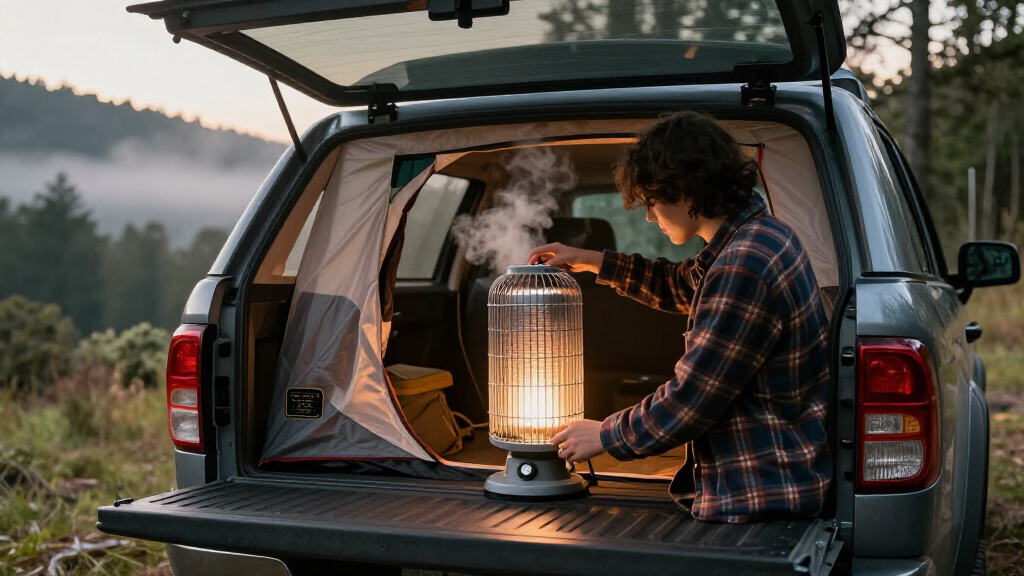
How We Picked
I compared these heaters for the specific demands of truck bed tent camping: how they produce heat, what fuel and power arrangements they need, how portable they appear from their listed form factors, and how much setup their controls and components suggest. I also weighed features with a practical effect on campsite use, including altitude adjustment, timers, app or remote control, tank configuration, and stated electrical compatibility. Safety-related details mattered, but a listed alarm or safety feature does not make an enclosed tent safe for an unsuitable heater.
The ranking favors options with a useful balance of truck-camp practicality, control, and clearly stated features rather than treating the largest output number as an automatic win. The VEVOR with Bluetooth and a CO alarm leads for its combination of controls and an added warning feature; the LF Bros earns distinction for power-input flexibility and timer functions. The propane Buddy models rank as simpler alternatives, while the remaining diesel heaters serve buyers who prioritize an all-in-one format, altitude capability, or a particular control setup. Product names and claims alone do not establish real-world heat output, runtime, or safe tent compatibility, so I call out those limits rather than assume them.
| truck bed tent heater | Fuel |
|---|---|
| VEVOR 8KW Diesel Heater | Diesel |
| VEVOR 8KW Diesel Heater | Diesel |
| LF Bros 110V/12V 5KW Diesel He | Diesel |
| Mr. Heater 9,000 BTU Portable | Propane |
| 8KW Toolbox Diesel Heater | Diesel |
| RDXTIK 5L Diesel Heater | Diesel |
| 8000W All-in-One Diesel Air He | Diesel |
| Mr. Heater 3,800 BTU Little Bu | Propane |
| VEVOR 8KW Diesel Heater All in | Diesel |
| VEVOR 8KW Diesel Heater with B | Diesel |
Factors to Consider When Choosing Truck Bed Tent Heaters
For a truck bed tent, the right heater is the one that fits the campsite’s power, fuel, and ventilation realities—not simply the one with the biggest number on its listing. I’d settle the installation and safety questions before choosing between diesel and propane, then compare convenience features.
Match the heater type to where it will sit
Truck bed tents have limited floor space, and a heater’s footprint affects where people, bedding, and gear can go. A portable all-in-one diesel unit may simplify carrying its fuel tank and heater together, but it still needs safe exhaust routing and a suitable location outside the sleeping space unless the manufacturer explicitly specifies a safe installation method. A radiant propane heater can be physically straightforward, yet its use depends on the unit’s instructions and clearances. Don’t assume that “portable” means suitable for operation inside a tent. Check dimensions, required clearances, and the proposed placement before buying, and leave a way to exit without moving the heater.
Plan fuel and power as one decision
Diesel heaters require fuel and electrical power for their controls and operation, so think through both supplies before choosing a model. A listing that supports multiple voltage inputs does not tell you what battery capacity you need or how long a particular setup will run; consult the manual for electrical draw and startup requirements. Propane avoids a diesel tank but still calls for compatible fuel cylinders and attention to the heater’s instructions. A common mistake is comparing fuel type while overlooking how the heater will be powered at a remote campsite. If your truck is off, calculate the effect of heater use on any battery you rely on for starting or other camp equipment.
Treat tent ventilation and carbon monoxide as non-negotiable
Fabric shelters are not automatically safe places to operate combustion appliances. Follow the exact manufacturer instructions for indoor or outdoor use, ventilation, clearances, and exhaust placement; if a heater is not approved for the intended location, don’t use it there. A built-in CO alarm, such as the feature listed on one VEVOR model, is an additional warning measure, not permission to ignore ventilation or a replacement for an independent detector. Keep a working carbon monoxide alarm appropriate to your setup, and know the symptoms of exposure. If safe exhaust routing or ventilation cannot be maintained in your truck bed tent, choose another heating plan.
Choose capacity for the shelter, not the headline number
Output figures can be difficult to compare across diesel and propane heaters, and a larger advertised number does not automatically make a better tent heater. A small, well-sheltered sleeping area may call for more controllable heat rather than maximum output, while wind, insulation, bedding, and outside temperature can change the demand. Avoid assuming an “8KW” label predicts a specific warm-up time or runtime without independent performance data. Look for a usable control range and clear operating guidance, then pair the heater with insulation and ventilation that suit the conditions. For cold-weather trips, bring an unheated backup plan instead of relying on a single device.
Factor altitude and weather into the fuel choice
High elevation can affect combustion appliances, so altitude claims deserve attention if mountain camps are part of your plans. One VEVOR listing specifies automatic altitude adjustment, while the LF Bros lists a plateau mode; those features may be useful, but buyers should verify the stated limits and operating instructions rather than assume every elevation is covered. Cold, wind, and changing weather also affect comfort and fuel use, even when a heater continues to run. If you camp across a wide range of elevations, favor clear manufacturer guidance and a practical backup. Don’t choose an altitude feature solely from a headline claim without checking its limits.
Pay for controls only when they solve a real camp problem
Bluetooth, remote controls, LCD panels, and timers can make operation more convenient, especially when the heater is placed outside the sleeping area. They do not improve safe exhaust routing or guarantee more heat, so avoid treating extra electronics as a substitute for a sound setup. A timer may help manage scheduled operation, while an app is useful only if its connection works where you camp and the unit remains accessible. For a first heater, straightforward controls and a clear manual may matter more than a long feature list. Spend extra attention on the parts that affect your actual routine, then keep the control system as simple as you can comfortably use.
Frequently Asked Questions
Can I run a diesel or propane heater inside a truck bed tent?
Only use a heater in a tent if its manufacturer explicitly approves that exact use and you can follow all instructions for ventilation, clearances, and exhaust. Combustion heaters can create carbon monoxide, and fabric shelters have limited space for safe placement. Diesel models generally require careful exhaust routing, while propane models still need the operating conditions specified by their manufacturer. A built-in alarm is not a substitute for proper ventilation or a separate working CO detector. If you cannot meet the instructions reliably, don’t run the heater in the tent.
Do I need a separate battery for an all-in-one diesel heater?
Not necessarily, but you need a power source that matches the heater’s electrical requirements and can handle its startup and running draw. A vehicle battery may be depleted if the heater runs for a long period with the engine off, which can leave the truck unable to start. Check the manual for current draw, voltage compatibility, and recommended battery capacity rather than relying on a product title. A dedicated power station or auxiliary battery can separate camp heating from starting power, if it meets the manufacturer’s specifications. Include charging plans in your trip setup.
Is a diesel heater or a propane heater a better fit for truck bed camping?
Neither fuel type is automatically better; the right match depends on where the heater can operate safely and what supplies you can manage. The diesel options in this roundup offer forced-air heating and features such as tanks, timers, or altitude modes, but they bring electrical and exhaust-routing needs. The Mr. Heater Buddy units are simpler portable radiant alternatives, though they still require careful adherence to use and ventilation instructions. Compare complete setup requirements, not just fuel convenience or advertised output. If either option cannot be used safely in your planned location, choose a different way to stay warm.
What matters more: an 8KW rating or altitude adjustment?
The answer depends on where and how you camp, and neither label by itself proves real-world performance. An 8KW claim may be useful for identifying a product category, but it does not tell you how quickly it will heat your particular tent or how much fuel it will use. Altitude adjustment or plateau mode may matter more if you regularly camp high above sea level, though you should verify each model’s stated operating range. For lower-elevation trips, controls, power supply, and safe installation may matter more than that feature. Check the manual and choose around your normal conditions rather than a single headline specification.
How should I compare two VEVOR 8KW diesel heaters with similar names?
Compare the exact model details rather than assuming the shared brand and output claim mean the units are identical. In this roundup, listings distinguish features such as a CO alarm, Bluetooth app control, automatic altitude adjustment, remote operation, and all-in-one construction. Verify which controls, electrical inputs, tank components, and accessories are included with the specific unit you plan to buy. Also read the installation and safety instructions to confirm the setup fits your truck and tent arrangement. If the listing leaves a key detail unclear, seek clarification before relying on it for a trip.
Conclusion
For the best overall balance, I’d choose the VEVOR 8KW Diesel Heater with Bluetooth and a CO Alarm, provided its power and installation needs fit the campsite plan. For buyers who value control flexibility, LF Bros is my best value-style pick thanks to its listed 110V/12V compatibility, plateau mode, and timer; verify the full setup requirements before purchase. For a premium feature set, the VEVOR with automatic altitude adjustment makes the most sense for trips where elevation and remote controls matter. For beginners who prefer a simpler portable format, I’d start by comparing the Mr. Heater Little Buddy models, while following their instructions for use and ventilation. For campers prioritizing compact radiant heat, the 3,800 BTU Little Buddy is the specific-use option; for those wanting a larger portable diesel package, compare the toolbox and 5L all-in-one units by their exact power and control details. No pick overrides safe operation: if you cannot provide the required ventilation, clearances, power, and exhaust handling, choose another heating method.
Evergreen bestsellers Picks
bestsellers
As an affiliate, we earn on qualifying purchases.