The Toyota T100 is often called the forgotten full-size truck, but it played a key role in Toyota’s truck history. Introduced in the mid-1990s, it filled a gap between midsize and full-size pickups, offering better capability and size. With options like a 3.4L V6 and various trims, it provided durability and versatility. If you want to uncover how this underrated truck influenced future models like the Tundra, keep exploring.
Key Takeaways
- The Toyota T100 was a mid-1990s full-size pickup that bridged the gap between midsize and full-size trucks.
- It influenced the development of Toyota’s larger trucks, including the Tundra, emphasizing durability and safety.
- The T100 offered engines like 3.0L V6 and 3.4L V6, with configurations for towing and everyday driving.
- Despite limited production (1993-1998), it gained a loyal following for reliability and practicality.
- Often overlooked today, the T100 is considered a “forgotten” but historically significant step in Toyota’s full-size truck evolution.

MOTOKU Pair Exterior Door Handle with Keyholes for Toyota T100 Truck Pickup 1993-1998 Front Driver and Passenger Side
Compatible with Toyota T100 1993-1998
As an affiliate, we earn on qualifying purchases.
As an affiliate, we earn on qualifying purchases.
Origins and Market Position of the T100

Have you ever wondered why Toyota introduced the T100 in the mid-1990s? Toyota aimed to fill a gap between midsize trucks like the Dodge Dakota and traditional American full-size pickups. The T100 offered a slightly smaller size but with a full-size bed, catering to buyers who wanted utility without the bulk of larger trucks. It featured a V6 engine, prioritizing fuel economy and refinement over V8 power, which was uncommon in full-size American trucks at the time. Positioned as a practical, reliable alternative, it appealed to those seeking durability and efficiency. However, its unconventional size and engine choices created some confusion among traditional truck buyers. Despite mixed market reactions, the T100 carved out a niche, laying the groundwork for Toyota’s full-size truck future.
EZ-COVER 6'4" Soft Roll Up Truck Bed Cover Compatible for 1995-1998 Toyota T100 Vinyl Tonneau Cover
【 Vehicle Accessories 】 Compatible for 1995 1996 1997 1998 Toyota Tundra trucks. Bed length: 6'4"/76"; (not applicable…
As an affiliate, we earn on qualifying purchases.
As an affiliate, we earn on qualifying purchases.
Engine Options and Performance Capabilities
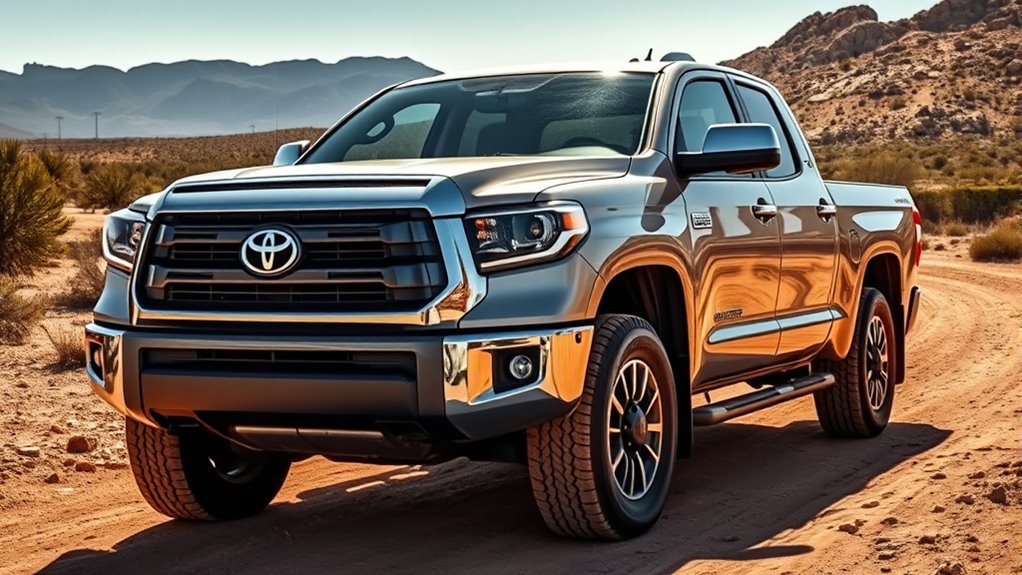
The Toyota T100 offered a range of engine options tailored to different needs, emphasizing fuel efficiency and smooth performance. Its initial setup included a 3.0L V6 with 150 hp and 180 lb-ft torque, later replaced by a more powerful 3.4L V6 producing up to 245 hp and 285 lb-ft torque. A 2.7L I4 with 150 hp was introduced for economy-focused 2WD models. These engines provided a balanced mix of power and efficiency, with towing capacities up to 5,200 lbs. Here’s a quick comparison:
| Engine | Power (hp) | Torque (lb-ft) | Notable Feature |
|---|---|---|---|
| 2.7L I4 | 150 | 177 | Economical base engine |
| 3.0L V6 | 150 | 180 | Original engine, reliable |
| 3.4L V6 | 190-245 | 220-285 | Most powerful, versatile |
These options offered smooth handling both on and off-road, suited to diverse tasks. Additionally, selecting the appropriate engine can significantly impact the overall performance and longevity of the vehicle.

AISIN GENUINE TKT-025 Engine Timing Belt Kit with Water Pump – Compatible with Select Toyota 4Runner, T100, Tacoma, Tundra
AISIN's Water Pump/Timing Belt Service Kit is the common-sense combo as these components should always be replaced at…
As an affiliate, we earn on qualifying purchases.
As an affiliate, we earn on qualifying purchases.
Design Features and Variants Over the Years

Throughout its production run, the Toyota T100’s design evolved to meet changing customer needs and improve practicality. You’ll notice it started with a straightforward regular cab and long bed, emphasizing utility. Midway through, Toyota introduced the Xtracab, adding 21.7 inches of cabin space and extra seating, making it more versatile. The truck was available in three trims: base, DX, and SR5, offering options for different budgets and preferences. Over the years, safety features like airbags and side door-guard beams were added, enhancing driver protection. The overall dimensions remained consistent, about 209 inches long and 75 inches wide, but interior upgrades made it more comfortable. Despite minimal redesigns, each update refined its functionality, blending Toyota’s reliability with improved convenience and safety. Additionally, the T100 incorporated Free Floating design concepts to improve ride quality and handling.

Miytsya 1 PC Tri-Color Grille Badge Emblem Decoration Accessories Universal Compatible with Toyota 4Runner Tacoma Tundra and Other Mesh or Slotted Grille (Yellow & Orange & Red)
High-quality Material: The three-color grille acrylic badge accessories in this product are made of high-quality plastic, it is…
As an affiliate, we earn on qualifying purchases.
As an affiliate, we earn on qualifying purchases.
Evolution Through Model Years

From its debut in 1993 to its discontinuation in 1998, the Toyota T100 underwent a series of incremental updates that improved its performance, safety, and comfort. Over these years, Toyota refined its engines, added safety features, and expanded options. The 1994 model introduced the 2.7L I4 and driver’s side airbag, while 1995 saw the 3.4L V6 and the Xtracab extended cab. By 1997, the engine output increased to 245 hp, enhancing towing and hauling capacity. These changes kept the T100 competitive, even as it maintained its size and engine choices. SAFETY FEATURES continued to evolve, emphasizing driver protection and vehicle reliability.
Reception, Legacy, and Impact on Toyota’s Truck Lineup

The Toyota T100 carved out a unique niche in the truck market with its focus on fuel economy and reliability, even if it didn’t fully meet traditional full-size expectations. You may notice that, despite mixed reviews at launch, it developed a loyal following for its durability and smooth ride. Its legacy clearly influenced Toyota’s next move, paving the way for the Tundra, which embraced V8 power and larger size to meet broader demands. Additionally, its emphasis on safe backup systems and dependable operation set a foundation for future models to prioritize reliability and safety.
Niche Market Role
Despite its unconventional size and engine lineup, the Toyota T100 carved out a unique niche in the pickup truck market by appealing to buyers seeking reliability, fuel efficiency, and a smoother ride without the bulk of traditional full-size trucks. You would find that its smaller dimensions and V6 focus made it ideal for those wanting a capable workhorse with better maneuverability and lower operating costs. It attracted a specific segment—business owners, outdoor enthusiasts, and urban drivers—who valued durability over sheer size or V8 power. While it didn’t dominate sales, it gained respect for its longevity and dependability. Its role wasn’t to replace full-size American trucks but to offer an alternative for customers prioritizing comfort, economy, and Toyota’s renowned quality—factors that influenced future Toyota trucks, especially the Tundra. Additionally, the T100’s design and features reflected market niche preferences, which continue to influence Toyota’s approach to truck design today.
Cult Following Development
Although the Toyota T100 didn’t achieve blockbuster sales during its production run, it gradually cultivated a dedicated following among enthusiasts and practical buyers alike. You might be surprised how many owners appreciate its durability and smooth performance. Here’s what drew fans in:
- Unmatched Reliability – Many owners report their T100 lasting beyond 300,000 miles with minimal issues.
- Smooth Ride and Handling – Its refined driving experience set it apart from typical trucks of the era.
- Fuel Economy – Unlike American full-sizers, it offered competitive mpg, appealing to budget-conscious buyers.
- Versatility – Its size struck a perfect balance, accommodating hauling needs without overwhelming on smaller roads.
- Reputation for Longevity – The T100’s reputation for long-term durability continues to attract collectors and loyal fans today.
This loyal group helped cement the T100’s status as a cult classic, influencing future Toyota trucks.
Influence on Tundra
The enduring popularity and loyal following of the Toyota T100 laid the groundwork for the development of the Tundra, substantially shaping Toyota’s truck lineup. Its lessons in balancing size, comfort, and fuel economy informed the Tundra’s design, allowing Toyota to enter the full‑size segment confidently. The T100’s focus on reliability, smooth performance, and refined ride proved that a truck could prioritize quality without sacrificing utility. This reputation helped shift expectations, leading Toyota to equip the Tundra with V8 engines and larger cabs, addressing earlier limitations. As a result, the T100’s legacy pushed Toyota to redefine what a full‑size truck could be, establishing a foundation for future success and influencing the industry’s view of Japanese trucks in a segment long dominated by American brands. Additionally, the T100’s emphasis on performance and comfort influenced Toyota’s adoption of advanced vehicle technology features in subsequent models, ensuring their competitiveness in the evolving market.
Technical Specs and Practical Considerations

When evaluating the Toyota T100, you’ll want to consider its engine options and how much power they deliver for your needs. Its drivetrain choices, including 2WD and 4WD, impact both handling and capability, especially when paired with manual or automatic transmissions. Additionally, you should look at its towing capacity and fuel economy to determine if it fits your practical requirements. Being aware of ground beef spoilage and its associated odors can also help in understanding vehicle maintenance needs related to cleanliness and hygiene.
Engine Options and Power
The Toyota T100 offered three main engine options during its production run, each designed to balance performance, fuel economy, and practicality. You can choose based on your needs, whether towing, daily driving, or economy.
- The 2.7L I4 produces 150 hp and 177 lb-ft torque, offering excellent fuel efficiency for light-duty use.
- The 3.0L V6 generates 150 hp and 180 lb-ft torque, providing smooth power for everyday tasks.
- The 3.4L V6, introduced in 1995, delivers 190 hp and 220 lb-ft torque, with later versions reaching up to 245 hp and 285 lb-ft, ideal for towing and hauling.
Each engine pairs with manual or automatic transmissions and 2WD or 4WD options, giving you flexibility for various driving conditions. Engine options play a crucial role in determining the vehicle’s overall performance and suitability for different tasks.
Drivetrain and Transmission
Toyota T100 offers a versatile drivetrain lineup, allowing you to choose between two-wheel drive (2WD) and four-wheel drive (4WD) configurations to suit various driving conditions. The 2WD setup is ideal for everyday urban driving and light hauling, offering better fuel economy and simplicity. The 4WD option enhances off-road capability and adds traction on challenging terrains, making it suitable for outdoor adventures or rough weather. Transmission choices include a five-speed manual and a four-speed automatic, giving you flexibility based on your driving style. The manual transmission provides more control for off-road or towing scenarios, while the automatic simplifies daily driving. Both transmissions are designed for smooth operation, complementing the truck’s overall balance of power and ease of use. Additionally, drivetrain technology impacts vehicle performance, durability, and maintenance requirements, ensuring the T100 meets diverse driving needs.
Towing and Fuel Economy
Towing capacity and fuel economy are key factors to contemplate when selecting a T100 for your needs. You’ll find that this truck offers a practical balance between power and efficiency. Here are four important points to consider:
- The T100 can tow up to about 5,200 lbs, making it suitable for hauling trailers, boats, or campers.
- Fuel economy ranges from 17 to 20 mpg combined, depending on engine choice and driving conditions.
- The 3.4L V6 engine provides the best towing capacity and power, especially in later models.
- Its relatively lightweight design helps maximize fuel efficiency without sacrificing too much towing ability.
Frequently Asked Questions
How Does the T100 Compare to Other Full-Size Trucks in Reliability?
You’ll find the T100 is remarkably reliable compared to other full-size trucks. It’s built with durable components and designed for longevity, often lasting well beyond 300,000 miles with proper maintenance. Unlike many American trucks of its era, it’s known for smooth operation and fewer mechanical issues, making it a dependable choice for those seeking a truck that prioritizes durability and consistent performance.
What Are Common Issues or Maintenance Concerns for the T100?
You should watch out for potential issues like rust, especially in the frame and undercarriage, due to its age and exposure. Keep an eye on the suspension components, as they can wear out over time, causing handling problems. Regularly check the cooling system for leaks or corrosion, and make sure the transmission fluid is clean. Routine maintenance on the brakes and drivetrain will help keep your T100 running smoothly.
Is the T100 Suitable for Off-Road Adventures?
You’ll find that the T100 is like a dependable trail buddy—reliable and smooth on rough paths. Its good handling and available 4WD make it capable for off-road adventures, especially on less challenging terrains. However, it’s not built for extreme conditions like rock crawling or deep mud. Think of it as a versatile companion for weekend escapades, offering comfort and control without the ruggedness of dedicated off-road rigs.
How Does Fuel Economy Vary Across Different Engine Options?
You’ll find that the fuel economy varies depending on your engine choice. The 2.7L I4 delivers the best mileage, averaging around 17-20 mpg combined, making it economical for daily driving. The 3.0L V6 offers similar figures, while the 3.4L V6, especially with higher horsepower, tends to consume more fuel, dropping to about 15-18 mpg. Your driving style and conditions also influence these numbers.
Are Parts and Service Readily Available for the T100 Today?
Parts and service for the Toyota T100 are still fairly available today, especially through specialty shops and online marketplaces. Since the truck has a reputation for durability, many owners keep theirs running with some effort. You can find common replacement parts like suspension components, filters, and brake parts, but harder-to-find items might require sourcing from salvage yards or international suppliers. Regular maintenance keeps this truck on the road.
Conclusion
Ultimately, the Toyota T100’s tale is a testament to tenacity and shift. Though often overlooked, its unique blend of bold design and balanced performance left a lasting legacy. By embracing its evolution and enduring appeal, you can appreciate its place in Toyota’s truck timeline. The T100’s timeless truth reminds us that even the most forgotten models forge forward, fueling future innovations—fostering fascination and fervor for trucks that truly stand the test of time.