The Ram 2500 and Ford F-250 both excel in heavy-duty tasks, but they differ in key areas. The Ford offers a wider engine choice and higher towing capacity, making it great for towing heavy trailers. Ram emphasizes payload and feature-rich interiors with top tech like a 12-inch touchscreen. Your choice depends on whether you need maximum towing power or better payload and comfort. Keep exploring to discover more details and help decide which truck suits your heavy-duty needs best.

Get business pricing on garage and car supplies
- Business-only prices and quantity discounts
- Tax-exempt purchasing
- Multiple users, one account, clear invoices
Key Takeaways
- Ford F-250 offers higher maximum towing capacity (~22,000-23,000 lbs) and more engine options, including a powerful 6.8L V8.
- Ram 2500 provides slightly higher payload capacity (up to 4,420 lbs) and a high-tech interior with a 12-inch Uconnect touchscreen.
- Ford features a 10-speed automatic transmission and a longer 5-year/100,000-mile warranty; Ram has an 8-speed transmission and shorter warranty.
- Both trucks include advanced safety features; Ford emphasizes driver assistance tech, while Ram focuses on luxury and driver engagement.
- Price-wise, Ram 2500 is slightly more expensive but offers competitive features; Ford F-250 balances performance and warranty support.
As an affiliate, we earn on qualifying purchases.
Engine Options and Performance
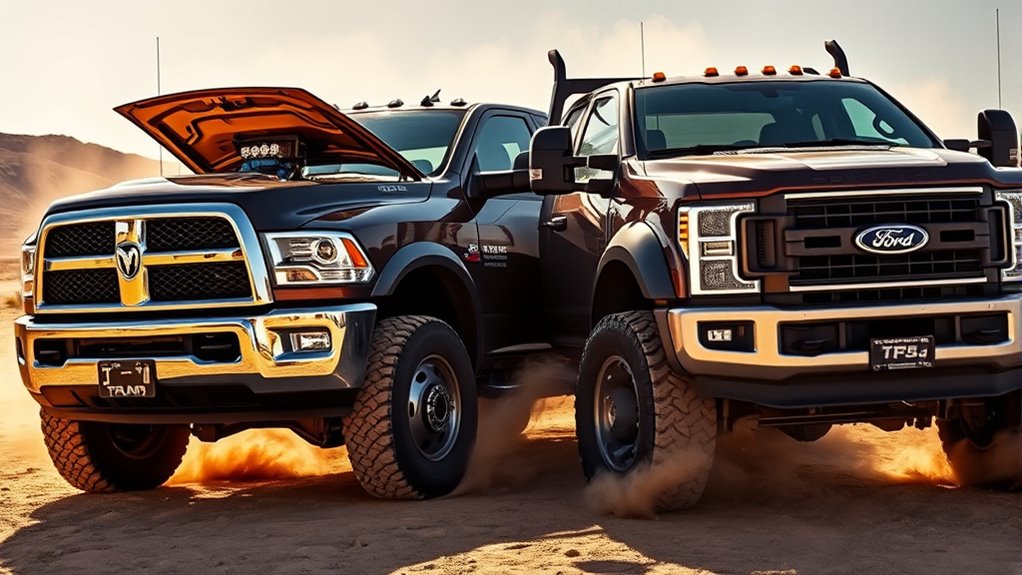
When comparing engine options between the Ram 2500 and Ford F-250, Ford offers a broader selection, giving you more flexibility to match your needs. The F-250 provides three engine choices: a 6.8L V8, a 7.3L V8, and a 6.7L Power Stroke Turbo Diesel, catering to a range of power and efficiency preferences. Its diesel engine produces over 475 horsepower and more than 1,050 lb-ft of torque, making it a powerhouse. In contrast, the Ram 2500 has two options: a 6.4L HEMI V8 and a 6.7L Cummins Turbo Diesel. While Ram’s diesel offers up to 420 horsepower and 1,075 lb-ft of torque, the Ford engines generally provide more variety and higher horsepower, giving you more choices for your specific workload. Additionally, engine versatility is a key factor for many buyers seeking optimal performance tailored to different tasks.
Ram 2500 12-inch touchscreen stereo
As an affiliate, we earn on qualifying purchases.
As an affiliate, we earn on qualifying purchases.
Towing Capabilities and Limitations
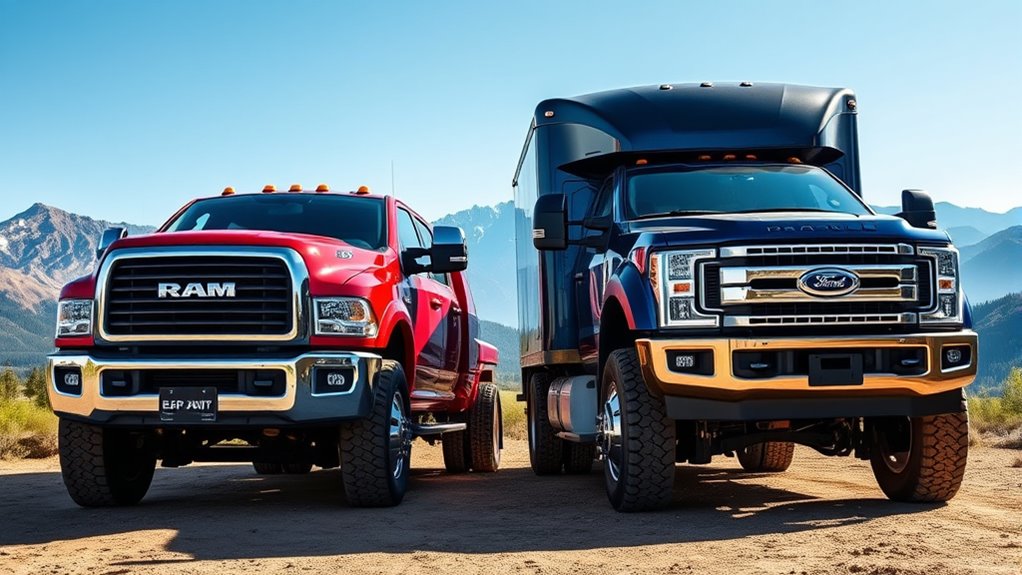
When comparing towing capabilities, you’ll want to consider both maximum capacity and how stable the tow feels during use. The Ford F-250 generally pulls more weight, but factors like configuration and setup play a big role in achieving those limits. Keep in mind that reaching maximum towing capacity often requires specific equipment and adjustments for safety and performance. Additionally, understanding projector technology can provide insights into how vehicle features might impact towing visibility and safety.
Max Towing Capacity
Are you curious about how much weight these heavy-duty trucks can tow? The Ford F-250 outshines the Ram 2500 with a maximum towing capacity of 22,000 to 23,000 pounds, depending on the configuration. In contrast, the Ram 2500 can tow up to 20,000 pounds. This gives the Ford a clear advantage of 2,000 to 3,000 pounds for heavier loads. Keep in mind, achieving these maximum capacities requires specific setups and proper equipment. Both trucks are built for serious towing tasks, but the Ford F-250’s higher towing limit makes it better suited for the heaviest loads. Your choice depends on your towing needs, but if max capacity is top priority, the Ford F-250 offers a notable edge. Proper wiring basics and safety considerations are essential when preparing these trucks for maximum towing capabilities.
Towing Stability Factors
Despite having slightly lower towing capacities, the Ram 2500 maintains impressive stability thanks to its smooth torque delivery and reliable transmission pairing. Its 8-speed automatic ensures steady power transfer, reducing jerks and sways during towing. The Cummins Turbo Diesel offers consistent torque, helping you maintain control even when hauling heavy loads. While it may not match the Ford F-250’s maximum towing figures, its design emphasizes stability over raw capacity. Both trucks require specific configurations, like proper trailer hitch setups and weight distribution, to optimize towing stability. Advanced features like Ram’s digital rearview mirror with tow mode enhance your awareness, ensuring safer, more controlled towing experiences. Overall, the Ram 2500’s engineering focuses on delivering a stable, confident tow, even at its capacity limits. Incorporating vintage-inspired tech features can further enhance the driving experience by adding familiar, reliable technology elements that improve usability and safety.
Configuration Requirements
Maximizing the towing capabilities of both the Ram 2500 and Ford F-250 requires careful configuration, as each truck has specific setup requirements to handle heavy loads safely. You need to verify the correct hitch, trailer brakes, and weight distribution systems are installed. For the F-250, selecting the right engine and axle ratio is critical for reaching maximum towing capacity, and an upgraded suspension may be necessary for heavy loads. The Ram 2500 requires proper trailer wiring and payload adjustments to optimize towing performance. Both trucks benefit from the appropriate towing packages, including trailer sway control and integrated trailer brake controllers. Failing to meet these configuration requirements can limit towing capacity and compromise safety, so you must follow manufacturer recommendations closely. Ensuring your vehicle’s configuration aligns with these specifications can significantly enhance safety and performance during heavy-duty hauling.
As an affiliate, we earn on qualifying purchases.
Payload Capacity and Heavy Lifting
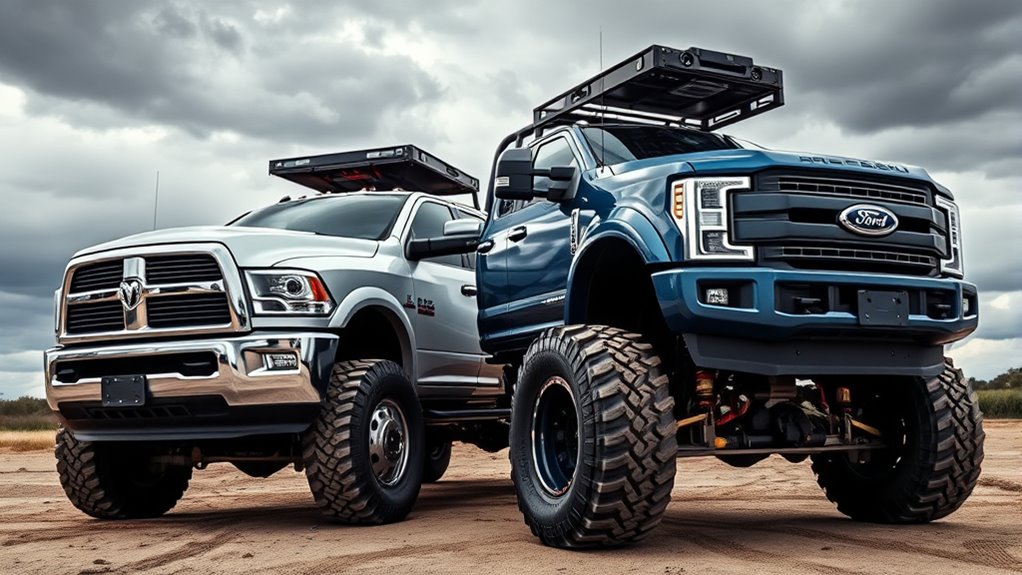
When it comes to payload capacity and heavy lifting, both the Ram 2500 and Ford F-250 are built to handle tough jobs, but there are slight differences that might influence your choice. The Ram 2500 can carry up to 4,420 pounds of payload, slightly higher than the F-250’s maximum of around 4,246 to 4,303 pounds. While the difference is marginal, it could matter if your work involves consistently heavy loads. Both trucks are capable of hauling significant payloads, with their strength coming from durable frames and reinforced beds. Your decision might hinge on other factors like towing capacity or features, but when it’s about raw payload potential, Ram edges out just a bit ahead. Either way, both are well-equipped for heavy lifting, and considering reliable load‑bearing features can help ensure safety and efficiency on demanding jobs.
Heavy duty truck safety features
As an affiliate, we earn on qualifying purchases.
As an affiliate, we earn on qualifying purchases.
Transmission Systems and Driving Experience
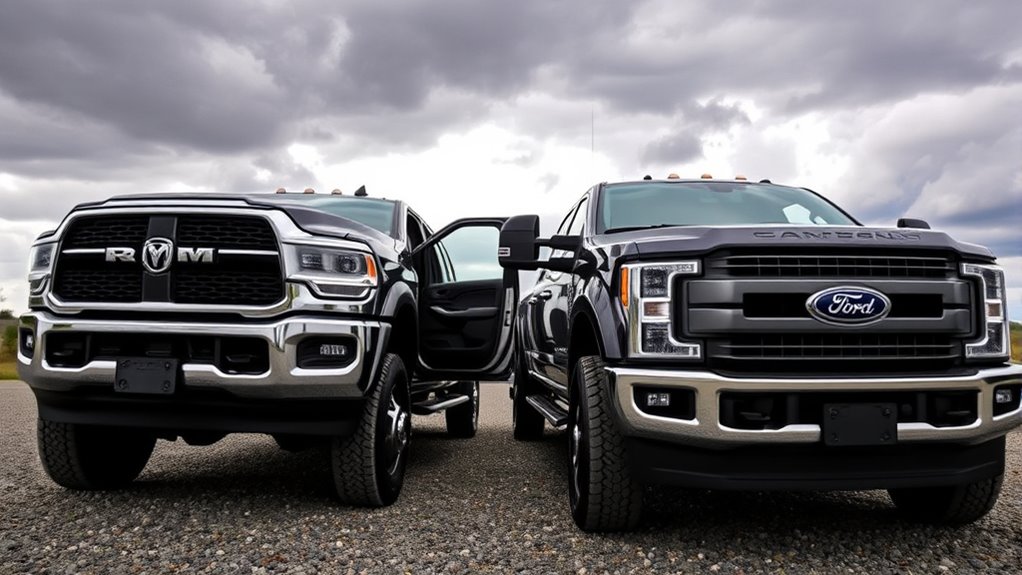
Both the Ram 2500 and Ford F-250 are equipped with robust transmission systems designed to handle heavy workloads, but they offer different driving experiences thanks to their gear setups. The Ford F-250 features a 10-speed automatic transmission that delivers smooth, seamless shifts, making driving feel more refined and less laborious, especially when towing or hauling. In contrast, the Ram 2500’s 8-speed automatic transmission pairs well with its Cummins diesel, providing reliable, consistent power delivery. While the Ford offers more gear options for refined performance, the Ram’s transmission prioritizes durability and simplicity. Your driving experience will depend on your needs—whether you prefer the smoothness and versatility of the Ford or the dependable, straightforward feel of the Ram. Understanding transmission systems can help you better grasp how these trucks handle heavy-duty tasks.
Interior Technology and Comfort Features
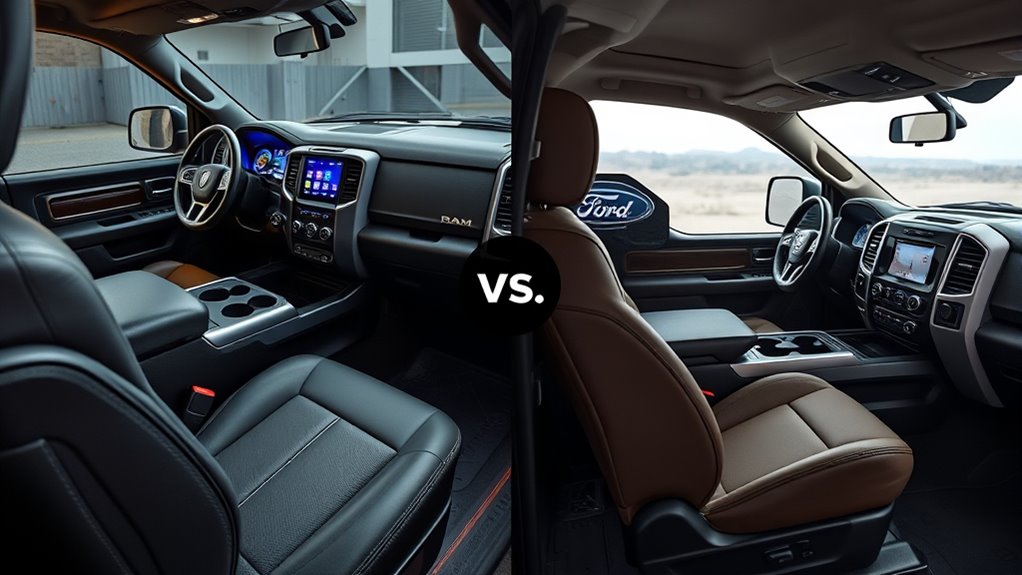
Interior technology and comfort features in the Ram 2500 and Ford F-250 are designed to enhance your driving experience with advanced displays, premium materials, and convenient amenities. The Ram 2500 offers a 12-inch Uconnect touchscreen with split-screen capability, leather upholstery, and wood or metal accents that elevate the cabin’s luxury feel. The digital rearview mirror with tow mode adds practicality. Meanwhile, the Ford F-250 features SYNC 4 infotainment, a 12-inch digital instrument cluster, and Pro Trailer Backup Assist, making navigation and towing easier. Both trucks include dual-zone climate control, heated seats, and premium audio options, providing comfort during long hauls. Overall, each truck prioritizes a driver-centric interior that balances technology and comfort to keep you engaged and relaxed on the road.
Advanced Safety and Assistance Technologies
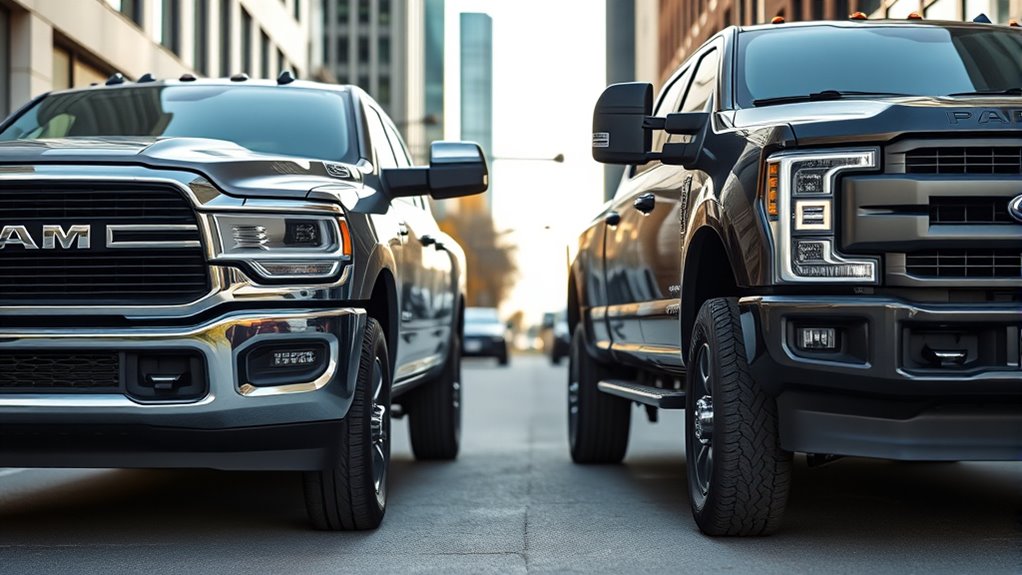
When it comes to safety and driver assistance, both trucks pack advanced features to keep you secure on the road. You’ll find systems like adaptive cruise control, lane-keeping assist, and pre-collision braking in both models, but they may differ in capabilities and availability. Let’s compare how each truck’s safety features and driver aids enhance your driving experience and confidence. For example, styling options may influence the integration and customization of these systems to suit your preferences.
Safety Feature Comparison
Advanced safety and driver assistance technologies are essential in helping you stay safe on the road, and both the Ford F-250 and Ram 2500 offer impressive features to enhance your driving experience. You’ll find a range of advanced systems designed to prevent accidents and assist with maneuvering. For example, the Ford F-250 includes adaptive cruise control, lane-keeping assist, and pre-collision braking to help you stay alert and avoid obstacles. Meanwhile, the Ram 2500 offers a digital rearview mirror with tow mode, parking sensors, and available blind-spot monitoring. These features work together to give you better control and awareness, reducing the risk of accidents. Both trucks prioritize safety, but their specific technologies cater to different driving needs and preferences. Modern safety systems are continually evolving to improve driver confidence and road safety.
Driver Assistance Systems
Driver assistance systems play a crucial role in enhancing safety and making towing and hauling less stressful, especially on challenging roads. Both the Ford F-250 and Ram 2500 come equipped with advanced safety features that support confident driving. Ford offers SYNC 4 with a digital gauge cluster, adaptive cruise control, lane-keeping assist, and pre-collision braking, helping you stay alert and avoid obstacles. The Ram 2500 features a digital rearview mirror with tow mode, alongside parking sensors and trailer sway control. These systems work together to improve stability, prevent accidents, and reduce driver fatigue. While each truck emphasizes different technologies, both prioritize driver assistance to make heavy-duty driving safer, easier, and more controlled—especially when handling large loads or maneuvering difficult terrain. Safe installation practices and proper system calibration are essential to maximize the benefits of these safety features.
Pricing Structures and Value Proposition
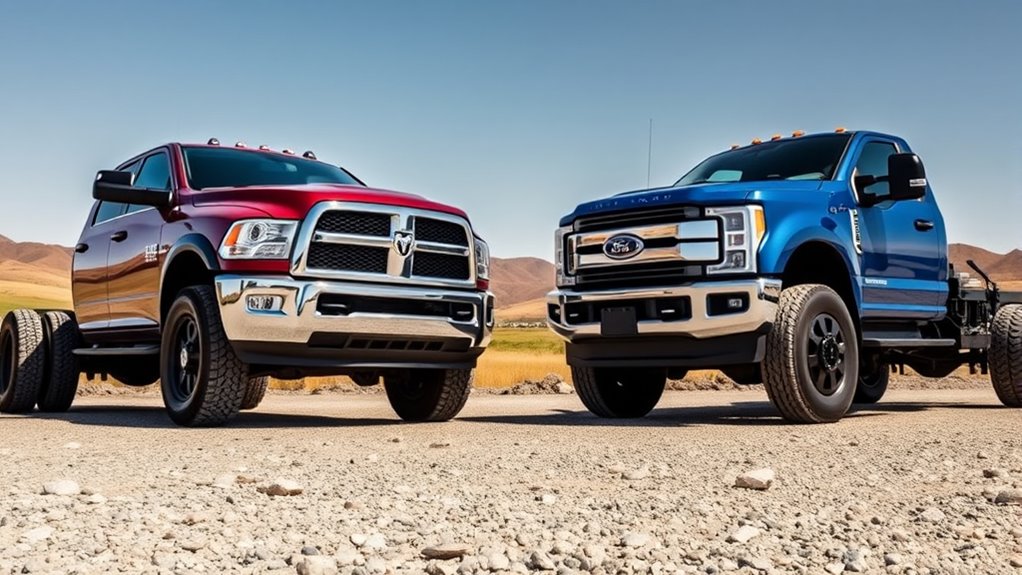
Pricing for the Ram 2500 and Ford F-250 is closely aligned, but subtle differences can influence your decision. The Ford F-250 has a slightly lower starting MSRP at $47,395 compared to Ram’s range of $47,660–$49,080. When considering value, think about:
- Warranty coverage: Ford offers a 5-year/100,000-mile powertrain warranty, giving you peace of mind longer-term.
- Feature options: Both trucks provide premium tech and safety features, but Ford’s digital gauges and SYNC 4 system add extra convenience.
- Resale value: Ford trucks tend to hold their value better, which can impact overall cost of ownership.
Ultimately, your choice depends on which features and warranty benefits matter most, alongside initial price considerations.
Warranty Coverage and After-Sales Support
When it comes to warranty coverage and after-sales support, the Ford F-250 offers a longer-term protection plan that can give you peace of mind over the years. Its 5-year/100,000-mile powertrain warranty surpasses Ram’s 3-year/36,000-mile bumper-to-bumper coverage, meaning you’re protected longer against major repairs. Ford’s extensive dealer network guarantees easier access to service and genuine parts, making maintenance more straightforward. Ram’s warranty is competitive but shorter, which might require you to contemplate extended coverage options. Both brands provide roadside assistance programs, but Ford’s coverage tends to be more thorough during the warranty period. Overall, Ford’s longer warranty and established support network offer a strong advantage if you want reliability and peace of mind for the long haul.
Practical Applications and Ideal Uses
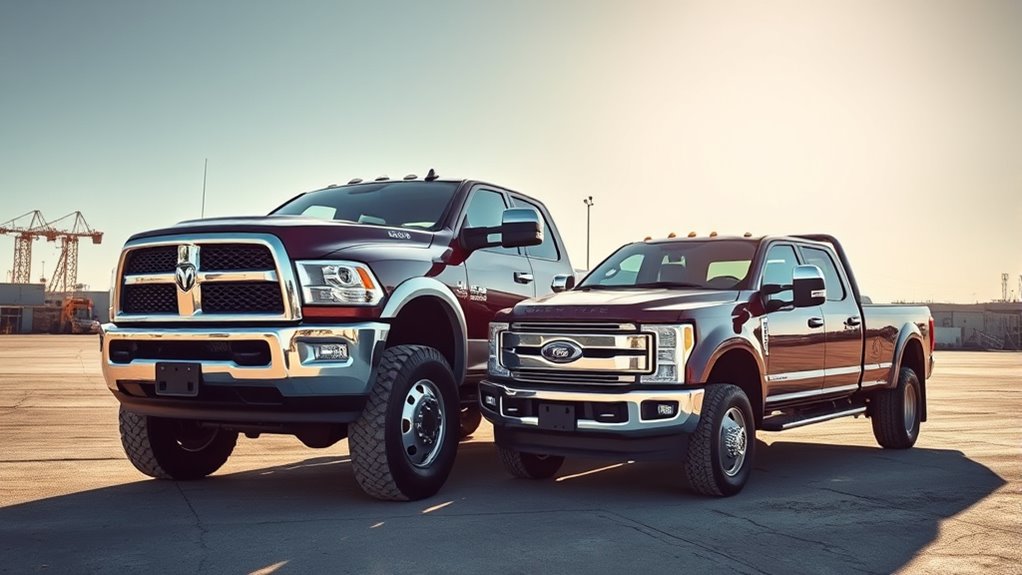
Both the Ram 2500 and Ford F-250 excel in heavy-duty applications, making them ideal choices for towing, hauling, and construction work. If you’re frequently towing large trailers or hauling heavy loads, the Ford F-250’s higher towing capacity and multiple engine options give you an edge. On the other hand, if your work involves consistent payloads or construction materials, the Ram 2500’s slightly higher payload capacity and robust diesel options provide greater reliability and efficiency.
- Towing large trailers or equipment across long distances
- Hauling heavy construction materials or landscaping supplies
- Performing demanding off-road or rough terrain tasks
Final Comparison and Which One to Choose

Choosing between the Ram 2500 and Ford F-250 ultimately depends on your specific needs and priorities. If towing capacity is your main concern, the F-250’s higher maximum of around 23,000 pounds gives it an edge. For payload, Ram offers a slight advantage with up to 4,420 pounds. When it comes to engines, Ford provides more options, including the powerful 6.7L Power Stroke Turbo Diesel, while Ram has a strong Cummins diesel. Technology also varies; Ford’s SYNC 4 and advanced safety features appeal to tech-savvy drivers, while Ram’s interior offers a luxurious touch. Pricing favors Ford slightly, and its longer warranty provides extra peace of mind. Ultimately, your choice hinges on whether towing strength, engine variety, or comfort is your top priority.
Frequently Asked Questions
How Do the Towing and Payload Capacities Compare in Real-World Conditions?
In real-world conditions, you’ll find that the Ford F-250 often handles heavier towing loads more comfortably, thanks to its higher maximum capacity of around 22,000–23,000 pounds. The Ram 2500, with a max of about 20,000 pounds, still performs well but may require more precise setup for ideal results. For payload, Ram’s slightly higher capacity means you can carry a bit more weight comfortably, but both trucks are excellent for heavy-duty tasks.
Which Truck Offers Better Fuel Efficiency and Operating Costs?
You’ll find that the Ram 2500 generally offers better fuel efficiency, especially with its Cummins diesel engine, which is known for its impressive MPG and lower operating costs. Ford F-250’s larger engines tend to consume more fuel, increasing expenses over time. If saving on fuel and maintenance matters most, Ram’s diesel options provide a more economical choice for heavy-duty work, helping you cut costs without sacrificing power.
What Are the Long-Term Reliability and Maintenance Considerations?
You’re about to face a choice that impacts your long-term peace of mind. Both trucks are built tough, but Ford’s longer warranty and proven track record suggest fewer surprises down the road. Ram offers solid reliability too, but maintenance costs may add up after the warranty expires. Trust your needs—if durability and lower repair risks matter most, Ford might be your safer bet for lasting performance.
How Do the Trucks Perform in Off-Road and Challenging Terrains?
You’ll find both trucks perform well off-road and on challenging terrains, thanks to their heavy-duty suspensions and available four-wheel drive systems. The Ram 2500 offers a comfortable ride with its adaptive air suspension and excellent traction control, while the Ford F-250’s high ground clearance and Pro Trailer Backup Assist help you navigate tough spots. Your choice depends on whether you prioritize smoothness or advanced terrain features.
Which Model Provides Better Resale Value Over Time?
You’ll find that Ford F-250 generally offers better resale value over time. It has a strong reputation for durability, brand recognition, and higher demand in the used truck market. Ford’s extensive dealer network and proven reliability contribute to its retention value. While Ram 2500 also holds its worth well, Ford’s broader appeal and solid track record make it a smarter investment for long-term resale.
Conclusion
When choosing between the RAM 2500 and Ford F-250, consider your towing and payload needs. Did you know that the F-250 can tow up to 37,000 pounds with the right configuration? If heavy-duty hauling is your priority, the F-250 might be the better fit. However, if interior comfort and technology are more important, RAM offers strong options. Ultimately, pick the truck that aligns best with your work and lifestyle needs.
Halloween Picks
halloween
As an affiliate, we earn on qualifying purchases.