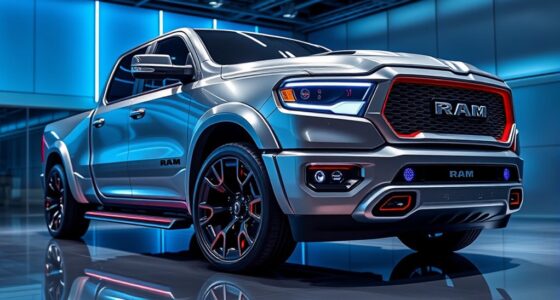
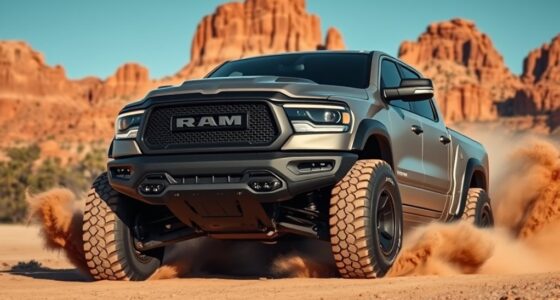
The Ram 1500 outperforms the Toyota Tundra in several key areas, especially with its quicker acceleration, better fuel economy, and lower long-term ownership costs. Ram offers more powerful engine options, including a 540-horsepower twin-turbo I6, and boasts faster 0-60 times. While the Tundra has a slightly higher towing capacity, Ram’s overall performance and efficiency make it a more versatile choice. To see how these trucks stack up in details, keep exploring the differences.

Get business pricing on garage and car supplies
- Business-only prices and quantity discounts
- Tax-exempt purchasing
- Multiple users, one account, clear invoices
Key Takeaways
- Ram offers a more powerful 540-hp twin-turbo I6 engine, surpassing Tundra’s V8 in horsepower and torque.
- Ram accelerates faster, reaching 0-60 mph in 4.2 seconds versus Tundra’s 4.9 seconds.
- Ram’s lower operational costs (fuel, insurance) improve long-term value despite similar initial prices.
- Tundra has higher towing capacity (12,000 lbs) but lower payload capacity compared to Ram.
- Ram’s superior performance, efficiency, and engine options make it the stronger choice overall.
As an affiliate, we earn on qualifying purchases.
Price Comparison and Value Proposition
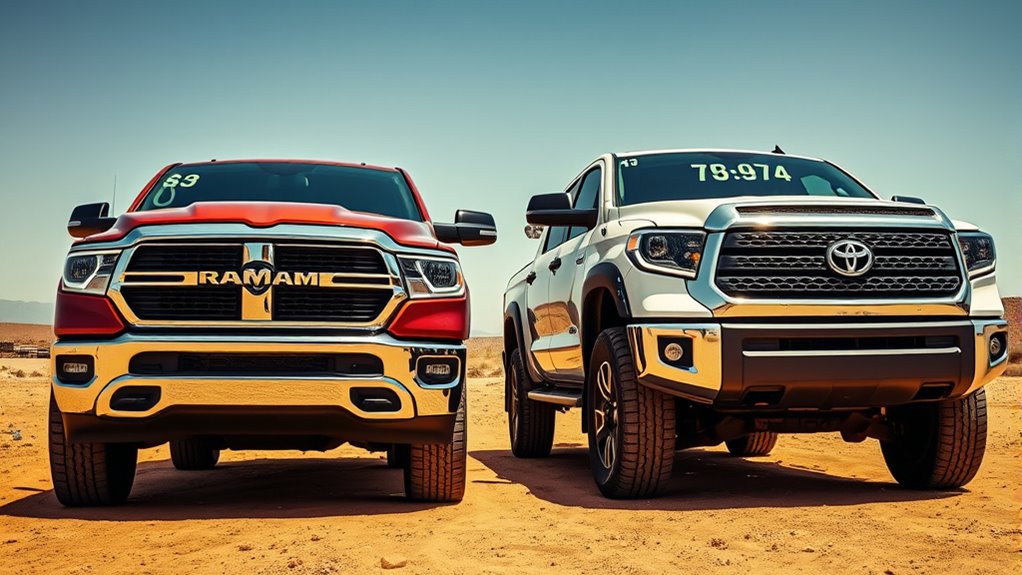
When comparing the Ram 1500 and Toyota Tundra, you’ll find that their starting MSRPs are very close—$43,620 for the Ram and $43,355 for the Tundra—making price less of a differentiator at the base level. However, when you equip similar features, the Ram is about $265 more expensive. Despite this, the Ram offers better long-term value through lower annual fuel costs—$10,537 compared to Tundra’s $11,587—and cheaper insurance, saving you roughly $328 annually. Maintenance costs are comparable, but the Ram’s slightly higher purchase price is offset by these ongoing savings. Overall, both trucks are priced competitively, but the Ram’s lower operational costs could make it a smarter investment over time. Additionally, considering the long-term value proposition, the Ram’s features may provide more benefits over the lifespan of the vehicle.
As an affiliate, we earn on qualifying purchases.
Engine Power and Performance Metrics
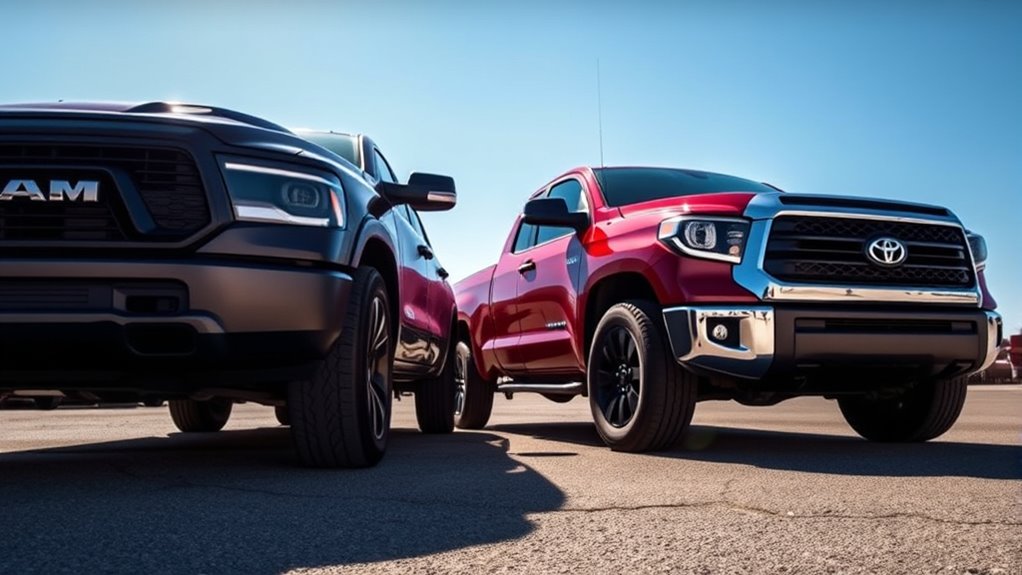
Engine power is a key factor in determining how these trucks perform on the road. You’ll notice that the Ram 1500’s standard engine delivers 305 horsepower, while the Tundra’s standard V6 offers 358 horsepower—initially suggesting Tundra’s edge. However, the Ram’s optional 3.0L Hurricane twin-turbo I6 pumps out a commanding 540 horsepower, dwarfing Tundra’s 437 horsepower. The Tundra’s i-FORCE MAX hybrid system boasts 583 lb-ft of torque, but the Ram’s maximum torque hits 521 lb-ft with its premium engine. Suprem fabric’s durability and performance characteristics highlight the importance of choosing high-quality materials for long-lasting results.
Ram’s optional turbo engine delivers 540 horsepower, surpassing Tundra’s 437, with impressive torque for confident towing.
- Feel the raw power of the Ram’s turbocharged engine, ready to tackle any challenge
- Experience quicker acceleration with Ram’s superior horsepower and torque
- Enjoy confident towing and hauling, knowing your engine’s performance won’t hold back
best truck for towing and hauling
As an affiliate, we earn on qualifying purchases.
As an affiliate, we earn on qualifying purchases.
Acceleration and Test Drive Results
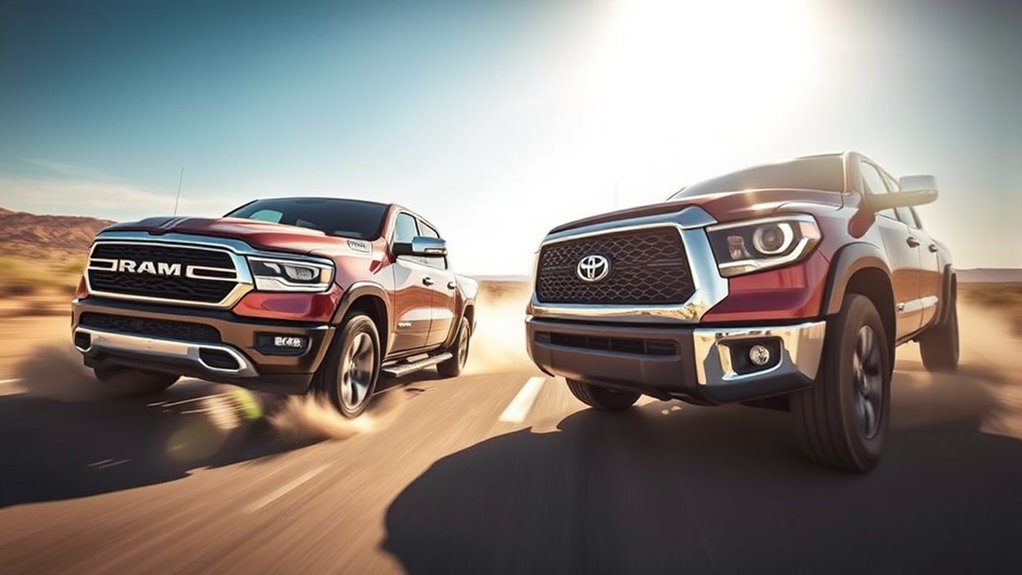
The Ram 1500 outperforms the Toyota Tundra in acceleration tests, delivering quicker 0-60 mph times across various configurations. In testing, the Ram Limited achieves this speed in just 4.2 seconds, while the Tundra Limited takes around 4.9 seconds. This performance gap holds true in multiple configurations, with the Ram consistently pulling ahead. You’ll notice the difference during test drives, especially when merging or passing on the highway. The Ram’s turbocharged engines, particularly the 3.0L Hurricane twin-turbo I6, provide rapid acceleration that’s both responsive and confident. Meanwhile, the Tundra’s standard twin-turbo V6 lags slightly behind, taking longer to reach highway speeds. Overall, the Ram’s acceleration results give it a clear edge in dynamic driving situations.
As an affiliate, we earn on qualifying purchases.
Towing and Payload Capacities
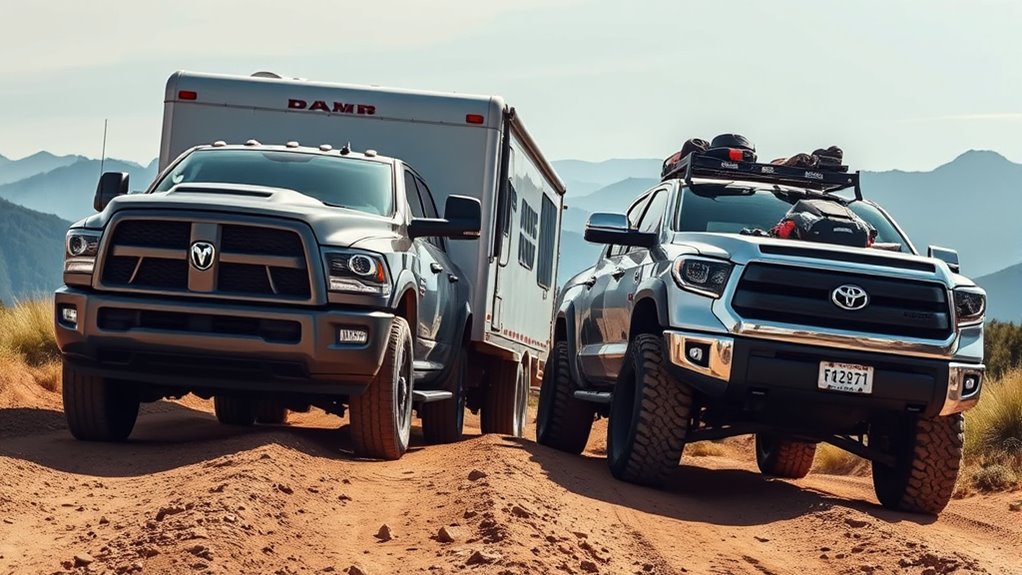
While acceleration demonstrates a vehicle’s quickness off the line, towing and payload capacities directly impact its ability to handle heavy loads. The Toyota Tundra outshines the Ram 1500 with a maximum towing capacity of 12,000 pounds, compared to Ram’s 11,550 pounds. However, the Ram 1500 excels in payload, supporting up to 2,370 pounds versus Tundra’s 1,940 pounds. This means you can haul heavier cargo in the Ram. Additionally, energy-efficient cloud servers are increasingly being used in automotive technology to enhance vehicle connectivity and smart features.
- Feel confident towing large trailers with the Tundra’s higher capacity
- Rely on the Ram for heavier payloads and bulkier loads
- Experience a lighter curb weight, making the Ram more agile when hauling
Both trucks are capable, but your choice depends on whether towing strength or payload capacity matters most to you.
Fuel Economy and Operating Costs

When comparing fuel economy and operating costs, you’ll notice that the Ram 1500 offers better fuel savings with its higher MPG ratings. This can lead to lower overall ownership expenses, even if the initial price is slightly higher. Considering these factors helps you choose a truck that balances performance with long-term costs. Additionally, understanding the vehicles’ performance evolution over time can provide insights into their durability and maintenance needs.
Fuel Savings Advantage
Despite their similar starting prices, the Ram 1500 offers a clear fuel economy advantage that can lead to significant savings over time. With 20 MPG city and 25 MPG highway, it outperforms the Tundra’s 18 and 23 MPG, saving you money on fuel each year. Over time, these differences add up, reducing your operating costs. You’ll enjoy:
- Lower annual fuel expenses, putting more money back in your pocket
- Extended driving range, so you can go further without refueling
- Reduced environmental impact, thanks to better efficiency
- Incorporating Free Floating design principles can help optimize your vehicle’s aerodynamics and efficiency.
This fuel savings edge makes the Ram 1500 a smarter choice for daily driving and long-term ownership, offering both economic and ecological benefits without sacrificing performance.
Cost of Ownership
The Ram 1500’s superior fuel economy directly impacts your overall ownership costs, making it a more economical choice over the long run. With annual fuel costs around $10,537, it saves you roughly $1,050 compared to the Tundra’s $11,587. Additionally, insurance costs are lower for the Ram, saving about $328 annually. Maintenance expenses are comparable but slightly better for the Ram, helping keep ongoing costs down. While the Tundra offers higher towing capacity, the Ram’s better fuel efficiency and lower insurance and fuel costs make it more affordable to own day-to-day. Over time, these savings accumulate, reducing your total cost of ownership. So, if you’re looking to keep expenses manageable, the Ram 1500 provides a clearer financial advantage. Well-draining soil for optimal vehicle storage and maintenance can also help in the longevity of your truck.
Interior Comfort and Passenger Space
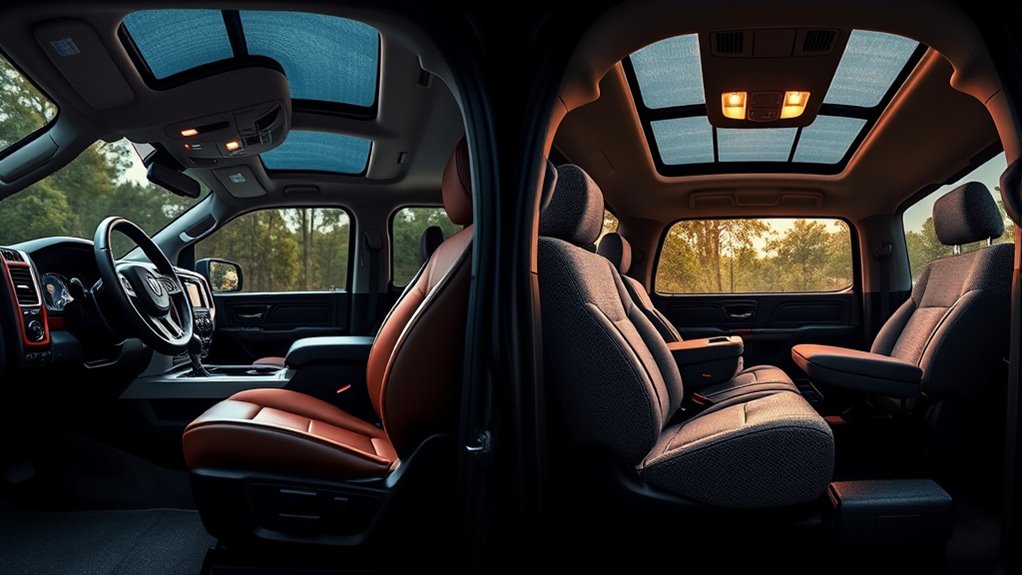
Choosing between the Ram 1500 and Toyota Tundra means considering how comfortable and spacious their interiors feel. The Ram 1500 offers seating for up to six passengers, giving you more room to relax or accommodate friends and family. Its larger wheelbase contributes to a more open cabin, enhancing overall comfort. The Tundra, with its five-passenger capacity and slightly shorter wheelbase, still provides a cozy, functional interior but with less overall space. Additionally, the Ram 1500’s smart design incorporates thoughtful features that maximize interior comfort and usability for all occupants. Some key differences include:
- Ram 1500’s larger cabin seats more passengers comfortably
- Enhanced legroom and headroom in the Ram for long drives
- Tundra’s slightly tighter fit, but still practical for daily use
Safety Features and Driver Assistance Technology

Both trucks offer impressive safety features, but you’ll find differences in their driver assistance options. The Ram 1500 provides an optional hands-free active driving assist system, while the Tundra comes standard with dynamic radar cruise control and Toyota Safety Sense. Understanding these systems helps you choose the vehicle that best supports your safety needs. Additionally, home‑life tips can help you optimize your vehicle maintenance routine to ensure safety and reliability.
Advanced Safety Systems
Advanced safety systems have become a key factor in evaluating modern trucks, as they help protect you and your passengers on the road. Both the Ram 1500 and Toyota Tundra offer impressive safety features, but they differ in their technology emphasis. The Tundra comes standard with Toyota Safety Sense, including adaptive cruise control, lane departure alert, and pre-collision systems, giving you peace of mind. Meanwhile, the Ram 1500 offers optional hands-free active driving assist, enhancing your confidence during highway drives.
Consider these safety benefits:
- ✨ Forward collision avoidance protects you from unexpected obstacles.
- 🚗 Blind spot detection keeps you aware of surrounding vehicles.
- 🌐 Surround view cameras provide a complete view around your truck.
These systems work together to keep you safer, smarter, and more confident behind the wheel.
Driver Assistance Options
Driver assistance options in modern trucks play a vital role in enhancing safety and reducing driver fatigue. You’ll find both the Ram 1500 and Toyota Tundra equipped with essential safety features like forward collision avoidance, blind spot detection, and surround view cameras. The Ram 1500 offers an optional hands-free active driving assist system, helping with steering and braking on compatible highways, giving you extra confidence on long drives. Toyota Tundra includes standard dynamic radar cruise control and additional Toyota Safety Sense features, which automatically adjust speed and alert you to potential hazards. These driver assistance technologies work together to make your driving experience safer and less stressful, whether steering through city streets or highways. Ultimately, both trucks prioritize your safety with advanced systems designed to support you every mile.
Exterior Dimensions and Practical Design
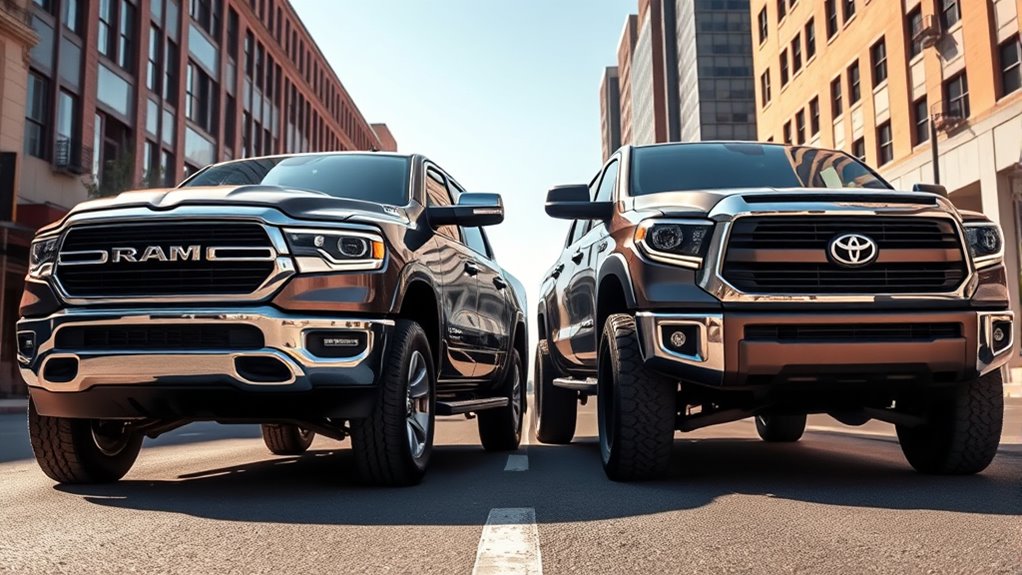
When comparing the exterior dimensions of the Ram 1500 and Toyota Tundra, you’ll notice that the Tundra has a slightly longer wheelbase at 145.7 inches, providing more interior space and stability on the road. The Ram 1500, however, offers a more streamlined design that’s easier to maneuver in tight spaces. You’ll appreciate the practical layout, including:
The Tundra’s longer 145.7-inch wheelbase offers more space and stability, while the Ram 1500 is easier to maneuver.
- A spacious bed for hauling large cargo with ease
- A lower overall height for better visibility and easier access
- Well-placed cargo tie-downs that secure your load confidently
These dimensions influence daily usability, making your drive smoother and more convenient. Whether you prioritize interior space or a more manageable size, both trucks deliver distinct advantages that suit different practical needs. For those interested in optimizing their vehicle’s utility, understanding practical vehicle design can help inform your choice.
Overall Ownership Costs and Incentives
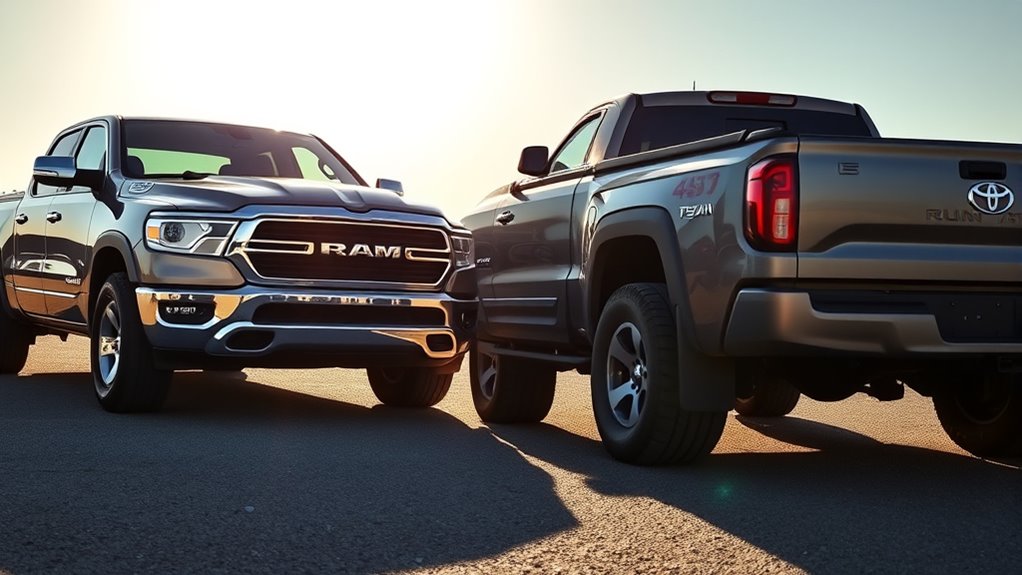
Considering the differences in size and features, your overall ownership costs play a significant role in choosing between the Ram 1500 and Toyota Tundra. The Ram 1500 has a slightly higher starting price but offers better fuel economy, saving you money on fuel annually. Insurance costs are lower for the Ram, reducing long-term expenses. Maintenance costs are comparable, but the Ram’s lighter weight can translate to less wear and tear. Incentives and rebates may vary depending on the region, but generally, the Tundra offers competitive pricing with strong resale value. Both trucks provide quality, but the Ram’s superior fuel efficiency and lower insurance premiums can make it more economical over time, especially if you prioritize reduced ownership costs. Additionally, understanding AI ethics can be beneficial if you’re considering the integration of smart technology features to enhance your vehicle’s safety and functionality.
Which Truck Offers the Best Overall Performance
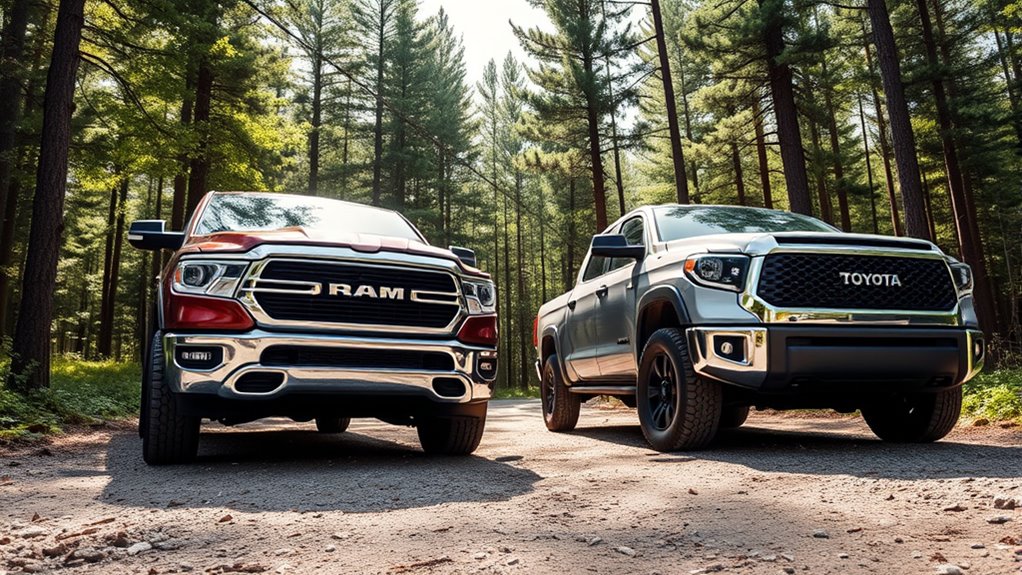
The Ram 1500 outperforms the Toyota Tundra in overall performance thanks to its superior acceleration, fuel efficiency, and available powertrain options. You’ll feel the thrill of faster acceleration, with the Ram reaching 0-60 mph in just 4.2 seconds, outperforming the Tundra’s 4.9 seconds. Its engine options provide impressive horsepower and torque, especially the 540-horsepower twin-turbo I6. Plus, the Ram’s better fuel economy means more miles between fill-ups, saving you money and stress.
- Experience exhilarating speed and power when you need it most
- Save on fuel costs with more efficient performance
- Enjoy a smoother, more responsive driving experience
Frequently Asked Questions
How Does Each Truck’s Resale Value Compare Over Time?
You’ll find that the Toyota Tundra generally holds its resale value better over time, thanks to its strong reputation for reliability and durability. The Ram 1500 also retains good value, especially with its modern features and performance, but it tends to depreciate faster than the Tundra. If resale value is a top priority for you, the Tundra’s higher retention rate makes it a smarter investment in the long run.
What Are the Long-Term Reliability Differences Between Ram 1500 and Tundra?
Think of your truck as a loyal companion on the road’s rugged trail. Toyota Tundra’s reputation for long-term reliability outshines Ram 1500’s, thanks to its proven track record and fewer mechanical issues. You’ll find Tundra’s build more resilient over time, needing fewer repairs, while Ram 1500 may require more maintenance and repairs as miles accumulate. If durability’s your priority, Tundra’s the steady partner you can count on.
Which Truck Has Better Off-Road Capabilities and Features?
You’ll find the Toyota Tundra generally has better off-road capabilities, thanks to its standard multi-terrain select system, crawl control, and available off-road packages like TRD Pro. The Ram 1500 offers good off-road features, but its focus leans more toward comfort and on-road performance. If off-roading is your priority, Tundra’s specialized features and rugged design give it a clear edge over the Ram 1500.
How Do Warranty Coverage and Service Plans Differ?
You’ll find that Ram 1500 offers a more thorough warranty, including a 3-year/36,000-mile basic coverage and a 5-year/100,000-mile powertrain warranty, often with additional roadside assistance. Toyota Tundra’s warranty includes a 3-year/36,000-mile basic plan and a 5-year/60,000-mile powertrain warranty. Ram’s longer coverage and optional service plans provide better value, ensuring your truck stays protected longer and reducing potential repair costs over time.
What Are Owners’ Real-World Experiences With Maintenance and Repairs?
You’ll find that owners generally report lower maintenance and repair costs with the Ram 1500, thanks to its simpler design and reliable components. Many appreciate the shorter service intervals and fewer visits to the shop. In contrast, Tundra owners sometimes mention higher costs and more frequent repairs, especially for older models. Overall, Ram owners enjoy easier ownership, while Tundra owners note durability but at a slightly higher maintenance expense.
Conclusion
Ultimately, choosing between the Ram 1500 and Toyota Tundra is like picking your favorite star in a vast night sky—each shines brightly in its own right. If you crave raw power and rugged charm, the Ram’s V8 roars louder. For reliability and balanced performance, the Tundra stands tall. Whichever you select, remember you’re steering a mighty ship through the roads, charting your own adventure with confidence and style. The road is calling—choose your champion wisely.
Halloween Picks
halloween
As an affiliate, we earn on qualifying purchases.