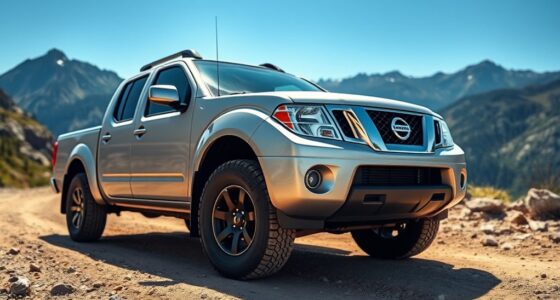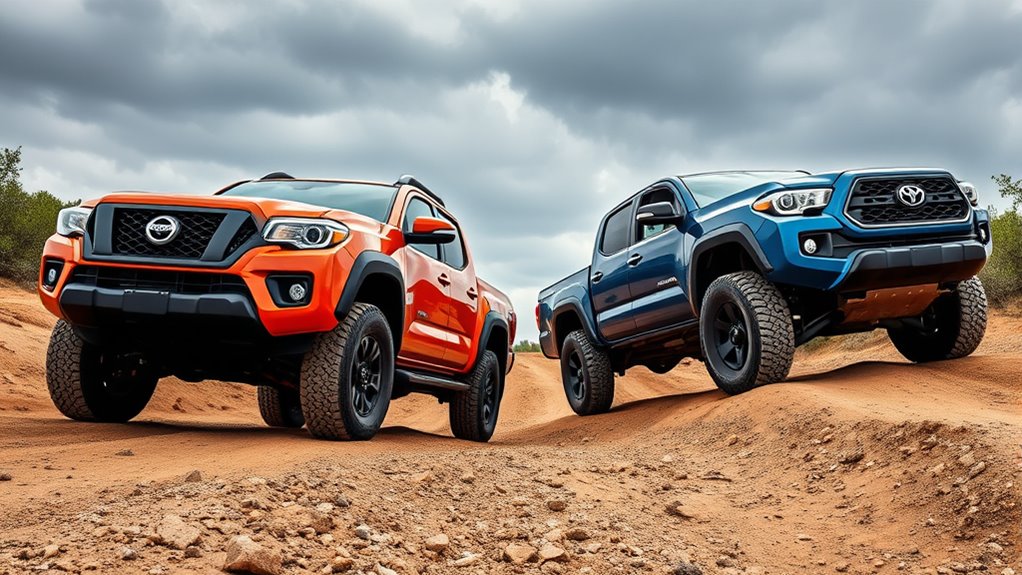
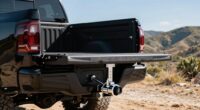
The Nissan Frontier Pro-4X offers a powerful 3.8L V6 engine, durable Bilstein shocks, and around 9.8″ ground clearance, making it reliable for tough terrains, with basic off-road tech like hill descent control. The Toyota Tacoma TRD Off-Road features a turbocharged 2.4L engine, advanced terrain management including Multi-Terrain Select and Crawl Control, and about 11″ ground clearance for challenging off-road trails. Your choice depends on if you want brute strength or advanced off-road tech—exploring further reveals which suits your adventure style best.
Key Takeaways
- Tacoma offers advanced off-road tech like Multi-Terrain Select and Crawl Control, while Frontier provides basic hill descent control and off-road gauges.
- Tacoma has a higher ground clearance (~11″) and approach angle (~30°), enhancing technical trail capability compared to Frontier’s ~9.8″ clearance.
- Tacoma features a disconnecting sway bar and superior articulation, making it more adept on challenging terrains; Frontier emphasizes durability with less tech.
- Both trucks include off-road packages, but Tacoma’s terrain management systems and advanced suspension give it a performance edge off-road.
- The Frontier’s off-road package focuses on mechanical robustness and simplicity, while Tacoma’s package integrates sophisticated terrain control and tech features.

2 Pcs Shovel Holder for Truck, Heavy Duty Shovel Mounts for Roof Rack, Quick Release Axe Holder Mount Kit, Metal and Rubber Car Accessories/ Garage Storage/ Truck/ Wall Mounting Brackets
【Durable Metal Rubber Clamps】Our shovel holders are equipped with metal supporting brackets and quality rubber buckles; This tool…
As an affiliate, we earn on qualifying purchases.
As an affiliate, we earn on qualifying purchases.
Engine Performance and Powertrain Differences

When comparing the engine performance of the Nissan Frontier Pro-4X and the Toyota Tacoma TRD Off-Road, the Frontier’s 3.8L V6 stands out with its naturally aspirated design, delivering 310 horsepower and 281 lb-ft of torque. This engine provides strong, linear power suitable for towing and heavy-duty tasks. The Frontier uses a 9-speed automatic transmission, offering smooth shifts and good efficiency. In contrast, the Tacoma features a turbocharged 2.4L inline-4 engine with 278 horsepower and 317 lb-ft of torque, paired with an 8-speed automatic. The turbocharged setup emphasizes fuel efficiency and low-end torque, but it’s less powerful overall. While the Frontier’s engine emphasizes raw power, the Tacoma’s engine offers a blend of efficiency and torque, making each suited to different driving priorities. Additionally, engine technology plays a significant role in optimizing performance and reliability for off-road adventures.

Suitable for Front Upper Grill for 2022-2024 Nissan Frontier (DC/Hardbody Edition/LE/PRO-4X/PRO-X/Platinum LE) | Replacement Part 62310-9BU0D | Sleek Black Finish | Perfect Fit for 2.5L & 3.8L Engines
– **Perfect Fit:** Designed specifically for the 2022-2024 Nissan Frontier DC, including Hardbody Edition, LE, PRO-4X, PRO-X, Platinum…
As an affiliate, we earn on qualifying purchases.
As an affiliate, we earn on qualifying purchases.
Off-Road Capabilities and Terrain Management Tools

When it comes to off-road capabilities, the terrain management tools each truck offers can make or break your adventure. The Tacoma TRD Off-Road features advanced tech like Multi-Terrain Select and Crawl Control, giving you more control over difficult terrain. Meanwhile, the Frontier Pro-4X provides essential tools like hill descent control and off-road gauges, but with fewer automated systems for terrain adjustment. Incorporating European cloud innovation can enhance data management and vehicle connectivity in off-road environments, ensuring more reliable performance in remote areas.
Terrain Management Features
Terrain management features play a crucial role in how well a truck handles rough and challenging off-road conditions. The Nissan Frontier Pro-4X offers basic terrain management with hill descent control and off-road gauges, giving you essential feedback and control. Its hill descent system helps you maintain a steady speed on steep declines, but it lacks advanced terrain modes. In contrast, the Toyota Tacoma TRD Off-Road provides more sophisticated tools like Multi-Terrain Select, which lets you customize traction settings for mud, sand, or rocks. It also includes Crawl Control, enabling low-speed, hands-free navigation over tough terrain. Additionally, the Tacoma’s disconnecting sway bar improves articulation and stability on uneven surfaces. These features give you greater confidence and adaptability when tackling diverse off-road environments and highlight the importance of terrain management systems in off-road driving.
Off-Road Tech Tools
Off-road tech tools considerably influence a truck’s ability to handle tough terrain with confidence. These features enhance traction, control, and safety, making your off-road adventures smoother and more predictable. The Nissan Frontier Pro-4X offers hill descent control, off-road gauges, skid plates, and a locking rear differential—basic yet effective tools. In contrast, the Toyota Tacoma TRD Off-Road integrates more advanced tech, including Multi-Terrain Select, Crawl Control, and a disconnecting sway bar. These systems allow you to customize traction management, maintain low-speed control, and improve articulation over obstacles. Both trucks provide essential off-road tools, but Tacoma’s tech suite offers greater terrain adaptability, giving you more confidence on challenging trails. Your choice depends on whether you prioritize simple reliability or advanced terrain management.

Maisto 1:27 Off-Road 2023 Toyota Tacoma TRD Pro
Collectible quality True-to-scale detailed vehicle
As an affiliate, we earn on qualifying purchases.
As an affiliate, we earn on qualifying purchases.
Suspension, Ground Clearance, and Approach Angles

The suspension systems on the Nissan Frontier Pro-4X and Toyota Tacoma TRD Off-Road are designed to handle tough trails, but they differ in capability and approach. The Frontier’s suspension prioritizes durability with heavy-duty Bilstein shocks and a solid setup that handles rough terrain well, though it offers slightly less articulation than the Tacoma. Tacoma’s suspension features upgraded Bilstein shocks and a disconnecting sway bar, providing superior wheel travel and better articulation for uneven surfaces. Ground clearance on the Tacoma measures about 11 inches, giving it an edge over the Frontier’s approximately 9.8 inches, which enhances obstacle clearance and approach angles. The Tacoma’s approach angle is roughly 30 degrees, while the Frontier’s is around 27 degrees, making Tacoma more adept at tackling steep inclines and rocky terrain. Additionally, suspension articulation plays a crucial role in off-road performance, influencing how well each vehicle can maneuver over uneven surfaces.

Timloon Car Inclinometer Level Tilt Gauge Indicator Gradient Balancer Tool for Off-Road Vehicle and self-Driving Travelling Supplies
Safe Driving: In order to let you know the road condition better and ensure driving safety, the inclinometer…
As an affiliate, we earn on qualifying purchases.
As an affiliate, we earn on qualifying purchases.
Towing and Payload Capacities

When comparing towing and payload capacities, the Nissan Frontier Pro-4X stands out with its ability to tow up to 7,150 pounds, making it a strong choice for hauling heavy loads. Its higher towing capacity supports larger trailers, boats, or equipment, giving you more versatility on the road. The Tacoma TRD Off-Road, meanwhile, maxes out around 6,500 pounds, slightly lower but still capable for most tasks. In terms of payload, the Tacoma excels with approximately 1,610 pounds, compared to the Frontier’s 1,200 pounds, offering better utility for carrying gear or supplies. Here are some key points:
- Higher towing capacity in the Frontier
- Better payload capacity in the Tacoma
- Bed size variations favoring the Frontier
- Load distribution and trailer stability considerations
- Off-road package capabilities enhance both trucks’ performance on rugged terrains.
Interior Features and Technological Enhancements

When comparing the interior features, you’ll notice that Nissan offers off-road-specific gauges and an Intelligent Around View Monitor with Off-Road Mode, giving you better trail awareness. Toyota, on the other hand, provides advanced off-road tech like Multi-Terrain Select and Crawl Control, along with a more sophisticated infotainment system. Both trucks prioritize off-road monitoring, but each integrates different tech to enhance your driving experience.
Infotainment and Connectivity
Both the Nissan Frontier Pro-4X and the Toyota Tacoma TRD Off-Road prioritize off-road readiness with their infotainment and connectivity features, but they approach interior technology differently. You’ll find the Frontier equipped with off-road-specific gauges and an Intelligent Around View Monitor with Off-Road Mode, providing enhanced trail awareness. The Tacoma offers Multi-Terrain Select, Crawl Control, and a more advanced infotainment system tailored for off-road adventures. Additionally, the Tacoma’s local automation capabilities allow for more integrated and customizable off-road settings.
- Frontier features include a straightforward touchscreen, off-road gauges, and a backup camera.
- Tacoma’s system integrates terrain management, smartphone connectivity, and premium audio options.
- The Frontier’s interface is simple, focusing on durability and ease of use.
- Tacoma’s tech emphasizes versatility, offering more customization and multimedia options.
Off-Road Monitoring Tech
Off-road monitoring technology enhances your trail experience by providing real-time insights into your vehicle’s performance and surroundings. The Nissan Frontier Pro-4X features off-road gauges and an Intelligent Around View Monitor with Off-Road Mode, helping you navigate tough terrain with clarity. Meanwhile, the Toyota Tacoma TRD Off-Road integrates Multi-Terrain Select and Crawl Control, allowing you to adapt to various surfaces seamlessly. Additionally, Free Floating systems can improve stability and control during off-road adventures.
Pricing, Value, and Overall Cost of Ownership

The Nissan Frontier Pro-4X typically costs around $35,000, making it a more budget-friendly option compared to the Toyota Tacoma TRD Off-Road, which starts at about $40,000. You’ll pay less upfront but still get solid off-road features and towing capacity. The Frontier’s simpler mechanical setup means fewer repairs and lower maintenance costs, boosting its overall value. Meanwhile, the Tacoma’s higher price reflects its advanced terrain tech, higher ground clearance, and greater payload capacity—ideal if off-road tech matters most to you. Keep in mind, the Tacoma’s hybrid options and broader trim choices can add to costs but enhance versatility. Overall, the Frontier offers a compelling mix of capability and affordability, while the Tacoma targets buyers seeking premium off-road features and higher utility. Off-road Package features in both models can significantly influence overall performance and ownership costs.
Summary of Strengths and Suitability for Off-Road Enthusiasts

If you’re an off-road enthusiast, each truck offers distinct strengths that could influence your choice. The Nissan Frontier Pro-4X excels with its powerful 3.8L V6 engine, higher towing capacity, and reliable mechanical setup, making it ideal for those who prioritize raw power and durability. Its hydraulic steering provides authentic tactile feedback, enhancing driver control on rough terrains. On the other hand, the Toyota Tacoma TRD Off-Road features higher ground clearance, advanced off-road tech like Crawl Control, Multi-Terrain Select, and a disconnecting sway bar, making it better suited for challenging trails and technical terrain. The Tacoma’s superior approach angles and articulation boost its off-road agility. Both trucks are capable, but your decision hinges on whether you value brute strength and towing or advanced terrain management and ground clearance for more extreme adventures. Additionally, exploring hidden mysteries and the supernatural might seem unrelated, but understanding complex systems like off-road vehicle tech can sometimes feel like uncovering a secret world of engineering secrets.
Frequently Asked Questions
How Do the Off-Road Electronics Differ in User Interface and Ease of Use?
You’ll find that the Tacoma TRD Off-Road’s off-road electronics are more intuitive and easier to use, thanks to its dedicated controls like Multi-Terrain Select and Crawl Control, which you can adjust with simple knobs or buttons. In contrast, the Frontier’s off-road gauges and hill descent control require more familiarity and manual input, making user operation a bit less straightforward, especially for beginners or those unfamiliar with off-road tech.
Which Truck Offers Better Long-Term Reliability in Off-Road Conditions?
You’ll find that the Nissan Frontier Pro-4X generally offers better long-term reliability in off-road conditions. Its simpler, robust mechanical design has fewer electronic components that could fail over time, unlike the Tacoma’s advanced off-road electronics, which may require more maintenance and repairs. With a proven track record, the Frontier’s durable construction makes it a dependable choice for off-road adventures, especially if you prioritize reliability and lower maintenance costs.
Are There Significant Differences in Maintenance Costs for Each Vehicle’s Off-Road Features?
You’ll find that maintenance costs for both trucks’ off-road features are fairly similar, but Tacoma’s advanced tech like Crawl Control and disconnecting sway bar may require more specialized upkeep over time. The Frontier’s simpler setup with fewer electronic components generally leads to lower repair expenses. However, both vehicles benefit from routine checks of suspension, skid plates, and locking differentials, which are essential for off-road durability and keep costs predictable.
How Do the Trucks Perform in Deep Water Crossings or Mud?
Like ships charting stormy seas, your trucks handle water and mud differently. The Frontier Pro-4X’s higher ground clearance and steel skid plates help it tackle deep water crossings and muddy trails more confidently. Its robust V6 engine provides steady power, while the Hill Descent Control manages descent into water or mud. The Tacoma’s advanced off-road tech and disconnecting sway bar offer better articulation and control, but its lower clearance makes it slightly less capable in extreme conditions.
Which Model Has Better Aftermarket Support for Off-Road Modifications?
You’ll find that the Toyota Tacoma TRD Off-Road has a broader aftermarket support for off-road modifications. Its popularity among off-road enthusiasts means more aftermarket parts, lift kits, tires, and accessories are readily available. While the Nissan Frontier Pro-4X has some support, it’s not as extensive. If customizing your truck for off-road adventures is a priority, Tacoma’s larger community and parts options make it the smarter choice.
Conclusion
So, whether you prefer the rugged Pro-4X or the versatile TRD Off-Road, both trucks prove they can handle off-road adventures—despite what you might expect from their fancy packages. It’s almost funny how a bit of extra ground clearance or skid plates can turn a daily driver into an off-road warrior. In the end, whichever you choose, you’re probably more prepared than you think—just don’t forget your mud boots.