
The Jeep Scrambler is a classic, rugged pickup that showcases Jeep’s off-road heritage and versatile design. Introduced in 1981 and produced until 1986, it features a distinctive half-cab style, removable tops, and off-road-capable features like locking differentials and high ground clearance. Its durable construction and powerful engines made it popular among enthusiasts and collectors. If you want to explore how it influenced modern trucks like the Jeep Gladiator, keep exploring its storied history.
Key Takeaways
- The Jeep Scrambler, introduced in 1981 as the CJ-8, is a classic pickup blending off-road capability with utility.
- Its distinctive half-cab design and removable tops emphasize rugged style and customization options.
- Powered by inline-four or inline-six engines, it features a part-time 4WD system for impressive off-road performance.
- Built with durable Dana axles and leaf spring suspension, it offers excellent ground clearance and trail readiness.
- As a limited-production icon, the Jeep Scrambler remains a sought-after collector’s vehicle representing Jeep’s rugged heritage.

Vital All-Terrain (16 Pack) Floor Pan Drain Plugs fits 1976-1986 Jeep CJ-7 1981-1986 Jeep CJ-8 Scrambler
Low Density Polyethylene (Plastic Not Rubber)
As an affiliate, we earn on qualifying purchases.
As an affiliate, we earn on qualifying purchases.
Origins and Production Timeline

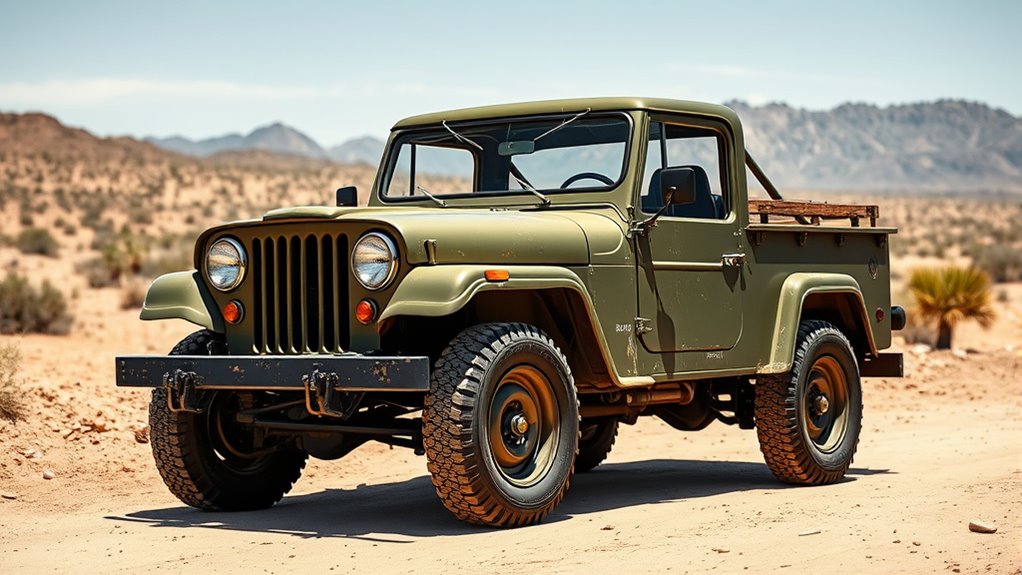
The Jeep Scrambler, known officially as the CJ-8, was introduced in 1981 as part of Jeep’s effort to expand its lineup of off-road vehicles. You’ll find that it was produced from 1981 to 1986 by American Motors Corporation (AMC). This model was a pickup truck derivative of the CJ-7, featuring a longer wheelbase of 103.5 inches, compared to the CJ-7’s 93.4 inches. During its five-year run, roughly 27,500 units rolled off the assembly line in Toledo, Ohio. The Scrambler served as a bridge between the CJ-7 and the larger CJ-10 pickups, offering a versatile combination of off-road capability and cargo capacity. Its production ended in 1986 as Jeep shifted focus to the new Wrangler series, driven by evolving safety standards. Understanding vehicle evolution helps enthusiasts appreciate how models like the Scrambler fit into Jeep’s broader history.

Nilight 2 Pack 3/4" D-Ring Shackle 4.75 Ton (9500 Lbs) Capacity with 7/8" Pin Heavy Duty Off Road Recovery Shackle with Isolators & Washer Kit for Jeep Truck Vehicle, Red (90053B)
【 UNIVERSAL D RING SHACKLES 】 – 3/4" d-ring shackles 4.75 Ton (9,500 Lbs),with an Industry Standard 7/8"…
As an affiliate, we earn on qualifying purchases.
As an affiliate, we earn on qualifying purchases.
Unique Design Elements and Body Features

The Jeep Scrambler stands out with its half-cab body style, giving it a distinctive look and practical versatility. You can choose between hard or soft removable tops, allowing you to customize for weather or style. These design features combine rugged appeal with functional flexibility, making the Scrambler a true off-road icon. Additionally, innovative design elements such as integrated AI-driven systems enhance the vehicle’s capabilities and user experience.
Half-Cab Body Style
The Jeep Scrambler’s half-cab body style stands out for its rugged, utilitarian design that combines open-air versatility with practical protection. You’ll notice the distinctive open sides beneath the removable roof panels, giving you the option to enjoy open-air driving or added shelter when needed. The half-cab design preserves the classic Jeep look while maximizing cargo space in the pickup bed behind the cab. Its simple, straightforward construction emphasizes durability and off-road capability, with reinforced panels and minimal ornamentation. This design also keeps weight down, enhancing maneuverability and off-road performance. Overall, the half-cab body style reflects Jeep’s focus on practicality and adventure, offering a unique blend of open-air fun and functional protection tailored for outdoor enthusiasts and rugged terrains. Innovative design elements ensure that the Jeep Scrambler remains a versatile and iconic vehicle in its class.
Removable Roof Options
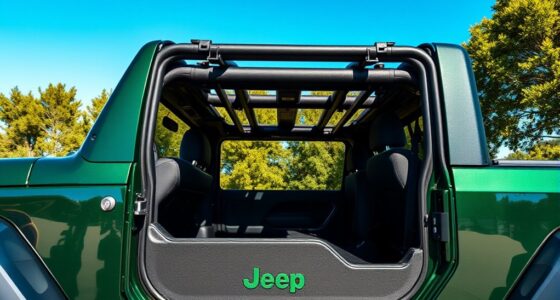
Removable roof options on the Jeep Scrambler enhance its versatility and open-air driving experience. You can choose between hard or soft tops, allowing you to adapt the vehicle to weather conditions and your outdoor adventures. The design features quick-release hardware and modular panels, making removal straightforward without tools. When you remove the roof, you gain a true open-air feel that’s perfect for off-road excursions or sunny days. The half-cab design complements this flexibility, providing protection when needed while maintaining an open cabin when desired. These removable roof options showcase Jeep’s focus on rugged, customizable vehicles that prioritize fun and practicality. They also contribute to the Scrambler’s iconic look, blending functionality with a classic, adventurous style. Easy-to-use removal systems further simplify the process, encouraging spontaneous outdoor drives and enhancing the vehicle’s appeal to adventurous drivers.

Motormax Toy 2021 Gladiator Rubicon (Closed Top) Pickup Truck Black 124-127 Diecast Model Car by Motormax 79368
As an affiliate, we earn on qualifying purchases.
As an affiliate, we earn on qualifying purchases.
Engine Options and Performance Characteristics
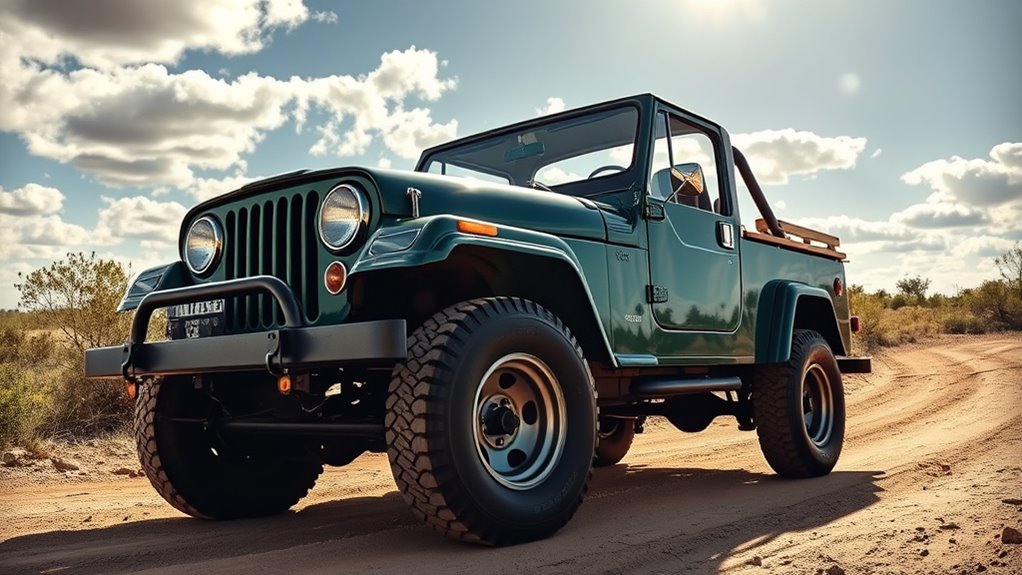
Jeep Scrambler offered a range of engine options designed to balance power, efficiency, and off-road capability. The base engine was the Pontiac 151 cubic inch (2.5-liter) Iron Duke inline-four, delivering 82 horsepower for fuel economy and everyday driving. For more power and torque, you could opt for AMC’s 258 cubic inch (4.2-liter) inline-six, which performed better off-road and for heavy-duty tasks. Some export models featured diesel engines, though these were less common. Transmission choices included four- and five-speed manual gearboxes and a three-speed automatic available in later years. The part-time 4WD system, combined with a Dana 300 transfer case, provided low-range gearing and excellent off-road traction. Overall, the engine options prioritized reliability and versatility to meet various driving needs. engine options were selected to provide a balance between performance and durability for diverse driving conditions.

Hardtop Anti-Fall Removal Lift for Jeep Wrangler JL, JK, TJ, and Other Models with Hardtops | Idle Items, Kayak & Attic Hoist | Supports 8-16 ft Ceilings, Comes with 6 T-Knobs, Single-Person Operation
【Installation Video】We have a detailed installation video and instructions in our catalog for you to DIY this lift…
As an affiliate, we earn on qualifying purchases.
As an affiliate, we earn on qualifying purchases.
Off-Road Capabilities and Dimensions

Your Jeep Scrambler’s ground clearance of about 8.3 inches and approach angles of 43° help it navigate rough terrains confidently. Its leaf spring suspension and Dana 30 axles provide durability and stability off-road. These features guarantee it performs well on challenging surfaces, combining rugged design with capable off-road performance. Additionally, incorporating advanced materials in its construction can further enhance its lightweight strength and resilience.
Ground Clearance and Approach Angles
Ground clearance and approach angles are critical factors that determine a vehicle’s off-road performance, and the Scrambler excels in both areas. With approximately 8.3 inches of ground clearance, it can clear rocks, roots, and uneven terrain without getting stuck. Its approach angle of about 43° allows you to tackle steep inclines without hitting the front bumper or undercarriage. The departure angle, around 18°, helps when descending slopes or crossing uneven ground without damaging the rear. These specs mean you can confidently approach obstacles and descend rough terrain without risking damage. The combination of good ground clearance and favorable approach angles makes the Scrambler a capable off-road companion, blending rugged design with practical dimensions that enhance your ability to navigate challenging trails. Proper off-road design features like these help optimize vehicle performance in challenging environments.
Suspension and Axle Design
The Scrambler’s suspension and axle design are key to its off-road prowess, combining durability with flexibility. Its leaf spring setup front and rear provides sturdy support over rough terrain, absorbing shocks and maintaining stability. The full-floating Dana 30 front axle reduces weight and improves turning radius, while the rear axle handles heavy loads effectively. This setup ensures you can tackle uneven trails confidently. The Dana 300 transfer case offers a low-range of 2.62:1, boosting traction on steep inclines. Here’s a quick look at its components:
| Component | Material/Design | Advantage |
|---|---|---|
| Front Axle | Dana 30, full-floating | Reduced weight, better handling |
| Rear Axle | Heavy-duty, solid axle | Enhanced load capacity |
| Suspension Type | Leaf springs | Durability on rugged terrain |
| Transfer Case | Dana 300, manual engagement | Improved off-road traction |
Additionally, axle design plays a crucial role in the vehicle’s overall capabilities by providing the necessary strength and flexibility needed for challenging off-road conditions.
Off-Road Performance Factors
Thanks to its well-designed suspension and dimensions, the Jeep Scrambler delivers impressive off-road performance. With about 8.3 inches of ground clearance, you can navigate rough terrain without worry. The approach angle of 43° and departure angle of 18° help you climb steep inclines and descend sharp declines safely. Its lightweight curb weight of around 2,700 pounds boosts maneuverability and traction on uneven surfaces. The leaf spring suspension, combined with the full-floating Dana 30 front axle, offers durability and stability. The part-time 4WD system with a Dana 300 transfer case and low-range ratio of 2.62:1 guarantees strong off-road traction and control. Overall, the Scrambler’s dimensions and design make it a capable, rugged vehicle ready to tackle challenging terrains. Additionally, its off-road capabilities are enhanced by specialized features designed for rugged environments.
Market Position and Target Audience

With its rugged design and practical cargo bed, the Jeep Scrambler positioned itself as a versatile pickup for outdoor enthusiasts and utility-focused users. You are part of a niche that values durability, off-road capability, and functional hauling. Its market appeal can be summarized as follows:
- Targeted at outdoor adventurers seeking a capable, stylish vehicle for recreational activities.
- Ideal for farmers and ranchers needing a compact yet reliable utility truck.
- Popular among collectors and enthusiasts who appreciate its classic Jeep heritage.
- Suited for those looking for a balance between off-road performance and everyday practicality.
- The vehicle’s market position combines ruggedness with versatility tailored to active lifestyles.
Variations and Export Models
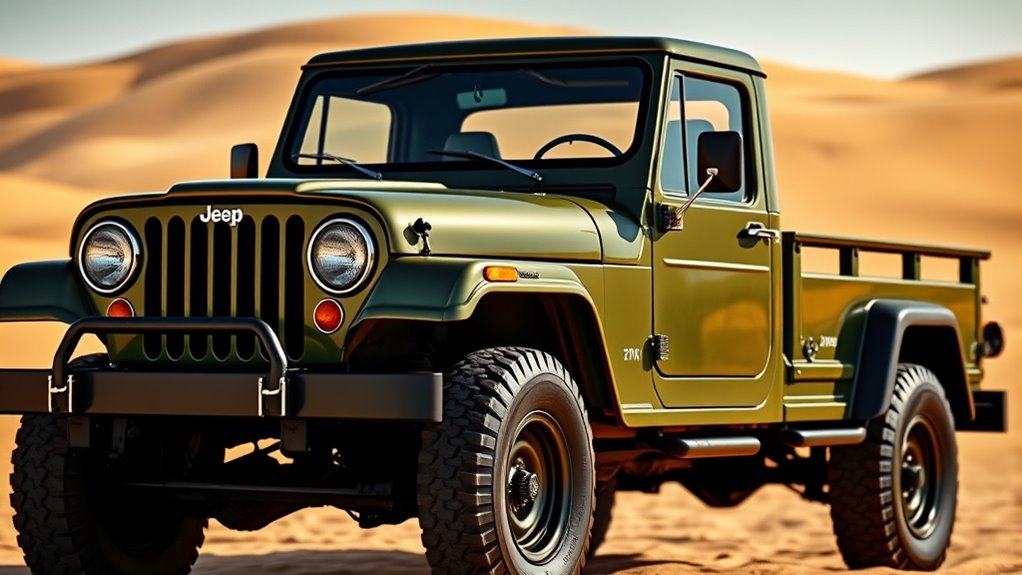
Numerous variations and export models of the Jeep Scrambler expanded its appeal beyond the North American market, catering to diverse needs and regulations. In some regions, you could find models equipped with diesel engines, especially in Europe and Australia, where diesel’s efficiency was highly valued. Export versions often featured modifications to meet local safety standards, such as different lighting or bumper designs. You might also encounter special editions tailored for particular markets, including rugged versions with upgraded suspension or heavier-duty components. These variations allowed you to choose configurations suited for off-road adventures, utility work, or compliance with regional laws. Overall, Jeep adapted the Scrambler to fit a broad range of customer demands worldwide, making it a versatile and globally recognized pickup during its production years.
Transition From CJ Platform to Wrangler

Why did Jeep shift from the CJ platform to the Wrangler? The main reason was to meet evolving safety standards and improve off-road performance. As regulations tightened in the late 1980s, Jeep needed a more modern, safer platform. This transition involved several key changes:
Jeep shifted to the Wrangler to meet safety standards and enhance off-road performance.
- Structural Safety: The new Wrangler incorporated a more rigid frame, enhancing crash protection.
- Design Flexibility: The Wrangler’s body-on-frame construction allowed for removable doors and tops, maintaining Jeep’s iconic versatility.
- Off-Road Capability: Upgraded axles, a Dana 44 rear, and improved suspension systems boosted off-road performance.
- Market Adaptation: The Wrangler’s design aligned with consumer preferences for modern, safer off-road vehicles, paving the way for future Jeep models.
This switch marked Jeep’s move into a new era of rugged, safety-conscious vehicles.
Legacy and Impact on Jeep’s Lineup

The Jeep Scrambler set the stage for modern trucks by blending off-road capability with pickup utility, influencing Jeep’s current lineup. It remains a symbol of off-road heritage that appeals to enthusiasts and collectors alike. Its limited production and unique design have cemented its status as a sought-after classic among Jeep fans.
Influenced Modern Trucks
The Jeep Scrambler’s rugged design and practical utility have left a lasting mark on modern trucks, influencing Jeep’s approach to blending off-road capability with everyday usability. Its legacy can be seen in several key areas:
- The emphasis on combining utility and adventure, inspiring models like the Jeep Gladiator.
- The integration of removable tops and versatile cargo beds, reflecting the Scrambler’s adaptable design.
- Focus on lightweight yet durable construction, improving off-road handling and fuel efficiency.
- The adoption of advanced 4WD systems and high ground clearance, ensuring off-road readiness in modern pickups.
These elements continue to shape Jeep’s trucks, emphasizing rugged versatility and off-road prowess for today’s adventure-minded drivers.
Symbol of Off-Road Heritage
The Jeep Scrambler has become a lasting symbol of off-road heritage, embodying Jeep’s dedication to rugged capability and versatility. Its design combined durability with practicality, making it a favorite among outdoor enthusiasts and off-road adventurers. The extended wheelbase, solid axles, and high ground clearance guaranteed it could tackle tough terrains with ease. Its classic styling and rugged construction reflect Jeep’s core off-road values, inspiring future models like the Jeep Gladiator. The Scrambler’s reputation for dependability and versatility helped cement Jeep’s identity as a leader in off-road vehicles. Even decades after its production ended, it remains a benchmark for capable, go-anywhere pickups, symbolizing Jeep’s unwavering commitment to adventure and exploration.
Collector’s Classic Status
As a symbol of off-road excellence, the Jeep Scrambler has secured a revered spot in automotive history, especially among collectors. Its limited production run, roughly 27,500 units, and distinctive styling make it highly sought after today. You’ll find that:
- Its unique blend of pickup utility and Jeep off-road traits appeals to enthusiasts and collectors alike.
- Its relative rarity increases its value, especially well-preserved or restored models.
- The Scrambler’s influence on Jeep’s future trucks, like the Gladiator, underscores its legacy.
- Aftermarket support and engine upgrade options keep these vehicles relevant and customizable.
Because of these factors, the Scrambler remains a prized classic, symbolizing Jeep’s innovative crossover of utility and adventure that continues to captivate collectors.
Collectibility and Restoration Scene
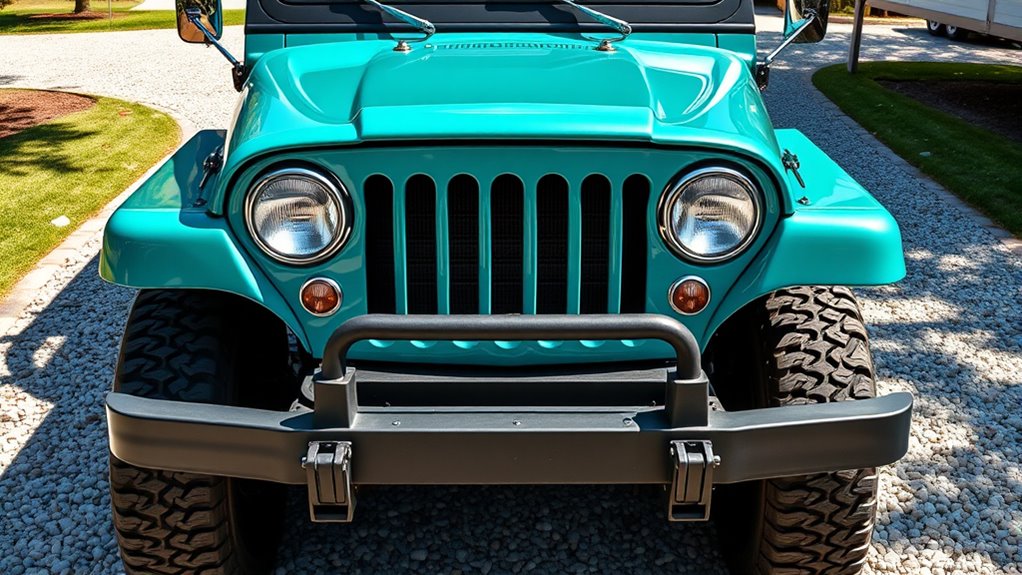
Because of its unique blend of rugged Jeep off-road capability and pickup practicality, the Jeep Scrambler has become a highly sought-after classic among collectors and restorers. Its limited production run and distinctive styling make it a rare find, especially in good condition. Enthusiasts actively seek out original models, often restoring them to preserve their vintage appeal. The aftermarket scene is vibrant, offering parts, upgrades, and diesel conversion kits to enhance performance and reliability. Many owners invest in detailed restorations, focusing on originality or modern upgrades to improve drivability. The Scrambler’s nostalgic value and historical significance continue to drive its popularity in the collector market. As a result, well-maintained examples command premium prices, and dedicated clubs organize events celebrating this classic Jeep’s legacy.
Modern Influences and the Jeep Gladiator Connection
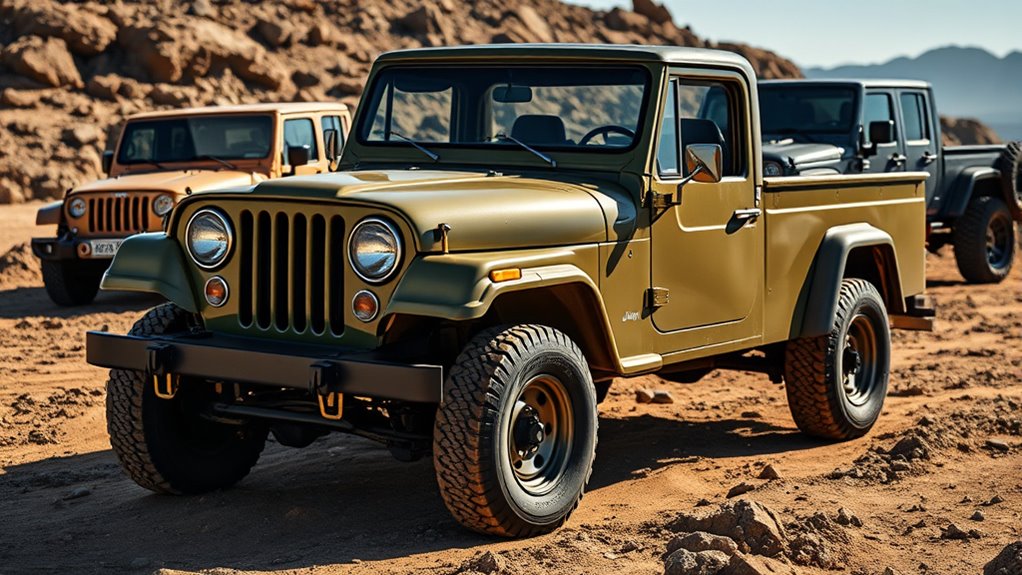
Modern Jeep models continue to draw inspiration from the Scrambler’s rugged design and versatile utility. The Jeep Gladiator, in particular, pays homage to the Scrambler’s spirit through its blend of off-road capability and pickup functionality. Here’s how it connects:
- Its truck bed echoes the classic Scrambler’s cargo area, combining utility with iconic styling.
- The Gladiator’s available four-door design offers modern comfort while maintaining the rugged silhouette.
- Off-road features like locking differentials and disconnecting sway bars mirror the Scrambler’s trail-ready traits.
- The vehicle’s construction emphasizes durability, reflecting the original’s focus on toughness and reliability.
These influences demonstrate Jeep’s commitment to preserving its heritage while advancing its truck lineup into the modern era.
Frequently Asked Questions
What Are the Most Common Modifications for Jeep Scrambler Restorations?
You typically upgrade the suspension for better off-road performance and replace worn-out parts with modern, durable components. Many restorers install upgraded axles, larger tires, or lift kits to improve clearance and handling. You might also swap out the engine for more powerful or efficient options, add modern lighting, or enhance the interior with new seats and gauges. These modifications boost both the vehicle’s appearance and functionality, making your Scrambler more capable and enjoyable to drive.
How Does the Jeep Scrambler Compare to the CJ-7 Off-Road-Wise?
The Jeep Scrambler is like a rugged mountain goat compared to the CJ-7 off-road-wise. It offers a longer wheelbase for added stability and a full-floating Dana 30 axle that improves durability and turning. Its ground clearance and approach angles are similar, but the extended length enhances cargo capacity and stability on rough terrain. Overall, the Scrambler’s design makes it slightly more capable and versatile for off-road adventures than the CJ-7.
Are There Any Known Manufacturing Defects or Issues With the Scrambler?
Yes, there are some known issues with the Jeep Scrambler. You might encounter rust in the body panels and frame, especially if it’s been exposed to moisture or road salt. The leaf spring suspension can wear out over time, leading to handling issues. Also, the electrical system may have wiring problems, and some engines, like the Pontiac 151, could develop cooling or carburetor issues. Regular maintenance helps prevent these problems.
What Safety Features Were Added to the Scrambler During Its Production Run?
Think of the Scrambler as a rugged ship steering safety waters—you’ll find it had limited safety features during its run. It mainly relied on basic roll-over standards, with no airbags or advanced crash protection like today’s vehicles. The focus was on off-road toughness rather than modern safety tech. So, while sturdy off the trail, it didn’t come equipped with the modern safety bells and whistles you’d expect in newer vehicles.
How Rare Is a Fully Original, Unmodified Jeep Scrambler Today?
A fully original, unmodified Jeep Scrambler today is quite rare. Most have undergone restorations or modifications due to age, use, or personal preferences. Limited production numbers and the age of these vehicles mean finding one in pristine, untouched condition is a challenge. If you’re lucky, you might find a survivor with minimal changes, but complete originality is a prized rarity among collectors and enthusiasts.
Conclusion
So, whether you’re dreaming of reviving a vintage icon or just want a rugged ride that turns heads, the Jeep Scrambler has you covered. It’s like that one friend who’s been around forever—always dependable, a bit nostalgic, and somehow still cool. Sure, it’s a classic, but with modern updates, it’s ready to conquer both trails and Instagram feeds. Who knew history could be so stylishly off-road?