If you prioritize fuel efficiency and sustained high-speed performance, a turbocharger is your best choice, as it uses exhaust gases to boost power and reduces fuel consumption. For immediate throttle response and low-end torque, especially in towing or hauling, a supercharger provides instant power but with higher fuel use. Both have pros and cons depending on your truck’s application. Keep exploring to discover which system matches your needs perfectly.
Key Takeaways
- Turbochargers boost efficiency and sustained high RPM power but may cause turbo lag at low speeds.
- Superchargers deliver immediate throttle response and low-end torque, ideal for towing and quick acceleration.
- Turbocharging improves fuel economy and reduces emissions, aligning with current industry standards.
- Superchargers are mechanically simpler, easier to install, but consume more engine power and fuel.
- The choice depends on whether your priority is efficiency and high-speed performance (turbocharger) or instant response and low-end torque (supercharger).
How Energy Sources Differ Between Turbochargers and Superchargers

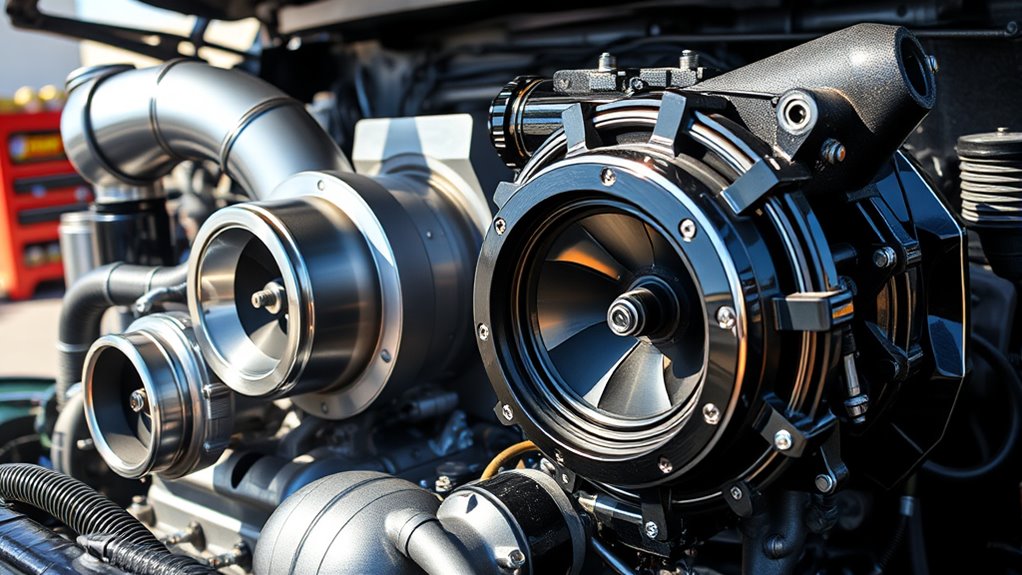
While both turbochargers and superchargers aim to boost engine power, they differ markedly in how they source their energy. Turbochargers use exhaust gases to spin a turbine, which then drives a compressor that pushes air into the engine. This harnesses energy that would otherwise be wasted, making turbochargers more efficient. In contrast, superchargers are mechanically driven directly by the engine’s crankshaft through a belt or gear. They consume some engine power to operate, creating a parasitic loss, but deliver immediate boost. Turbochargers rely on exhaust flow, which varies with engine speed, while superchargers are powered continuously, regardless of engine load. This fundamental difference impacts efficiency, performance, and how each system integrates with your truck’s engine. Innovative European Cloud Servers for Sustainable and Secure Solutions
Impact on Power Delivery and Throttle Response
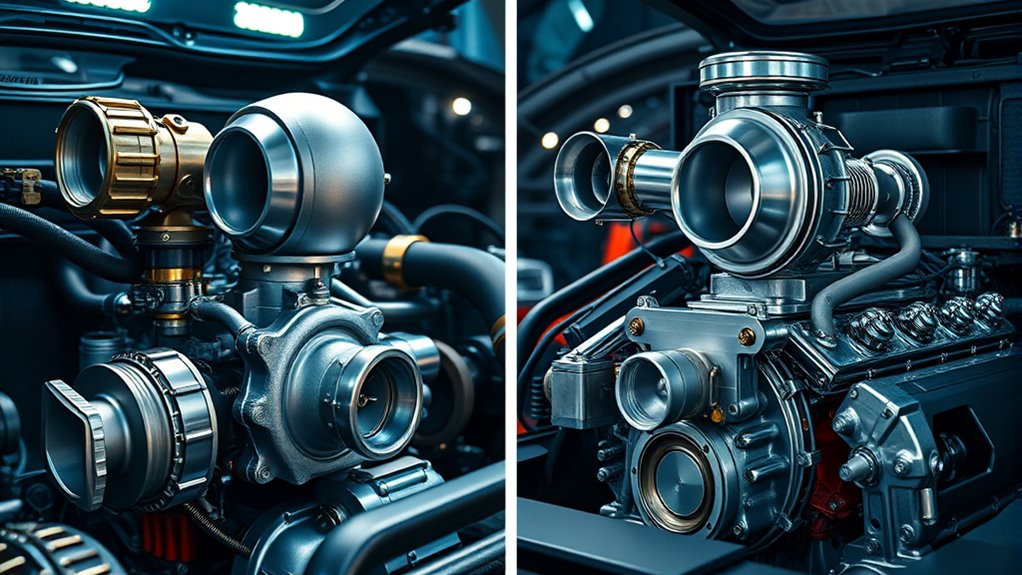
The way turbochargers and superchargers deliver power directly affects your truck’s throttle response and overall driving feel. Turbochargers often produce a delayed response called turbo lag because they rely on exhaust gases to spool up. This can make acceleration feel less immediate, especially at lower RPMs. In contrast, superchargers provide instant boost since they are mechanically driven by the engine, delivering power immediately as you press the throttle. This results in a more direct and predictable response, ideal for quick acceleration or towing. While turbochargers excel at high RPM power and efficiency, superchargers shine in low-end torque and immediate throttle response. Your choice impacts how your truck reacts to your input, shaping your driving experience markedly.
Fuel Economy and Efficiency Considerations
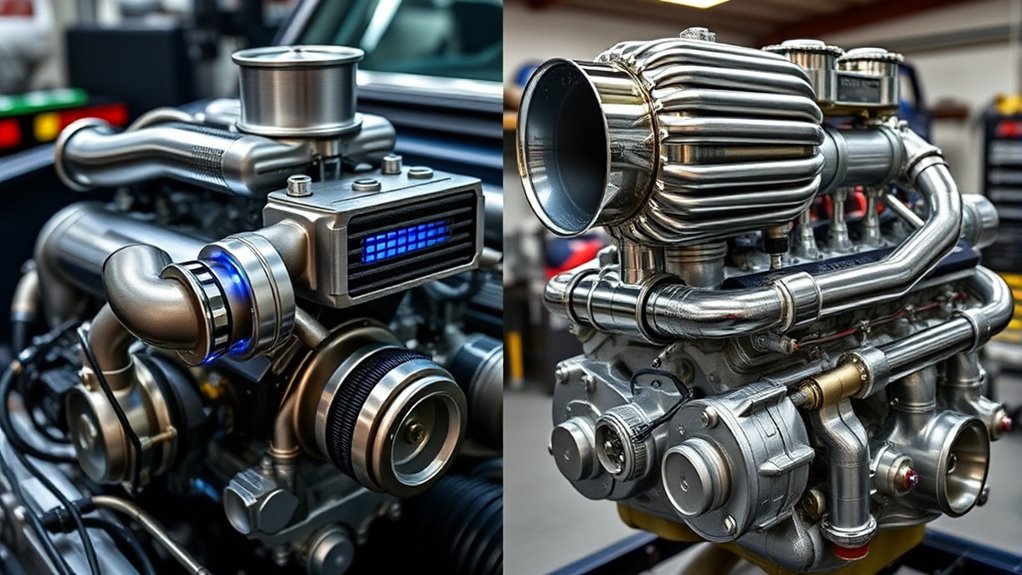
Turbochargers can boost your fuel savings by enabling smaller engines to deliver more power, making them more efficient overall. However, superchargers tend to reduce fuel economy because they draw power directly from the engine to operate. Efficiency often depends on how much boost you need and whether the system’s parasitic power loss impacts overall performance.
Fuel Savings Potential
Are you wondering which technology offers better fuel savings? Turbochargers typically enhance fuel economy by enabling smaller engines to produce more power, reducing fuel consumption during steady driving. Superchargers, however, tend to decrease efficiency because they consume engine power to operate. Consider these points:
- Turbochargers only boost fuel savings when actively providing boost, usually during high-demand periods.
- They allow for downsized engines that use less fuel overall.
- Superchargers draw power continuously, which can negate some efficiency gains.
- Turbocharged engines often meet stricter emissions standards, indirectly supporting better fuel economy.
- The contrast in technology significantly influences the overall efficiency and performance of your vehicle.
Parasitic Power Loss
Superchargers draw a portion of your engine’s power to operate their mechanical components, which directly reduces overall efficiency. Because they rely on belt or gear drives connected to the crankshaft, they consume energy that could otherwise go to your wheels. This parasitic power loss means your engine has to work harder, lowering fuel economy and efficiency. Superchargers require continuous power to maintain boost, even when extra power isn’t needed. In contrast, turbochargers use exhaust gases that would otherwise be wasted, making them more efficient overall. While turbochargers only impact fuel economy when producing boost, superchargers constantly draw power, reducing your truck’s efficiency even during light loads. This parasitic loss is a key factor when considering long-term operational costs and fuel savings. Additionally, efficiency losses can influence your vehicle’s overall environmental impact by increasing fuel consumption.
Boost-Dependent Efficiency
Because turbochargers only boost engine efficiency when producing additional air pressure, their impact on fuel economy depends on how much and how often you’re in boost. When you’re not in boost, they don’t affect fuel consumption. To maximize efficiency:
- You’ll see better fuel economy when driving at steady speeds with minimal throttle.
- Frequent heavy boosts, like climbing steep hills, can temporarily reduce fuel savings.
- Modern turbo systems can adjust boost levels, optimizing efficiency based on driving conditions.
- Over time, turbocharged engines tend to be smaller, lighter, and more fuel-efficient than naturally aspirated ones, especially in variable driving scenarios.
In essence, turbochargers improve efficiency when used judiciously, but excessive boost can negate those benefits.
Maintenance Requirements and Complexity
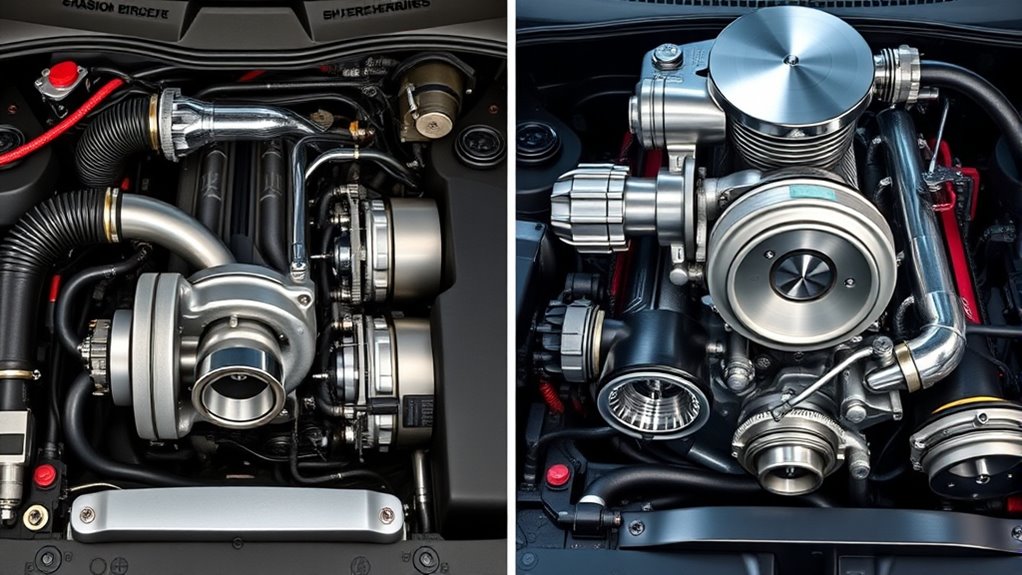
Superchargers are mechanically simpler and easier to maintain because they have fewer moving parts and straightforward installation. Turbochargers, on the other hand, involve more complex components like oil and coolant lines, which can require specialized upkeep. This added complexity often means more frequent or costly maintenance for turbocharged systems. Additionally, Lifevest Advisors recommends thoroughly researching the specific components used in each system to better understand their maintenance needs.
Mechanical Simplicity
When comparing mechanical simplicity, superchargers generally require less maintenance and have fewer complex parts than turbochargers. Superchargers are belt-driven, with straightforward design and fewer components, making them easier to install and service. Turbochargers, however, have more intricate parts like oil lines, coolant lines, and turbines, which increase maintenance needs. They operate at higher temperatures, stressing engine oil and requiring more frequent checks. Additionally, turbochargers involve components like wastegates and intercoolers, adding complexity. Maintenance tasks include monitoring oil supply and ensuring proper cooling, which can be challenging. Furthermore, electric dirt bikes tend to require less maintenance overall compared to traditional gas-powered engines, due to fewer moving parts and no need for oil changes. Overall, superchargers provide a simpler, more robust setup, while turbochargers demand more attention due to their advanced design and operating conditions.
Maintenance Demands
Superchargers tend to be simpler to maintain than turbochargers due to their straightforward, belt-driven design with fewer components. They usually involve fewer moving parts and don’t require complex plumbing or oil lines. Turbochargers, on the other hand, are more intricate, with components like turbines, compressors, oil, and coolant lines that need regular checks. The high temperatures and pressures in turbochargers increase wear, leading to more frequent maintenance. Additionally, turbocharged engines often need specialized attention for oil quality and cooling systems to prevent damage. Overall, superchargers offer easier installation and simpler upkeep, while turbochargers demand a more detailed maintenance routine. Maintaining cooling systems properly is especially important for turbocharged setups to prevent overheating and component failure.
Performance Characteristics and Peak Power
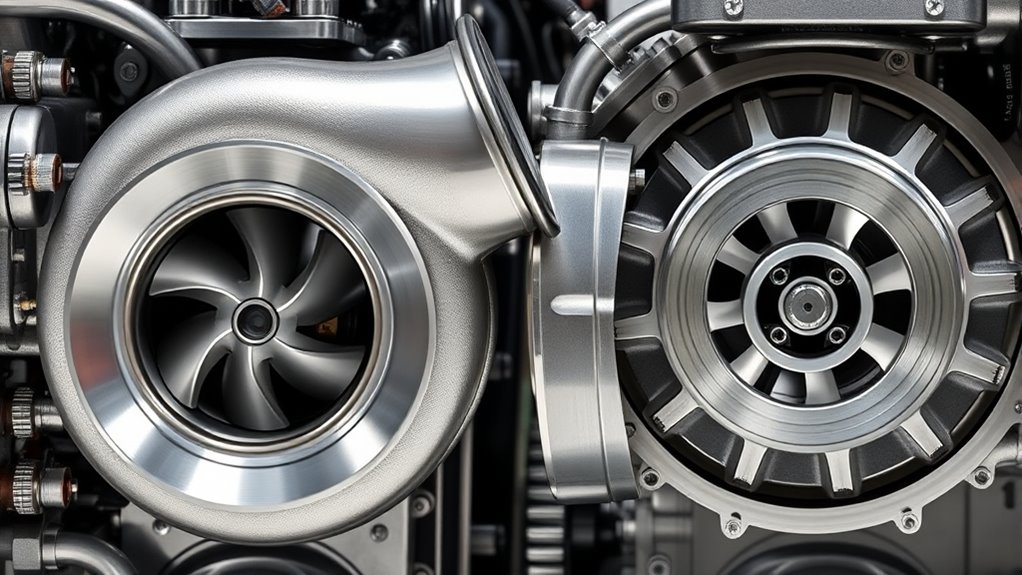
Are you wondering how turbocharging and supercharging compare when it comes to peak power and performance? Turbochargers generate higher peak power by leveraging exhaust gases, producing substantial boost at higher RPMs. Superchargers, however, provide instant throttle response with consistent power delivery across the RPM range. To understand their performance differences:
Turbochargers deliver high peak power at high RPMs, while superchargers provide instant, consistent throttle response across the entire RPM range.
- Turbochargers achieve higher peak boost and power levels at elevated RPMs.
- Superchargers deliver immediate, linear boost from low to high RPM.
- Turbocharged engines excel in sustained high-speed performance.
- Supercharged engines are preferred for quick acceleration and low-end torque.
While turbochargers peak later, they produce greater overall power at high RPMs. Superchargers offer predictable, immediate power, ideal for applications demanding instant response.
Suitability for Different Truck Applications
Choosing the right forced induction system depends heavily on the specific demands of truck applications. Turbochargers excel in long-haul and heavy-duty tasks where fuel efficiency and sustained power matter. They suit diesel engines used in freight and construction, maximizing fuel economy and reducing emissions. Superchargers, on the other hand, are ideal for applications needing instant throttle response, like towing or performance trucks. They provide immediate power boost, beneficial in stop-and-go operations. Consider the table below:
| Application Type | Best Suited System |
|---|---|
| Heavy-duty freight trucks | Turbochargers |
| Towing and hauling | Superchargers |
| Performance or vintage trucks | Superchargers |
| Long-distance travel | Turbochargers |
Your choice hinges on whether you prioritize efficiency or immediate power.
Industry Trends and Market Adoption
In the current automotive market, turbochargers have become the dominant forced induction technology across various truck segments due to their superior efficiency and ability to meet strict emission standards. You’ll find turbochargers in most modern diesel and gasoline trucks because they enhance fuel economy and reduce emissions. Superchargers, however, are mostly reserved for niche applications, like performance or vintage trucks, due to their higher fuel consumption and mechanical simplicity. The trend toward turbocharging is driven by: 1. Industry regulations favoring cleaner, more efficient engines. 2. Manufacturers aiming to meet fuel economy standards. 3. Increased adoption in heavy-duty and commercial trucks. 4. The shift toward smaller, more efficient engine designs that still deliver ample power. Overall, turbochargers dominate the market, shaping future truck engine development. Additionally, advancements in turbocharger technology continue to improve performance and reliability, further cementing their position in the industry.
Installation and Cost Factors
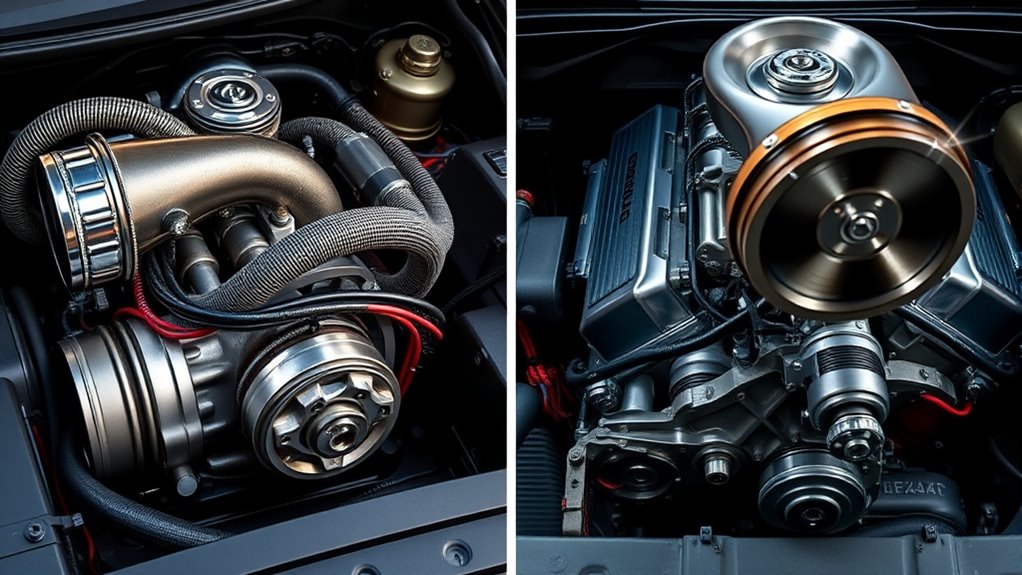
Installing turbochargers typically involves more complex procedures and higher initial costs compared to superchargers. You’ll need to integrate exhaust plumbing, oil and coolant lines, and verify proper tuning, which can require professional installation. This complexity often leads to increased labor costs. Turbochargers themselves are usually more expensive upfront, especially for high-performance models, and may need additional components like intercoolers. Conversely, superchargers are mechanically simpler, often bolted directly onto the engine with minimal modifications. They generally cost less initially and are easier and quicker to install. However, keep in mind that superchargers also add to your engine’s parasitic load, which can slightly increase maintenance needs over time. Overall, turbocharging tends to demand a larger investment both in parts and labor upfront. Additionally, the efficiency of a turbocharger can provide better fuel economy over time despite the higher initial costs.
Which Boosting System Is Right for Your Truck?
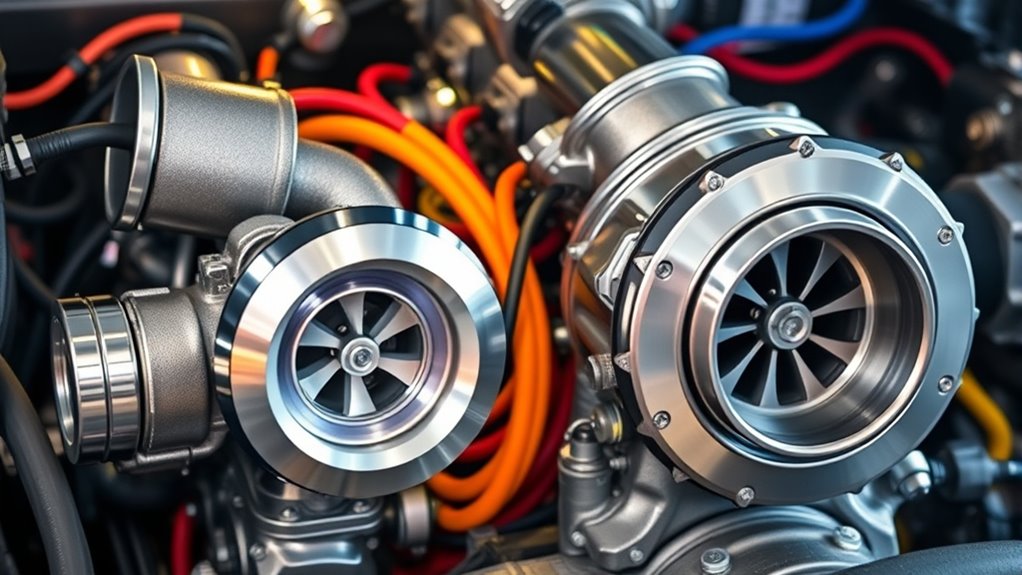
Deciding between a turbocharger and a supercharger depends on your truck’s intended use, driving habits, and performance priorities. Consider these factors:
- If you want better fuel economy and efficiency, a turbocharger is ideal, especially for long-distance hauling.
- For instant throttle response and low-end torque, a supercharger delivers immediate power, perfect for towing or off-road adventures.
- If your goal is sustained high-speed performance, turbochargers provide exponential power at higher RPMs.
- For ease of installation and simpler maintenance, superchargers are more straightforward, making them suitable for DIY enthusiasts.
- Understanding the free-floating design of some boosting systems can help you choose the best option for your truck’s setup.
Your choice hinges on whether efficiency, immediate power, or sustained high performance matters most for your driving needs.
Frequently Asked Questions
How Does Turbo Lag Affect Daily Driving Comfort?
Turbo lag can make your daily driving less smooth by delaying throttle response. When you press the accelerator, you might notice a brief hesitation before the engine delivers the expected power. This can be frustrating, especially in stop-and-go traffic or when merging onto highways. However, modern turbocharged trucks often minimize lag with advanced technology, so you can still enjoy fuel efficiency without sacrificing too much responsiveness.
Can Superchargers Improve Fuel Economy in Specific Scenarios?
Think of a supercharger as a sports car’s nitrous boost—giving you instant power but at a cost. Generally, superchargers don’t improve fuel economy; they actually decrease it because they draw power from the engine. However, in specific scenarios like towing or heavy hauling, a supercharger can help maximize power when needed, but for overall efficiency, it’s not the best choice.
What Are the Long-Term Reliability Differences Between Turbo and Superchargers?
You’ll find turbochargers tend to be more reliable long-term because they have fewer moving parts and operate at lower RPMs, reducing wear. Superchargers, with their mechanical drive and higher speeds, face more stress and maintenance issues over time. However, turbochargers require careful oil and cooling system upkeep due to higher temperatures, but overall, they’re built for durability and sustained performance in trucks.
Are There Hybrid Systems Combining Turbo and Supercharging?
Yes, hybrid systems combine turbo and supercharging to give you the best of both worlds. They’re like a two-for-one deal, providing immediate throttle response from the supercharger and sustained power from the turbo. These setups improve performance across the RPM range, boost efficiency, and reduce lag. While more complex and costly, they’re ideal if you want a smooth, versatile power delivery without sacrificing fuel economy or responsiveness.
How Do Maintenance Costs Compare Over the Lifespan of Each System?
You’ll find that turbochargers generally have higher maintenance costs over their lifespan because of their complex components, such as oil and coolant lines, and the need for specialized upkeep. Superchargers, being mechanically simpler with fewer moving parts, tend to cost less to maintain. However, turbochargers may require more frequent repairs due to higher operating temperatures and pressures, so consider these factors when evaluating long-term expenses for your truck.
Conclusion
Choosing between a turbocharger and a supercharger is like picking the right gear for your adventure—each has its own rhythm and roar. Turbochargers offer a steady, fuel-efficient boost, while superchargers deliver an instant punch of power. Consider your truck’s heartbeat and your driving dreams. Whichever you choose, you’re revving up for a ride that turns heads and leaves a trail of power behind. Make your decision, and let your truck’s true potential roar to life.