
TL;DR

Get business pricing on garage and car supplies
- Business-only prices and quantity discounts
- Tax-exempt purchasing
- Multiple users, one account, clear invoices
Peugeot has shown the E-T16 Concept, a performance-focused electric hatchback featuring the square Hypersquare steering control. The design depends on steer-by-wire, which replaces the conventional mechanical steering connection with electronic controls and motors. The car and its claimed performance figures are concept-stage, and Peugeot has not announced production plans for the E-T16.
Peugeot has presented the E-T16 Concept, a tri-motor electric hatchback whose unusual, square-shaped Hypersquare steering control is designed to work with steer-by-wire. The concept, shown at the 2026 Paris Motor Show, replaces a conventional round wheel with a compact control surface featuring buttons and a central display, illustrating how electronic steering can change the control layout.
Peugeot describes the Hypersquare as a steer-by-wire system calibrated for performance driving. The company says its central display can show information such as vehicle speed and lap timing, while controls near the driver’s hands provide access to functions with finger movements. Those are manufacturer descriptions; the available report does not provide independent test results or measurements of the system’s response.
In a conventional car, a steering wheel connects mechanically to the front wheels through steering components such as a column and rack. Steer-by-wire instead sends the driver’s input to a computer, which directs motors to turn the wheels. Because the steering ratio can be adjusted electronically, the control does not have to rotate as much as a conventional wheel. That is what makes a non-round design practical in principle.
Peugeot says the E-T16 has three electric motors and can complete three Nürburgring Nordschleife laps—more than 60 kilometers—in Performance mode without power limitation. That figure is a claim in the company’s release, not a result independently established by the report. The E-T16 remains a concept, so its specifications should not be treated as confirmed production-car performance.
Why the Square Control Needs Software
The Hypersquare’s importance is less about its shape alone than the steering system that makes the shape usable. With a fixed mechanical connection, drivers generally turn a wheel through a much larger range to steer from lock to lock. A steer-by-wire setup can vary the ratio, allowing Peugeot to design a compact control that does not require the same hand-over-hand movement. That could free space for a display and buttons close to the driver’s fingers.
The arrangement also shifts part of the driving experience from mechanical hardware to software. In a conventional system, the driver feels forces transmitted through the steering mechanism. With steer-by-wire, those sensations must be generated or filtered by the system. Peugeot calls the Hypersquare precise and agile, but the report leaves open whether its steering feel will seem natural to drivers and how well the controls work during everyday driving, not just a performance demonstration.
For readers, the distinction matters because a novel steering design is not simply a styling choice: it changes how a driver controls the car and what feedback reaches their hands. The concept signals an approach Peugeot is exploring, not proof that the layout is ready for a production vehicle.
Products Worth Considering

Chemical Guys 14-Piece Arsenal Builder Car Wash Kit with Foam Blaster

Chemical Guys 10-Piece Car Wash Kit with Foam Gun

Chemical Guys Carbon Force Ceramic Paint Coating Kit, 1 fl oz, with 3 Applicators
As an affiliate, we earn on qualifying purchases.
From Conventional Wheels to Steer-by-Wire
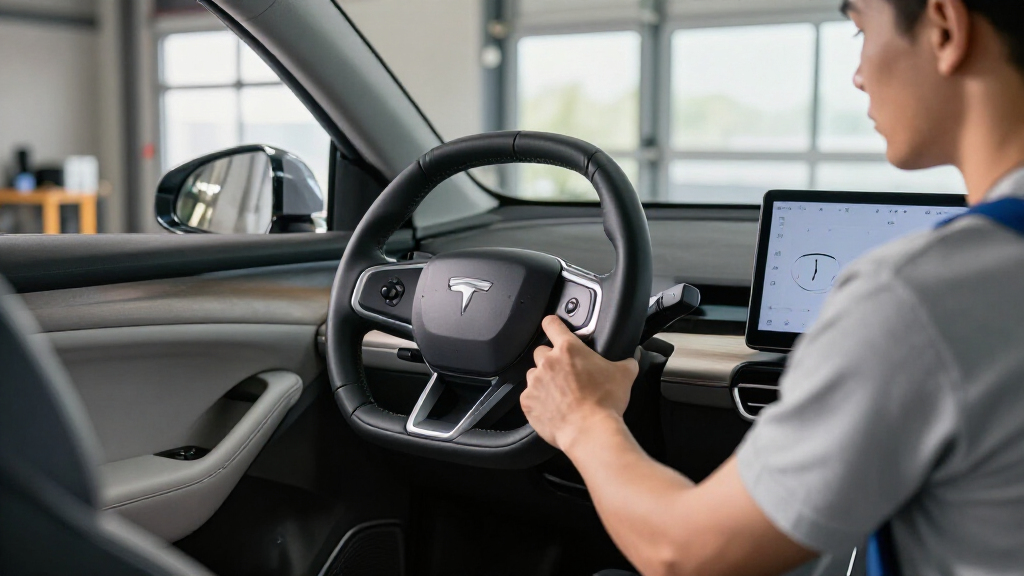
The report contrasts the Hypersquare with Tesla’s yoke, which removes the upper part of a conventional wheel while retaining conventional steering underneath. With a traditional steering ratio, drivers may still need to rotate the control substantially, a task that can be awkward on a yoke without a top section to grip. Steer-by-wire addresses that underlying constraint by allowing the steering ratio to vary.
Steer-by-wire itself is not new: the source report names the Tesla Cybertruck and Lexus RZ as vehicles that offer it. Peugeot has also displayed the Hypersquare on other concepts, including the Polygon, described in the report as a non-performance application. The E-T16 therefore adds another demonstration of the idea rather than establishing that Peugeot has put it into a production car.
The Paris presentation also included concepts from other French automakers, but the E-T16’s steering setup is the specific development at issue here. The source material describes it as a concept reveal and does not give a confirmed schedule for an E-T16 production model.
“The Hypersquare integrates a configurable central display showing essential information such as speed and lap timing according to driving conditions.”
— Peugeot, in its description of the E-T16 Concept
Production Plans and Driving Feel
Peugeot has not confirmed in the supplied material whether the E-T16 will reach production, when it might do so, or whether the Hypersquare will appear in a road-going model. The report also provides no independent assessment of the steering system’s precision, reliability, or feel. Peugeot’s description of the controls as ergonomic and agile remains a company claim until the system is evaluated in use.
It is also unclear how the car would handle system faults, what backup arrangements it would use, or how the control would be adapted for ordinary road conditions. The source notes that the show would have a demo unit, but offers no findings from a completed demonstration. The E-T16’s performance figures likewise remain manufacturer claims tied to a concept vehicle.
Show Demonstrations Before Any Launch
The next near-term opportunity to assess the Hypersquare is a hands-on demonstration at the Paris auto show, where the source report says a demo unit would be available. Such a demonstration could give visitors a sense of the control’s layout, but it would not by itself establish how a finished vehicle performs on public roads.
Any further production plans, technical specifications, safety details, or launch timing would need to come from Peugeot. Until the company provides those details and the system is tested beyond a concept display, the E-T16 is best understood as a demonstration of how steer-by-wire could enable a different steering interface.
Key Questions
What is Peugeot’s Hypersquare?
It is a square-shaped steering control with buttons and a configurable central display, shown in Peugeot’s E-T16 Concept. Peugeot pairs it with a steer-by-wire system.
Why does the Hypersquare need steer-by-wire?
Steer-by-wire sends steering inputs electronically to motors that turn the wheels, rather than relying on a direct mechanical connection. Its adjustable steering ratio can reduce how far the control needs to turn, making a compact, non-round design more workable.
Is the Peugeot E-T16 going into production?
The supplied report identifies the E-T16 as a concept and gives no confirmed production plan or launch date.
Are the E-T16’s Nürburgring figures verified?
No independent verification is provided in the source material. Peugeot says the concept can complete three Nordschleife laps, more than 60 kilometers, in Performance mode without power limitation; that remains the company’s claim.
Has steer-by-wire been used in other vehicles?
The source report says the Tesla Cybertruck and Lexus RZ offer steer-by-wire. The Hypersquare is Peugeot’s concept-stage example of using the technology to support a notably different steering-control shape.
Source: rss