You shouldn’t overload your truck beyond its Gross Vehicle Weight Rating (GVWR), which is set to keep you safe and compliant. Overloading puts excessive stress on axles, tires, and brakes, increasing the risk of accidents, tire blowouts, and brake failures. It also leads to hefty fines and vehicle impoundment if you’re caught. Different states have varied regulations, and weight limits are strictly enforced. Keep your load within limits to protect your safety and avoid costly penalties—you’ll find more helpful details ahead.
Key Takeaways
- Exceeding GVWR leads to fines, vehicle impoundment, and potential license suspension, risking legal penalties and operational delays.
- Overloading stresses axles, tires, brakes, and suspension, increasing the likelihood of component failure and accidents.
- It lengthens braking distances and reduces stability, raising rollover risks and compromising overall safety.
- Overweight trucks can damage bridges and roads, violating federal and state regulations, and causing infrastructure deterioration.
- Proper load distribution and weight verification prevent overload violations, ensuring safety, compliance, and vehicle longevity.

BIT Air Scale 18-Wheeler Set – Bluetooth-Enabled Onboard Load Scale for Dedicated Trucks and Trailers
REAL-TIME MONITORING: Get accurate weight readings for total truck weight, cargo load, and individual axle weights directly through…
As an affiliate, we earn on qualifying purchases.
As an affiliate, we earn on qualifying purchases.
Federal Weight Limits for Trucks

Federal law strictly limits the maximum gross vehicle weight for interstate trucks to 80,000 pounds. This means your truck cannot legally carry more than this weight when traveling across state lines. The law also sets specific limits for individual axles: single axles are capped at 20,000 pounds, tandem axles at 34,000 pounds, and tridem axles at 42,000 pounds. Although some states allow heavier weights on non-interstate roads, federal restrictions apply on interstates to protect infrastructure and ensure safety. It’s essential to know these limits before loading your truck. Overloading beyond these federal thresholds can lead to hefty fines, vehicle impoundment, and increased safety hazards. Always verify your load’s weight and distribute it properly to stay compliant and avoid legal issues.

3000 Watts Pure Sine Wave Inverter 12V DC to 110V/120V AC Converter, 6000W Peak, LCD Remote Control, 4 AC Outlets, USB & Type-C – for RV, Truck, Off-Grid Solar System, Emergency Power
【3000W Pure Sine Wave Output – Clean & Stable Power】:Converts 12V DC battery power into stable 110V/120V AC…
As an affiliate, we earn on qualifying purchases.
As an affiliate, we earn on qualifying purchases.
Legal Consequences of Overloading

Overloading your truck can lead to severe legal consequences that can impact your driving record and finances. You could face fines of up to $10,000 per violation, and your vehicle might be impounded until you bring it into compliance. If you’re caught overloading repeatedly, your license could be suspended or revoked. Legally, you’re also liable for any damages or injuries caused in an accident with an overloaded vehicle, which can result in costly lawsuits. Insurance claims may be denied if authorities prove your truck was overloaded at the time of a crash. These penalties serve to discourage overloading, emphasizing the importance of adhering to weight limits to avoid legal trouble and financial loss. Additionally, overloading can compromise your vehicle’s stability and safety, increasing the risk of accidents and injuries.

32334 RuggedXL Lift Tool Kit, Husky Towing Centerline Weight Distribution Hitch
This is manufacturered to the same high quality specs as the original 32334 part that came with your…
As an affiliate, we earn on qualifying purchases.
As an affiliate, we earn on qualifying purchases.
Safety Hazards of Exceeding GVWR

Exceeding your truck’s GVWR considerably increases the risk of mechanical failures and accidents. Overloaded vehicles put excessive stress on axles, tires, brakes, and suspension systems, leading to premature wear or sudden failure. This can cause tire blowouts, brake fade, or suspension collapse, compromising your control. The added weight also extends braking distances, making it harder to stop quickly in emergencies. Stability becomes unpredictable, raising the likelihood of rollovers, especially during sharp turns or sudden maneuvers. Structural components may crack or break under the strain, risking catastrophic failure. These hazards not only endanger your safety but also threaten other road users. Staying within GVWR limits helps guarantee your truck operates reliably, allowing you to maintain control and reduce the risk of accidents caused by mechanical issues. Proper load management is essential to prevent these dangers and ensure safe driving conditions.

Platform Truck with Brake System 2600lbs Capacity Heavy Duty Push Cart Dolly Foldable Flatbed Cart with 5'' Swivel Wheels Large Steel Platform Dolly Cart for Groceries, Garage, Warehouse (24" x 48")
【2600lbs Huge Carrying Capacity】2600 lbs steel solid thickened bearing structure +5'' metal and rubber wheels provide super carrying…
As an affiliate, we earn on qualifying purchases.
As an affiliate, we earn on qualifying purchases.
Understanding the Federal Bridge Formula

Have you ever wondered how authorities determine whether a truck’s load is safe for bridges? The Federal Bridge Formula helps verify bridge safety by calculating the maximum weight allowed on axles and axle groups. It uses the distance between axles and the number of axles involved. The formula looks like this: W = 500(LN/N-1 + 12N + 36), where:
- *L* is the distance between axles in feet
- *N* is the number of axles in a group
- *W* is the maximum weight in pounds
This formula limits concentrated loads to prevent bridge damage. It ensures trucks don’t overload bridges despite legal weight limits, especially for heavy loads and multiple axles. Proper application helps avoid structural stress and potential failures. Understanding the Gold IRA markets can also be complex, highlighting the importance of expert guidance to navigate regulations and investment options.
Different Classifications of Truck Weight Limits

Understanding truck weight limits involves knowing how classifications are based on gross vehicle weight rating (GVWR). These classifications help determine the type of license you need and the regulations you must follow. For example, Class 7 trucks weigh between 26,001 and 33,000 pounds and require a Class C license. Class 8 trucks exceed 33,001 pounds and need a Class B license. Light-duty trucks weigh under 10,000 pounds, while medium-duty vehicles range from 10,001 to 26,000 pounds. Heavy-duty trucks are over 16,001 pounds, often falling into Class 8. Knowing these categories helps you stay compliant and avoid penalties. It also guides your loading practices, ensuring you don’t unintentionally exceed legal limits. Proper classification is essential for safety, legality, and efficient operation. Additionally, understanding the different weight classifications can help you select the appropriate vehicle for your specific needs.
Proper Loading Techniques and Best Practices

To guarantee safety and compliance, you must follow proper loading techniques that evenly distribute weight across your truck’s axles. Proper loading minimizes stress on the vehicle, enhances stability, and helps avoid violations. Start by checking your truck’s GVWR and GAWR limits. Aim to distribute weight so no single axle bears excessive load, preventing damage and unsafe handling. Use the following best practices:
- Position heavier items closer to the center of the truck for balanced weight.
- Distribute load evenly between the front and rear axles.
- Verify weight at weigh stations or with portable scales before departure.
- Remember that innovative European cloud servers emphasize energy efficiency and security, much like carefully balanced truck loads optimize vehicle performance and safety.
How Overloading Affects Vehicle Performance

Overloading your truck markedly diminishes its performance by impairing handling, braking, and stability. When you carry too much weight, the vehicle becomes less responsive, making steering more difficult and unpredictable. Braking distances increase considerably, which raises the risk of collisions, especially in emergencies. Overloading also puts extra stress on suspension components, tires, and axles, leading to premature wear or failure. Stability is compromised, heightening the likelihood of rollover, particularly during sharp turns or sudden maneuvers. You may notice a rougher ride, reduced acceleration, and increased fuel consumption. These issues not only make driving more hazardous but also strain the vehicle’s mechanical systems. Ultimately, exceeding the GVWR compromises safety, increases repair costs, and diminishes your ability to control the truck effectively.
The Role of Weigh Stations in Compliance
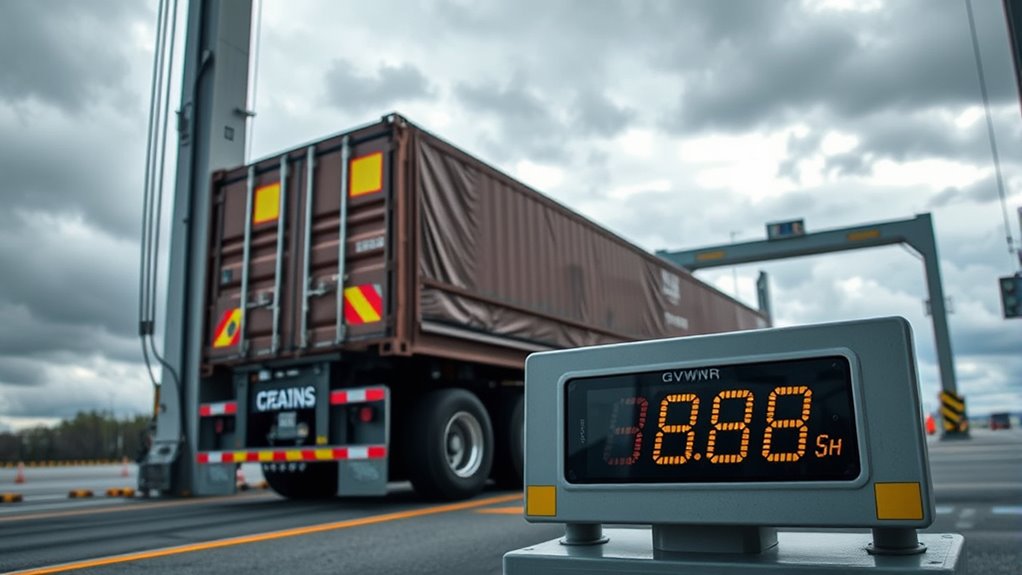
Weigh stations serve as checkpoints where authorities verify your truck’s compliance with weight regulations before you hit the road. At these stations, inspectors assess whether your vehicle exceeds legal limits, helping prevent damage to infrastructure and ensuring safety. When you pass through, they may:
Weigh stations verify truck weights to ensure safety and protect infrastructure.
- Weigh your truck using portable or fixed scales to confirm it’s within legal limits.
- Check documentation like permits and load logs to verify proper authorization.
- Inspect the overall condition of your vehicle for safety compliance.
- Recognize the importance of Free Floating in understanding weight distribution and stability during transit.
If your truck exceeds weight limits, you might face fines, vehicle impoundment, or delays. Weigh stations act as a vital enforcement tool, encouraging drivers to load trucks properly, avoid violations, and maintain safe, legal operation on the roads.
State Variations in Overload Regulations

While federal regulations set uniform weight limits for interstate trucks, each state has the authority to establish its own overload rules, leading to significant variations across the country. Some states allow higher axle weights or gross vehicle weights on certain roads, while others enforce stricter limits. For example, a truck might be legally overloaded in one state but not in a neighboring state, depending on local regulations. State authorities may also have different enforcement priorities and penalties. Before you travel, it’s essential to research specific state laws, especially if crossing state lines. Failing to comply can lead to fines, vehicle impoundment, or other penalties. Understanding these differences helps keep you compliant and safe on the road. State regulations can also influence permissible overload levels, which vary widely across jurisdictions.
Tips for Ensuring Your Truck Remains Within Limits

To avoid overloading, you should regularly check your truck’s weight with portable scales or weigh stations before heading out. Make sure to distribute the load evenly across all axles to prevent exceeding weight limits. Proper weight management helps you stay compliant and reduces safety risks on the road. Additionally, consulting comprehensive services related to vehicle compliance can provide further guidance on maintaining safe and legal load limits.
Regularly Check Weights
Regularly checking your truck’s weight is essential to stay within legal limits and guarantee safety on the road. By doing so, you prevent fines, vehicle damage, and accidents caused by overload. Use scales at weigh stations or portable weigh pads to verify your load. Keep these tips in mind:
- Weigh your truck before departure, especially if you’ve added cargo mid-trip
- Check axle weights and total weight periodically during long hauls
- Record weights to track any changes and ensure compliance
- Regularly inspect the vehicle’s suspension and tires to identify potential issues caused by overloading
Consistently monitoring your load helps you catch issues early, avoiding costly penalties and safety risks. Remember, even small overages can lead to serious consequences, so stay vigilant and make weighing part of your routine.
Distribute Load Properly
Properly distributing your load is essential to staying within legal weight limits and ensuring safe driving. Start by checking your vehicle’s Gross Vehicle Weight Rating (GVWR) and Gross Axle Weight Ratings (GAWR). Spread the weight evenly across all axles, avoiding overloading any single one. Use the federal bridge formula to determine safe axle group weights based on axle spacing. Aim to round up weights to the nearest 500 pounds for a safety margin. Before hitting the road, verify your load distribution at weigh stations or with portable scales. Remember, uneven loads can cause axle damage, compromise vehicle stability, and increase the risk of accidents. Proper load distribution helps you stay compliant, reduces wear and tear, and keeps everyone safe on the road. Understanding Rhythm Failure techniques can also help drivers plan better weight distribution for optimal performance.
Frequently Asked Questions
How Do I Accurately Measure Axle Weights Before Loading?
You accurately measure axle weights by using a certified truck scale or weigh station. Drive your truck onto the scale, ensuring each axle is properly positioned on separate sections. Check the display to record the weight for each axle group. Repeat if needed for accuracy, and always verify that your load distribution aligns with legal limits. This helps you stay compliant, safe, and avoid penalties or damage.
What Are the Best Tools to Check Truck Weight Compliance?
You should use calibrated truck scales or weigh stations to check weight compliance accurately. Portable axle scales are also helpful for quick checks on-site, ensuring even load distribution. Digital or mechanical scales give precise readings, so you avoid violations. Always verify weights before hitting the road, and consider using weigh-in-motion systems for continuous monitoring. Proper tools help you stay within legal limits, preventing fines and safety hazards.
Can I Legally Overload on Non-Interstate Roads?
You can legally overload on non-interstate roads if state regulations allow higher weights. However, you must stay within federal limits on interstates, which are stricter. Always check your state’s specific rules before loading, as some states permit higher weights on local roads. Keep in mind, overloading increases safety risks and can lead to fines or vehicle damage, so it’s best to stay within legal limits regardless of road type.
How Often Should I Verify Weight During a Long Haul?
You should verify your truck’s weight at least once every few hours or whenever you notice a change in load, road conditions, or after a break. Regular checks help guarantee you stay within legal limits and maintain safety. Use weigh stations or portable scales to confirm compliance. Frequent monitoring prevents fines, reduces accident risk, and keeps your vehicle handling properly during your long haul. Always stay vigilant about your load.
Are There Specific Signs Indicating My Truck Is Overloaded?
You might think your truck’s handling is fine, but signs of overload include excessive sagging, uneven tire wear, and difficulty steering. If the vehicle feels sluggish or the brakes seem less responsive, you’re likely carrying too much weight. Overloading can also cause abnormal vibrations or strange noises. Don’t ignore these clues; they indicate your truck is overstressed, risking damage and safety. Always check your load and distribute weight properly.
Conclusion
Staying within your truck’s GVWR keeps your journey smooth and your vehicle happy. Overloading might seem tempting, but it’s like trying to wear shoes two sizes too small—uncomfortable and risky. By respecting weight limits, you help guarantee your cargo’s safe arrival and avoid unnecessary bumps along the road. Keep your load balanced and within the recommended range, and you’ll enjoy a journey that’s as reliable as it is secure.