
TL;DR

Get business pricing on garage and car supplies
- Business-only prices and quantity discounts
- Tax-exempt purchasing
- Multiple users, one account, clear invoices
Mercedes plans to add MB.Drive Assist Pro, a destination-based driver-assistance system, to many electric and combustion models early next year, with eligible cars already on the road set to receive it through an over-the-air update. It allows hands-free driving on controlled-access highways but requires a driver to keep a hand on the wheel on surface streets, a distinction rooted in Mercedes’ view of driver responsibility and Level 2 automation.
Mercedes-Benz plans to bring MB.Drive Assist Pro, a destination-based driver-assistance system, to a large number of its electric and gasoline-powered vehicles early next year. The system will allow hands-free driving on controlled-access highways, but unlike Tesla’s Full Self-Driving (Supervised), it will require drivers to keep a hand on the wheel on surface streets—a design choice that reflects Mercedes’ approach to supervision, not a claim that the car can drive itself.
Drivers will be able to enter a destination and have the Mercedes system navigate a route and park, according to the InsideEVs report. The planned rollout includes new vehicles such as the CLA, while owners of eligible cars already purchased are expected to be able to add the feature through an over-the-air update. The report does not identify every model that will qualify or give a specific release date.
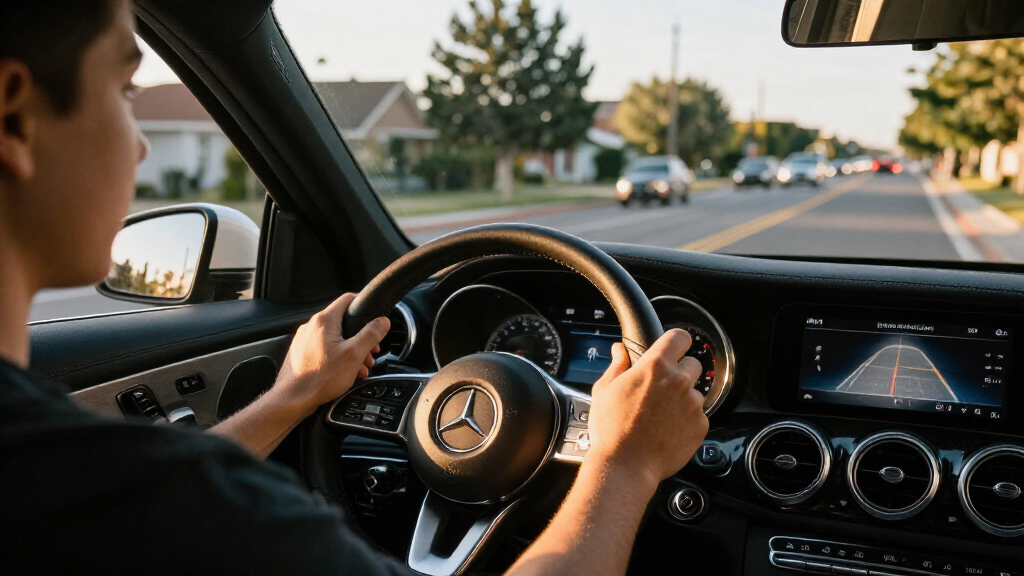
Mercedes describes the system as Level 2 Plus Plus, meaning the driver remains responsible for supervising the vehicle. It can operate hands-free on controlled-access highways, but on city streets the driver must keep a hand on the wheel. That differs from Tesla’s FSD (Supervised), which the report says permits hands-free operation on surface streets while still requiring driver supervision.
Mercedes says the system uses cameras as well as five radar sensors and 12 ultrasonic sensors, feeding information to an Nvidia-powered computer. The company argues that a broader set of sensor inputs can improve system performance and safety. Those are Mercedes’ claims; the source provides no independent comparative test results establishing that its system is safer or performs better than Tesla’s.
The Trade-Off on City Streets
The rule changes the experience for drivers considering an alternative to Tesla’s system. Mercedes offers point-to-point assistance and hands-free highway use, but its hand-on-wheel requirement in urban driving means users cannot expect the same level of hands-free operation across all roads. For some, keeping a hand on the wheel may feel like a useful reminder that the driver remains responsible. For others, it may make the feature less appealing or feel like a step back from the way they currently use FSD.
That difference matters because the systems are both supervised driver assistance, not permission for the driver to disengage. Mercedes’ approach foregrounds the boundary between assistance and automation: the person behind the wheel remains accountable on surface streets, where traffic, pedestrians, intersections and unexpected events create more varied conditions. The report does not establish whether the Mercedes approach produces better safety outcomes; it documents a difference in operating rules and company philosophy.
Mercedes also faces a product question beyond technical capability: whether buyers will choose a system that asks for more direct involvement in city driving in exchange for the brand’s vehicles, sensor setup and cabin experience. The source’s interviews suggest reactions differ. Some drivers value the added readiness of a hand on the wheel, while others say the requirement would make them less likely to leave Tesla.
Products Worth Considering

VIOFO A329S 4K 60FPS Front and 2K Rear Dash Cam

VIOFO A229 Plus Front and Rear Dash Cam with Dual 2K HDR

VIOFO A229 Pro 4K HDR Dash Cam with Front and Rear Cameras
As an affiliate, we earn on qualifying purchases.
Mercedes’ Level 2 Position
The Society of Automotive Engineers’ automation framework distinguishes systems in which a human must supervise from higher levels where the vehicle performs the driving task under defined conditions. Mercedes says MB.Drive Assist Pro remains Level 2, despite its “Plus Plus” label. The driver must monitor the road and be ready to act. A hand on the wheel on surface streets is one way Mercedes expresses that responsibility in the system’s use.
Mercedes Chief Technology Officer Jörg Burzer told InsideEVs that the distinction between Level 2 and Level 3 concerns who is responsible: with Level 2, the driver remains responsible; with Level 3, the vehicle’s system takes responsibility within its operating conditions. Burzer said controlled-access highways involve fewer variables than city streets. Mercedes has not said in the source when it will offer Level 3 operation across a broader range of conditions.
InsideEVs also spoke with Los Angeles-area Tesla drivers who described different levels of comfort with FSD. One said hands-on operation would probably not persuade him to switch, while another described having become comfortable using Tesla’s system without a hand on the wheel. Those accounts are individual experiences, not evidence that either system is safe to use without close supervision.
“With Level 2 Plus Plus, you are responsible. At Level 3, the machine, the car, the software stack, is responsible.”
— Jörg Burzer, Mercedes chief technology officer, speaking to InsideEVs
Rollout and Performance Questions
The report says the system is planned for early next year, but it does not give a launch date, price, complete list of compatible models, or the markets where the feature will be available. The scope of the promised over-the-air update for existing owners is also not specified.
It remains unclear how MB.Drive Assist Pro will perform in independent comparisons with Tesla FSD (Supervised), including how each handles difficult city situations and parking. Mercedes cites its additional radar and ultrasonic sensors as an advantage, but the source does not establish that this sensor configuration delivers better real-world safety. Nor does it provide a direct answer from Mercedes on why a buyer who prioritizes hands-free surface-street driving should prefer its system.
Both products require driver supervision under the descriptions in the report. Individual drivers’ accounts of using Tesla FSD hands-free, or even sleeping, are not proof that doing so is safe or permitted. The report does not provide evidence that either system can replace an attentive driver.
Details Before the 2026 Launch
Mercedes is expected to provide more information ahead of the planned early-2026 rollout, including which vehicles and markets are eligible, how existing owners can access the update, and any associated cost. Buyers will also need the system’s specific operating limits and driver-monitoring rules before they can compare it fairly with Tesla’s offering.
The practical comparison will depend on how the two systems behave in real-world use and on the rules that govern their operation in each market. Until model eligibility, availability and independent performance evidence are clearer, Mercedes’ confirmed distinction is the operating requirement: hands-free on controlled-access highways, hand on the wheel on surface streets, with the driver still responsible.
Key Questions
What is Mercedes MB.Drive Assist Pro?
It is a planned supervised, point-to-point driving-assistance system. The driver can enter a destination, and the vehicle can navigate and park, while the driver remains responsible for supervision.
Will drivers need to keep a hand on the wheel?
Yes, on surface streets, according to the report. The system is planned to allow hands-free driving on controlled-access highways, subject to its operating conditions and the driver’s supervision responsibilities.
When will the system be available?
Mercedes plans to add it to many electric and combustion models early next year. The report also says eligible vehicles already purchased will be able to receive it through an over-the-air update, but it gives no exact date or full eligibility list.
Is Mercedes claiming its system is safer than Tesla FSD?
Mercedes cites cameras, five radar sensors and 12 ultrasonic sensors and says varied sensor inputs can improve performance and safety. The source does not include independent comparative results proving that MB.Drive Assist Pro is safer than Tesla FSD (Supervised).
Source: insideevs.com