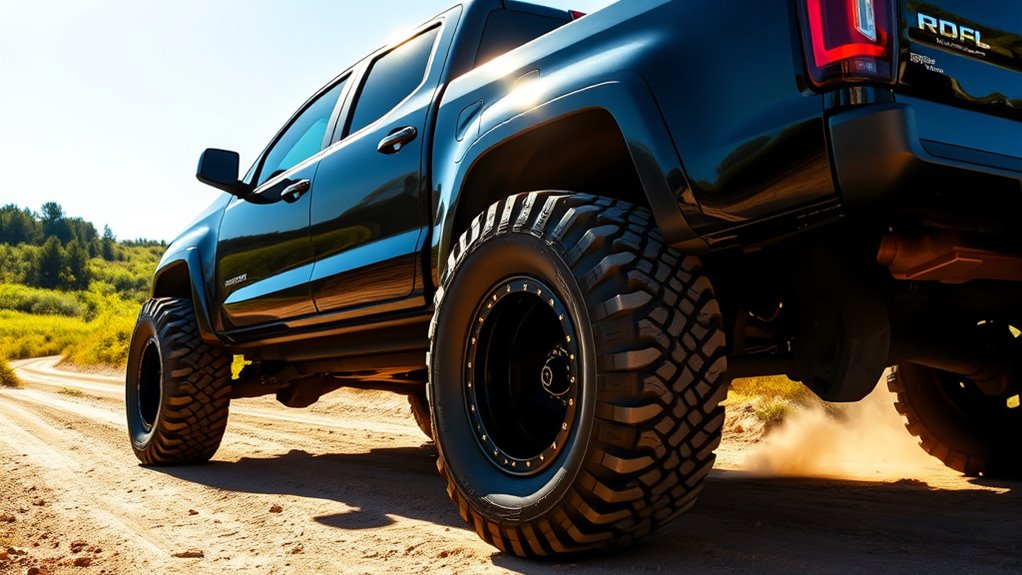

Lifting your vehicle or adding bigger tires almost always lowers your MPG because it increases weight, rolling resistance, and wind drag. Taller lifts and larger tires change airflow and add turbulence, making your engine work harder at highway speeds. Plus, they often disrupt the vehicle’s design, boosting resistance further. If you want to understand how to minimize these effects and keep your efficiency, there’s more to explore ahead.
Key Takeaways
- Larger tires increase rolling resistance and weight, reducing fuel efficiency by about 1-2 MPG.
- Lift kits raise vehicle height, increasing aerodynamic drag and wind resistance, which lowers MPG.
- Bigger tires can alter the final drive ratio, decreasing efficiency unless re-geared appropriately.
- Off-road tires and high lifts tend to cause more MPG loss due to increased turbulence and weight.
- Proper re-gearing, modest lift heights, and managing tire weight can help mitigate MPG reductions.

Checkered Flag Tire Beads Tire Balancing Beads, (4) 4oz Bags, 16oz/Set Suitable for Semis, Trucks, 4×4, Off Road Vehicles, Trailers – Efficient Ceramic Wheels & Tire Balancer, Long-Lasting Durability
EXTENDED TIRE LIFESPAN: Our ceramic balancing beads include additional cores and caps. This provides you with everything required,…
As an affiliate, we earn on qualifying purchases.
As an affiliate, we earn on qualifying purchases.
How Larger Tires Impact Fuel Efficiency

Larger tires directly affect your vehicle’s fuel efficiency by increasing the rotational mass and rolling resistance. When you install bigger tires, your engine has to work harder to turn them, which uses more fuel. These tires tend to be heavier, adding weight that the engine must move during acceleration and cruising. Additionally, bigger tires with aggressive tread patterns increase rolling resistance, further reducing fuel economy. The change in tire size can also alter your vehicle’s final drive ratio, making the engine run less efficiently unless you re-gear. Tire size changes can significantly influence overall vehicle performance and fuel consumption. In real-world tests, larger tires typically cause a 1 to 2 MPG drop, but this varies depending on tire size, type, and driving conditions. Overall, bigger tires generally lead to decreased fuel efficiency due to these mechanical and aerodynamic factors. Moreover, vehicle modifications like larger tires can sometimes affect your vehicle’s warranty or safety features if not properly installed or calibrated. Proper installation practices are essential to maintain safety and optimal performance, and understanding the impact on fuel economy can help you make informed upgrade decisions. Additionally, considering manufacturers’ recommendations can help prevent potential issues related to modifications.

USA Standard Gear Re-Gear & Installation Kit, 4.88 Ratio, Compatible with Jeep TJ D30 fr and D44 rr, ZGK008
COMPLETE KIT: Provides all of the necessary parts for a differential overhaul in one simple part number -…
As an affiliate, we earn on qualifying purchases.
As an affiliate, we earn on qualifying purchases.
The Effect of Lift Kits on Aerodynamics and Resistance
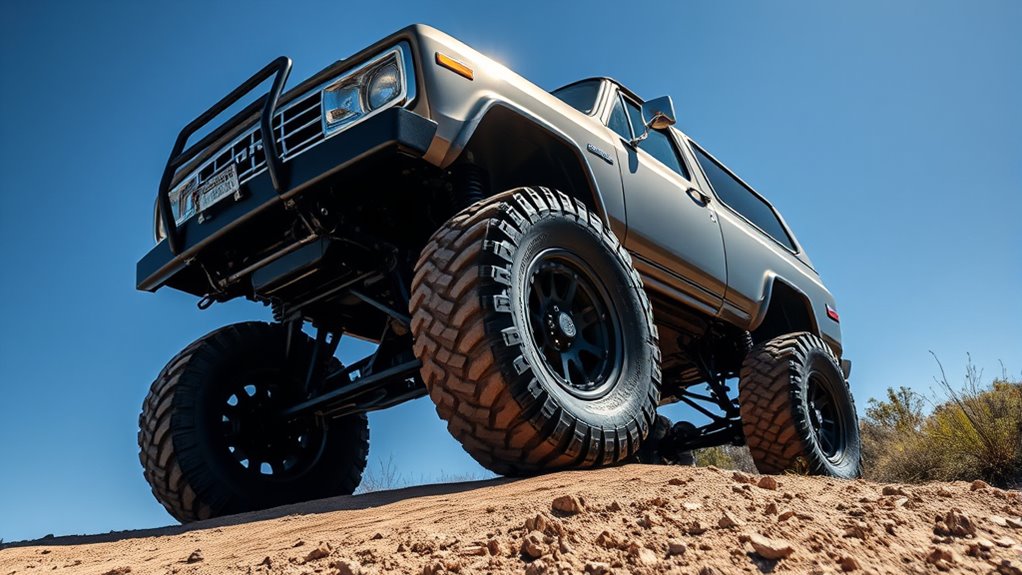
When you install a lift kit, your vehicle faces increased wind resistance and disrupted airflow patterns. These changes make it harder for your vehicle to cut through the air efficiently, especially at high speeds. As a result, your fuel economy can decrease due to the added aerodynamic drag. Additionally, modifications like larger tires can further impact vehicle aerodynamics, leading to increased resistance and reduced efficiency. The altered shape and size of the vehicle can also affect drivetrain performance, potentially causing additional strain on engine components. Furthermore, changes in vehicle weight distribution can influence overall fuel efficiency, making it an important factor to consider when upgrading your vehicle. Properly understanding aerodynamic principles can help mitigate some of these effects and improve your vehicle’s efficiency after modifications.
Increased Wind Resistance
Lift kits notably impact a vehicle’s aerodynamics by increasing its height and altering the airflow around it. When you raise your truck, the larger frontal area catches more air, creating greater wind resistance. This increased resistance forces the engine to work harder at highway speeds, reducing fuel efficiency. The higher your vehicle sits, the more turbulence and drag you generate, especially as airflow becomes more turbulent underneath. Even small lifts can considerably affect aerodynamics, especially at faster speeds. While the visual and off-road benefits are clear, the downside is that increased wind resistance translates directly into higher fuel consumption. To minimize this effect, keeping lift heights modest and avoiding excessive tire sizes helps preserve the vehicle’s aerodynamic profile and maintains better MPG. Additionally, aerodynamic drag is a critical factor influencing fuel economy and can be mitigated with thoughtful modifications. Understanding how vehicle aerodynamics influence fuel efficiency can help you make smarter upgrade choices. Improving underbody airflow can also reduce turbulence and drag underneath your vehicle, further enhancing fuel economy. Incorporating proper aerodynamics can significantly decrease resistance and optimize fuel consumption over time. For example, adding air deflectors or skirts can further streamline airflow and reduce drag.
Disrupted Airflow Patterns
Raising a vehicle with lift kits changes how air flows around and underneath it, disrupting the factory-designed aerodynamic patterns. This disruption increases turbulence and airflow separation, which boosts drag and fuel consumption. The added height exposes more of the vehicle’s surface to wind, inflating frontal area and turbulence at highway speeds. Larger tires and lifted bodies break the smooth airflow over the vehicle’s surface, creating vortices and eddies that pull air away from the intended flow paths. These disturbed airflow patterns cause the engine to work harder to overcome resistance, especially at higher speeds. To minimize this effect, keeping lift heights modest and avoiding overly large tires helps preserve the vehicle’s aerodynamic efficiency and fuel economy. Additionally, Proper vehicle aerodynamics play a crucial role in maintaining optimal fuel efficiency when modifying your vehicle. body modifications, such as larger tires, can further exacerbate airflow disruptions and should be considered carefully. Understanding aerodynamic principles can help you make smarter choices to reduce resistance and improve fuel mileage when customizing your vehicle. For example, streamlining exterior features can help offset some of the negative effects caused by lifts and larger tires. Incorporating aerodynamic enhancements like skirting or deflectors can also support better airflow management around lifted vehicles.

Grandroad auto 22.5" Premium Aerodynamic Semi Truck Wheel Covers, Durable Aero Efficiency Rim Guards for Enhanced Fuel Economy, Fits Standard Semi Truck Wheels, Easy Installation, Black
【Enhanced Fuel Efficiency】: Our Aerodynamic Wheel Covers are scientifically designed to reduce drag, enabling your semi-truck to slice…
As an affiliate, we earn on qualifying purchases.
As an affiliate, we earn on qualifying purchases.
The Role of Vehicle Design and Airflow Disruption
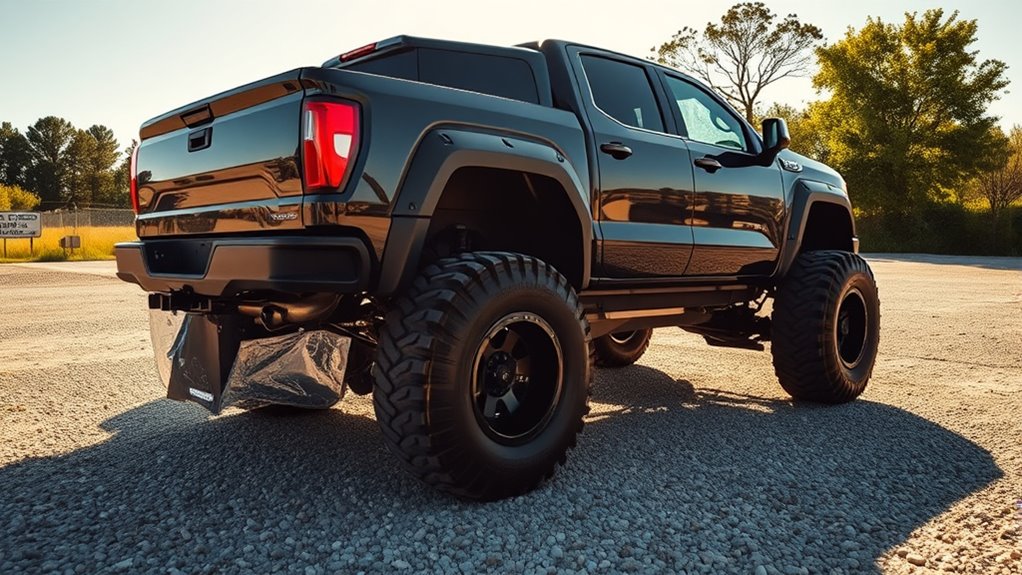
When you modify your vehicle’s design, such as installing larger tires or lift kits, you disrupt its original airflow patterns. This interference creates turbulence and increases drag, which can substantially lower fuel efficiency. Understanding how these airflow changes affect your vehicle helps you make smarter upgrade choices to preserve MPG. Additionally, improper modifications may lead to increased vehicle instability, further impacting overall performance and safety.
Aerodynamic Interference Effects
Vehicle design plays an essential role in how airflow interacts with your vehicle, directly impacting fuel efficiency. When you lift your truck or add bigger tires, you disrupt the factory-designed aerodynamic features like air dams, valances, and underbody panels. These components are optimized to minimize drag and improve MPG. Increasing the vehicle’s height or changing its shape causes airflow to become turbulent, especially around the front and sides. This turbulence raises aerodynamic drag, which scales with the square of your speed, meaning at highway speeds, your fuel economy drops more noticeably. Additionally, larger tires and lifts increase the frontal area and undercar airflow disturbances, creating more wind resistance. Streamlined design elements help reduce these interference effects and preserve your vehicle’s efficiency. Furthermore, the original aerodynamic features are carefully engineered to work together to optimize airflow, and altering them can significantly diminish their effectiveness. Changes to your vehicle’s shape can also lead to increased airflow turbulence, further decreasing fuel economy. Incorporating aerodynamic enhancements can help mitigate some of these effects and improve overall efficiency.
Airflow Turbulence Increase
Modifications like larger tires and lift kits directly disrupt the airflow around your vehicle, causing turbulence that increases drag. This extra turbulence leads to more resistance, forcing your engine to work harder and consume more fuel. Larger tires change the way air flows over the wheel arches, while lifts increase the vehicle’s height, creating unpredictable airflow patterns underneath. These disruptions reduce aerodynamic efficiency, especially at highway speeds where airflow plays a major role. To visualize this, consider the table below:
| Effect | Impact on Airflow |
|---|---|
| Larger tires | Disrupt smooth airflow over wheel wells |
| Lift kits | Increase airflow turbulence underneath |
| Aerodynamic features | Reduced effectiveness due to altered airflow |
Minimizing lift height and choosing appropriately sized tires helps maintain better airflow and fuel economy.

Flynsu 100 GPH Diesel Fuel Lift Pump Replacement for 1998.5-2004 Dodge Ram 2500 3500 5.9L Cummins Diesel TSD08100G
Ram 2500 3500 5.9 Diesel Fuel Lift Pump 100 GPH
As an affiliate, we earn on qualifying purchases.
As an affiliate, we earn on qualifying purchases.
Weight, Rolling Resistance, and Their Influence on MPG
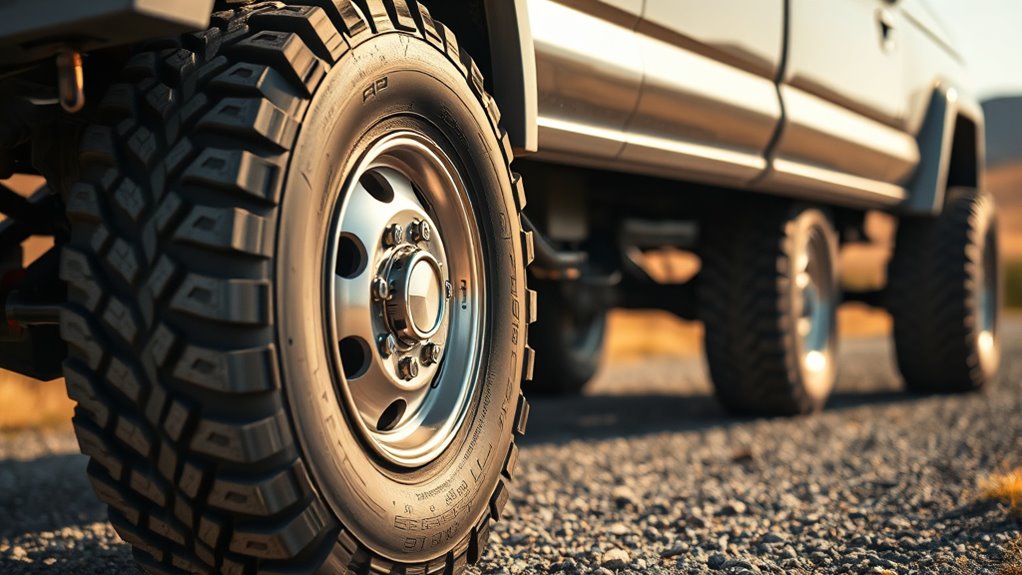
Larger tires and added lift kits increase a vehicle’s weight and rolling resistance, which directly impacts fuel economy. Heavier tires and suspension components mean the engine works harder to maintain speed, especially during acceleration. Increased rolling resistance from aggressive tread patterns or larger diameters adds friction, further reducing MPG. The added weight from lift kits also contributes to higher energy demands, especially in stop-and-go driving. Keep in mind:
- Heavier tires and wheels increase unsprung mass and resistance.
- Larger tires elevate rolling resistance, requiring more fuel.
- Off-road tread patterns intensify drag and decrease efficiency.
- Lift kits add weight and disrupt aerodynamics, compounding MPG loss.
Reducing tire weight and choosing less aggressive treads can help mitigate some fuel economy impacts.
Adjusting Gearing to Offset Tire Size Changes
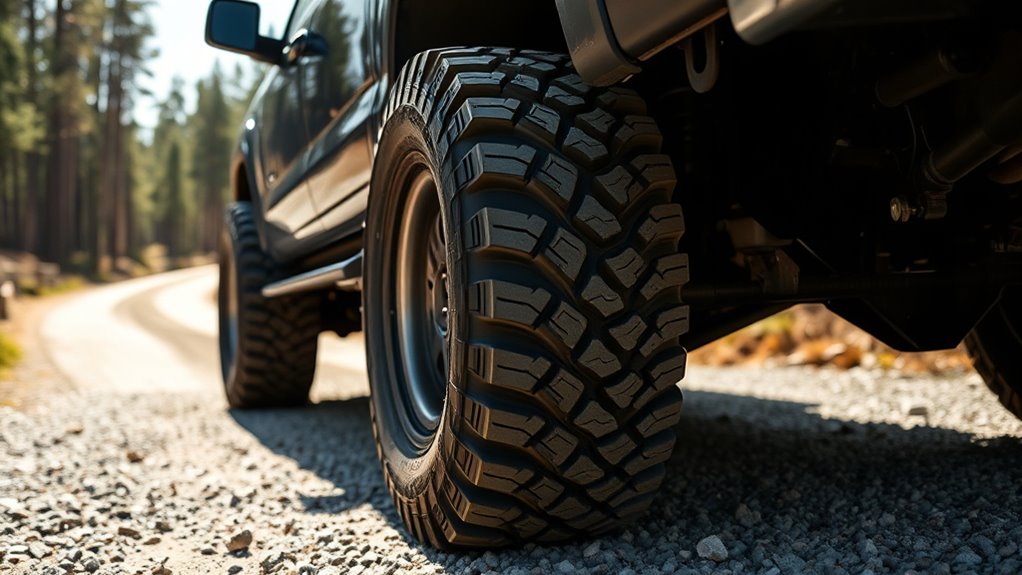
When you install bigger tires, your vehicle’s effective final drive ratio changes, which can negatively impact fuel economy. This means your engine has to work harder, often lowering MPG. To counteract this, you can re-gear your differential to a higher numerical ratio, restoring efficiency. Re-gearing involves installing different ring and pinion gears to match the new tire size, keeping engine RPMs closer to stock levels. Here’s a quick comparison:
| Tire Size | Re-Gear Ratio | Effect on MPG |
|---|---|---|
| 33-inch | 4.10 to 4.56 | Maintains or slightly improves efficiency |
| 35-inch | 4.10 to 4.88 | Restores original MPG levels |
| 37-inch | 4.10 to 5.13 | Optimizes power, reduces strain |
Proper re-gearing helps preserve your MPG and drivetrain health.
Real-World Results and Practical Considerations

In real-world driving, the impact of upgrades like bigger tires and lift kits on fuel economy varies based on driving conditions, vehicle setup, and how well modifications are executed. You might notice a 1 to 2 MPG drop, especially at highway speeds, due to increased rolling resistance, weight, and aerodynamic drag. However, effects differ depending on tire size and lift height.
Upgrading tires and lifts can reduce fuel economy by 1–2 MPG depending on conditions and modifications.
- Larger tires can add 1–2 MPG loss, especially with aggressive tread patterns.
- Lift kits raise aerodynamic drag, reducing MPG more at higher speeds.
- Re-gearing helps offset efficiency loss caused by bigger tires.
- Off-road tires and higher lifts tend to worsen fuel economy more than minor upgrades.
Being mindful of these factors ensures you balance style and capability without sacrificing too much efficiency.
Frequently Asked Questions
How Much Does Tire Width Influence MPG Loss?
Tire width considerably impacts your MPG loss because wider tires increase rolling resistance and weight, making your engine work harder. The more aggressive tread patterns on wide tires also add to drag and resistance. You can expect a reduction of about 1 to 2 miles per gallon, especially at higher speeds. To minimize fuel economy loss, consider narrower tires with less aggressive treads and lightweight options whenever possible.
Do Aftermarket Wheels Affect Fuel Economy Differently Than Stock Wheels?
Aftermarket wheels can affect your fuel economy differently than stock wheels, much like choosing different shoes changes how you walk. Heavier or wider aftermarket wheels increase rolling resistance and weight, making your engine work harder. If they’re larger or less aerodynamic, they can reduce MPG more than stock wheels. To keep your fuel economy on track, opt for lightweight, aerodynamically designed aftermarket wheels that match your vehicle’s specifications.
Can Tire Tread Pattern Significantly Impact Rolling Resistance and MPG?
Yes, your tire tread pattern can substantially impact rolling resistance and MPG. Aggressive, deep-tread tires designed for off-road use increase rolling resistance, which makes your engine work harder and reduces fuel efficiency. Smooth, highway-oriented tires with shallow treads create less resistance, helping you save fuel. If you want better MPG, opt for tires with a tread pattern optimized for low rolling resistance, especially for highway driving, to minimize fuel economy loss.
Is There a Recommended Lift Height to Minimize MPG Reduction?
You should aim for a lift of around 2 inches to strike a balance between style and efficiency. Imagine your vehicle as a sleek bird spreading its wings just enough to soar without catching more wind than necessary. Higher lifts act like gusts of wind, dragging your ride down. Keep it modest, and you’ll preserve your fuel economy while enjoying that rugged look you love.
How Do Driving Conditions Alter the MPG Impact of Lifts and Big Tires?
Driving conditions markedly influence how lifts and big tires affect your MPG. At highway speeds, aerodynamics play a major role, so lifts and larger tires cause more resistance and fuel loss. In city driving, added weight and rolling resistance matter more, reducing efficiency further. Off-road conditions may lessen the MPG impact since aerodynamics matter less, but rough terrains increase resistance. Adjusting your driving style based on conditions can help mitigate fuel economy losses.
Conclusion
Upgrading your tires and lift kits definitely impacts your fuel economy, but it’s not the whole story. While larger tires and lifts can add resistance and disrupt airflow, savvy adjustments like changing your gearing can help keep things in check. Remember, every upgrade has its trade-offs, so weigh the benefits against the fuel costs. Ultimately, it’s about finding the right balance—don’t let your modifications become a wolf in sheep’s clothing.