To back up a trailer like a pro, start by visualizing the space using G.O.A.L. checks and inspecting your vehicle, trailer, and surroundings for hazards. Position your truck at a wide angle with the trailer tongue pointing toward the parking spot. Use all mirrors and spotter guidance for smooth, controlled movements, making small steering adjustments. Practice patience and finesse, focusing on tiny, deliberate turns. Keep advancing your skills, and you’ll master perfect backing techniques every time.
Key Takeaways
- Plan your route, visualize trailer swing, and identify hazards using G.O.A.L. before starting to back up.
- Use all mirrors, backup cameras, and spotters to maintain clear visibility and guidance during maneuvering.
- Approach at a wide angle with a proper initial alignment, ensuring the trailer tongue points toward the parking spot.
- Make small, controlled steering adjustments, reversing slowly to gradually straighten the trailer.
- Double-check connections, safety chains, and area clearance before final parking for safety and security.

7-Inch Wireless Backup Camera for Truck – 2 Channel, DIY Grid Lines, HD 1080P, Night Vision, IP69K Waterproof, Backup Camera for Truck, Pickup, Trailer, Cars – Parking Safety & Towing Assistance
Effortless plug-and-play setup: Set up your backup camera for truck in just 20-30 minutes without any complicated wiring….
As an affiliate, we earn on qualifying purchases.
As an affiliate, we earn on qualifying purchases.
Preparing Your Vehicle and Trailer for Backing
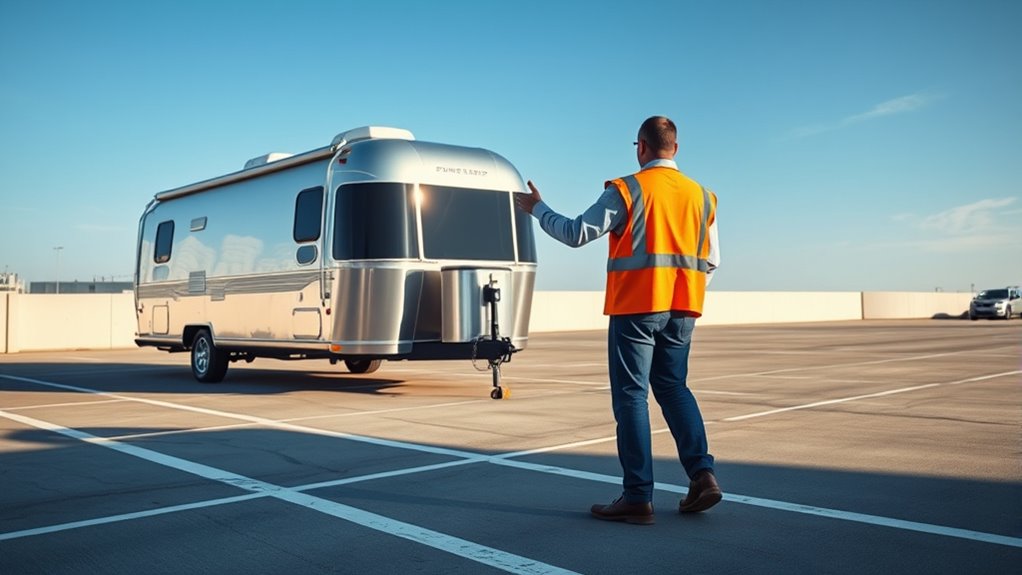
Before you start backing up, it’s essential to prepare your vehicle and trailer to guarantee a smooth and safe maneuver. First, visualize the space and identify potential obstacles using the G.O.A.L. method—get out and look around for hazards above, below, and behind. Position your truck at a wide angle to your backing spot, allowing room for a proper swing. Make sure trailer doors are open and safety chains, light cords, and electrical connections are secure to avoid delays. Check that tandems are set correctly for easier pivoting. Use all mirrors extensively, and if available, backup cameras to improve visibility. Taking these steps ensures you’re set up for a controlled, safe backing process, reducing surprises and increasing accuracy. Remember, practicing consistent vehicle positioning can help build confidence and improve your overall backing skills. Additionally, understanding trailer dynamics can greatly enhance your ability to maneuver effectively. Being aware of trailer sway can help you maintain control during backing, especially in windy conditions or with longer trailers. Developing a good sense of trailer weight distribution can also prevent unwanted sway and improve stability during backing. Incorporating trailer maintenance into your routine ensures all components function properly, contributing to safer and more predictable backing performance.

YATOINTO 2-Pack Grade 80 Trailer Safety Chain 35 Inch with 5/16'' Clevis Snap Hook and Chain Retainer | 21,000 lbs Break Strength | Transport Chain for Towing
[ UPGRADE EQUIPMENT G80 ] — Heavy duty grade 80 transport chain is made using high-strength, heat-treated alloy.G80…
As an affiliate, we earn on qualifying purchases.
As an affiliate, we earn on qualifying purchases.
Planning Your Backing Path and Spotting Hazards
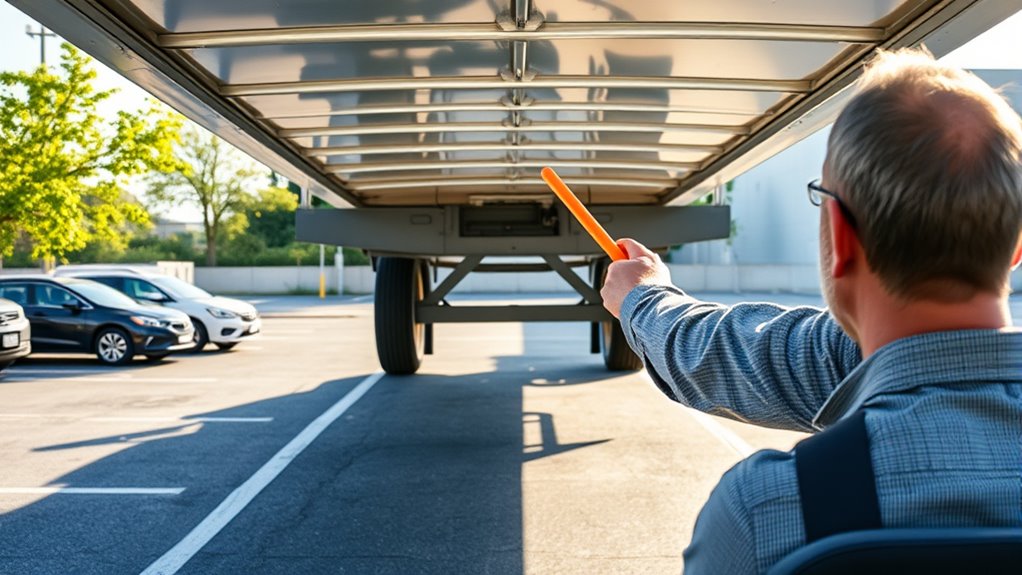
When planning your backing path, start by visualizing the entire route to the parking spot. Look ahead and imagine the trailer’s movement, considering how it will swing and turn. Identify potential hazards like overhead wires, low overhangs, ditches, or uneven surfaces. Walk around the vehicle to get a clear view of obstacles above, below, and behind the trailer—using the G.O.A.L. method to spot hazards. Check for pedestrians, other vehicles, or objects in the area. Plan a smooth, wide approach if needed, and decide on the best angle for backing in. By thoroughly visualizing and spotting hazards, you reduce surprises, increase safety, and make the backing process more controlled and predictable. Proper planning is key to a successful trailer backing maneuver. Additionally, understanding impactful quotes can inspire patience and confidence during challenging maneuvers. Incorporating environmental considerations, such as selecting appropriate sites and being mindful of surroundings, can further enhance safety and efficiency in your backing process. Being aware of hazard recognition techniques can help you better anticipate and avoid potential issues during the maneuver. Recognizing how creative storytelling influences brand perception can also motivate you to approach each backing situation with a positive mindset, turning challenges into opportunities for mastery. Moreover, practicing precision handling can significantly improve your overall backing skills and reduce the risk of accidents.

Universal Towing Mirrors Extenders for Towing, Clip-on Towing Mirror Adjustable Convex Rearview Mirrors for Vehicle Car Truck Trailer RV SUV, Side Mirror Extensions for Towing, 2 Pack
Suitable for 99% of vehicles: :Our mirror extensions for towing trailer mirrors are designed to be compatible with…
As an affiliate, we earn on qualifying purchases.
As an affiliate, we earn on qualifying purchases.
Positioning Your Truck and Trailer for the Maneuver
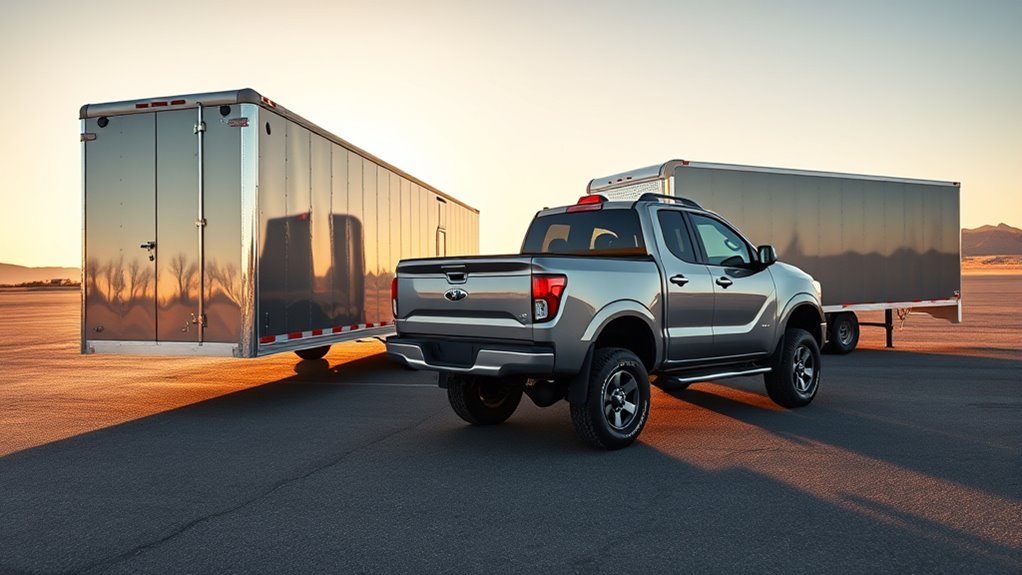
To begin positioning your truck and trailer for backing, guarantee your proper spotter placement to get clear guidance and avoid blind spots. Start by aligning the tractor at the right initial angle, often with a wide swing, to set up a smooth backing path. Accurate initial positioning simplifies the maneuver and reduces the need for corrections later. Ensuring your setup considers the field-of-view of your mirrors and cameras can greatly improve your awareness during the process. Additionally, understanding the contrast ratio of your visual aids can help you better distinguish objects and obstacles in low-light conditions. Recognizing the weight of wind turbine blades and how it affects transportation logistics can also be beneficial when planning large trailer loads. Being aware of water safety principles, such as ensuring your trailer is stable and secure, can prevent accidents during the backing process. Properly assessing visibility conditions can further enhance safety and precision during the maneuver.
Proper Spotter Placement
Proper spotter placement is crucial for a safe and efficient backing maneuver, especially in tight spaces. To maximize effectiveness, position your spotter where they have a clear view of both the trailer and your surroundings. Place them slightly ahead or to the side of the trailer’s path, avoiding blind spots. You are trained on data up to October 2023. A new sentence with proper spotter placement and the rest of the sentence.
Initial Tractor Alignment
Position your tractor and trailer at an appropriate angle to the backing spot before starting the maneuver. This initial setup is vital for a smooth backing process. Typically, you’ll want the trailer slightly offset from the parking space, with the truck positioned at a wide angle to the desired backup line. Confirm the trailer’s tongue is pointed in the general direction of the parking spot, allowing for a controlled swing as you reverse. Adjust your mirrors and check your surroundings to verify clearance and identify obstacles. Open trailer doors and connect safety chains and lights. This setup minimizes the need for sharp turns later, giving you better control and a clearer path during backing. Taking the time to initial positioning can greatly improve your overall backing accuracy and confidence. Understanding trailer sway techniques can also help maintain control during the maneuver. Additionally, practicing initial alignment can help develop muscle memory and reduce mistakes during complex maneuvers. Being aware of sound signals can further aid you in communicating with spotters or other drivers during the backing process.
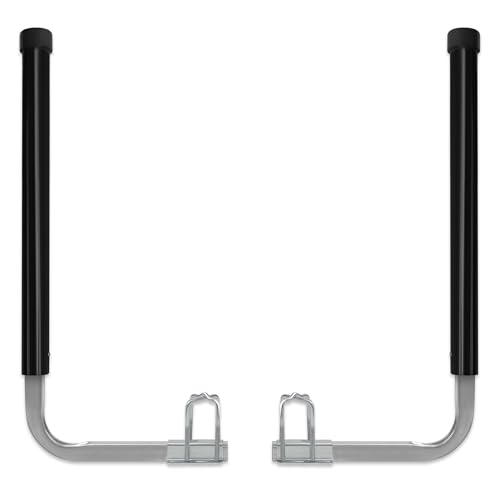
JY PERFORMANCE Boat Trailer Guide-ons, 40"/48" Adjustable, 2PCS Rustproof Electro-Galvanized Steel Trailer Guide ons, Trailer Guides with Black PVC Pipes, for Ski Boat, Fishing Boat, Sailboat Trailer
Durable Electro-galvanized Steel: Each guide-on is crafted from electro-galvanized steel for superior durability and rust and corrosion resistance
As an affiliate, we earn on qualifying purchases.
As an affiliate, we earn on qualifying purchases.
Utilizing Mirrors and Cameras for Optimal Visibility
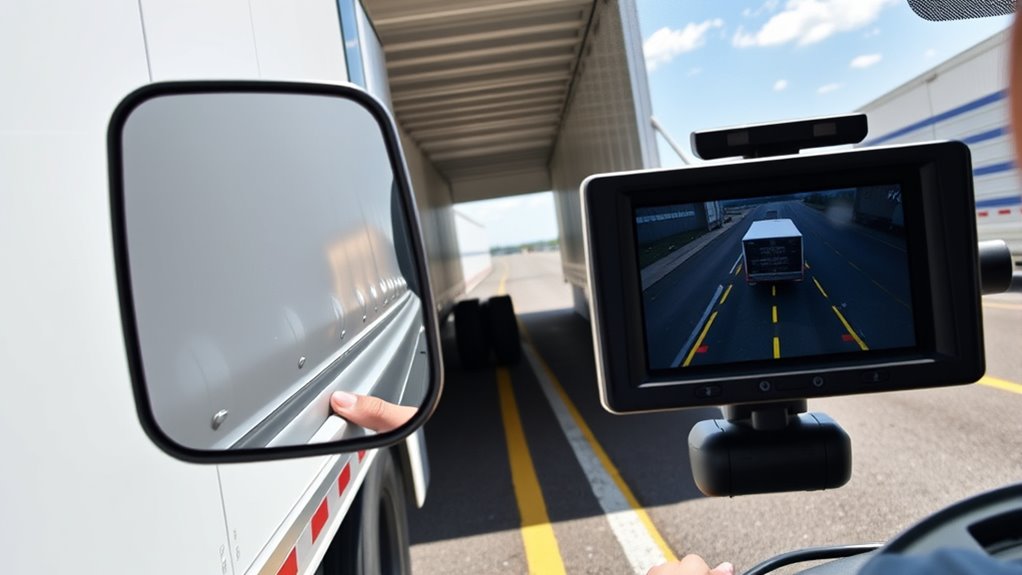
Utilizing mirrors and cameras effectively is essential for maintaining full awareness of your trailer’s position during backing maneuvers. Proper use guarantees you can detect obstacles, judge trailer angles, and make precise corrections. To maximize visibility:
- Regularly scan side mirrors to track trailer movement and identify blind spots.
- Use backup cameras to gain an overhead perspective, especially in tight spaces.
- Cross-reference mirror reflections with camera views for accurate spatial awareness.
- Keep mirrors clean and properly adjusted for clear, unobstructed views at all times.
Applying Proper Steering Techniques and Angle Control
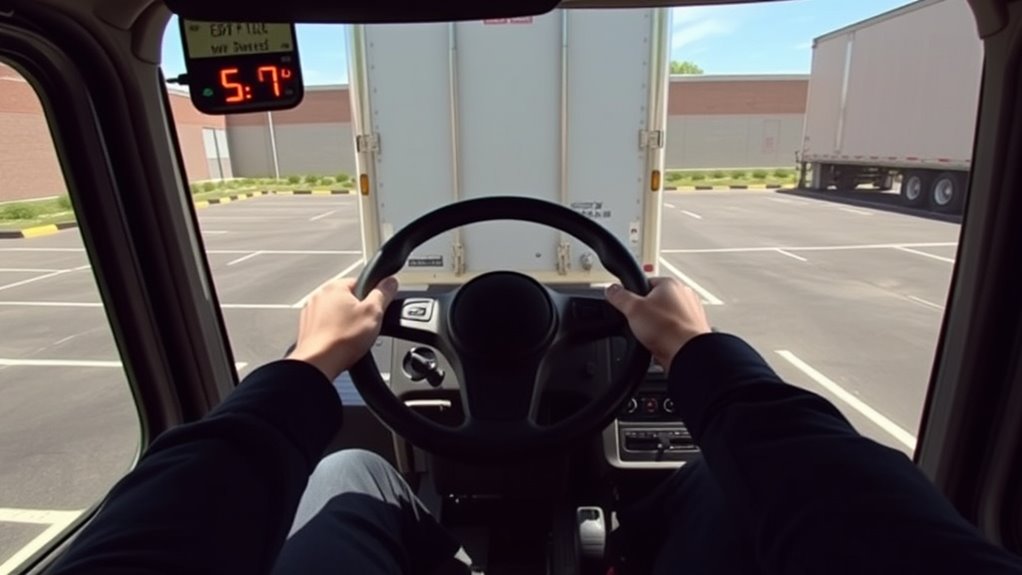
To back up a trailer smoothly, you need to initiate controlled movements with gentle, small steering corrections. Use the swoop technique by approaching the space at an angle and swinging away to set up a better alignment. As you near the spot, gradually straighten the steering to keep the trailer on the desired path. Maintaining steady steering control is essential for precise backing, especially when adjusting for small changes in direction. Developing a good sense of angle control can significantly improve your accuracy and confidence during the backing process. Practicing proper vehicle inspection and understanding your trailer’s behavior can also help prevent mishaps and improve overall safety.
Initiate Controlled Movements
Before you begin moving the trailer, it’s essential to start with slow, deliberate steering adjustments. This helps maintain control and prevents overcorrecting. To initiate controlled movements effectively:
- Keep your foot lightly on the brake and shift into reverse at a low speed.
- Make small steering inputs, turning the wheel gradually in the opposite direction of the desired trailer movement.
- Focus on the trailer’s response, watching how it angles and reacts to your corrections.
- Avoid sudden or sharp turns; instead, adjust gradually to guide the trailer smoothly toward the backing spot.
Use Swoop Technique
The swoop technique helps you set up the trailer at an ideal angle for backing in smoothly. Approach the backing spot at an acute angle, swinging wide to one side to position the trailer correctly. This setup allows better control and easier alignment. As you reverse, turn the steering wheel opposite the desired trailer movement—right to go left, left to go right—gradually guiding the trailer into position. Keep your speed low and make small corrections, avoiding sharp turns. To help visualize this, use the table below to understand key steps and angles:
| Step | Action | Result |
|---|---|---|
| Approach at an angle | Swing wide from the side | Sets up proper trailer alignment |
| Initial turn | Turn opposite to desired move | Guides trailer smoothly into spot |
| Maintain slow speed | Reverse cautiously | Prevents jackknifing |
| Final adjustment | Gradually straighten | Achieves precise parking |
Straighten Gradually
As you reverse and approach the desired parking spot, it’s essential to straighten the trailer gradually rather than making abrupt corrections. This helps maintain control and reduces the risk of jackknifing. To do this effectively:
- Make small, smooth steering adjustments, avoiding sudden turns.
- Use the mirrors to monitor trailer angle and position continuously.
- Unsteer slowly to follow the trailer’s pivot point, keeping it aligned.
- If the trailer begins to jackknife, stop, pull forward, and straighten before trying again.
Using Spotters and Maintaining Safety During Backing
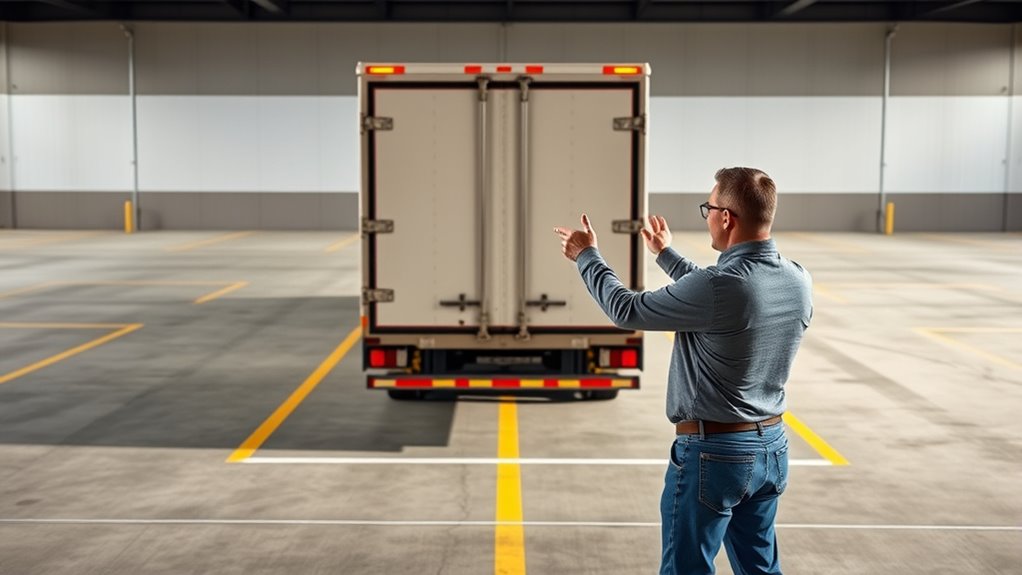
Using a spotter during backing maneuvers considerably enhances safety and accuracy by providing an additional set of eyes to monitor blind spots and guide your movements. Communicate clearly with your spotter using hand signals or radios to guarantee mutual understanding. Maintain eye contact and confirm instructions before making any adjustments. Keep the spotter in a safe position where they can see the trailer’s path and obstacles, avoiding standing in the trailer’s swing zone. Regularly check in with your spotter to confirm clearance and direction. Always be mindful of your surroundings, including overhead wires, ditches, or low overhangs that might not be visible from your seat. Rushing increases risk, so take your time and trust your spotter’s guidance to keep everyone safe.
Managing Trailer Movement With Precise Controls

To manage trailer movement effectively, focus on making small steering corrections and slow trajectory adjustments. Quick, sharp turns can cause jackknifing or loss of control, so take your time with gentle inputs. Precision is key to smoothly guiding the trailer into its parking spot without overshooting or causing damage.
Small Steering Corrections
Mastering small steering corrections is essential for maintaining control during trailer backing. Precise adjustments keep the trailer aligned and prevent oversteering. To do this effectively:
- Make tiny, smooth turns rather than large, abrupt ones to avoid overshooting your target.
- Focus on the trailer’s movement, using mirrors to gauge slight deviations in angle.
- Adjust gradually by turning the wheel just a quarter or half turn, then pause to observe the trailer’s response.
- Keep your hands steady on the wheel, using slow, controlled motions to correct course without causing instability.
These small corrections help you steer the trailer smoothly, maintaining momentum and reducing the risk of jackknifing or unintentional swings. Practice patience and finesse for confident backing.
Slow Trajectory Adjustments
Slow trajectory adjustments are essential for maintaining control and precision during trailer backing. You need to make small, deliberate steering corrections, avoiding sudden or large movements that could cause a jackknife or loss of control. Use gentle, gradual turns to guide the trailer along the desired path. When the trailer begins to drift, slightly turn the steering wheel in the opposite direction to nudge it back on course. Keep your speed low, typically at idle or just above, to react quickly and smoothly. Swing wide at the start to set a better angle, then tighten your line with slow, controlled adjustments. Remember, patience is key—making slow, precise moves helps you maintain better control and prevents accidents or misalignments.
Practicing in Simulated Environments to Build Skills
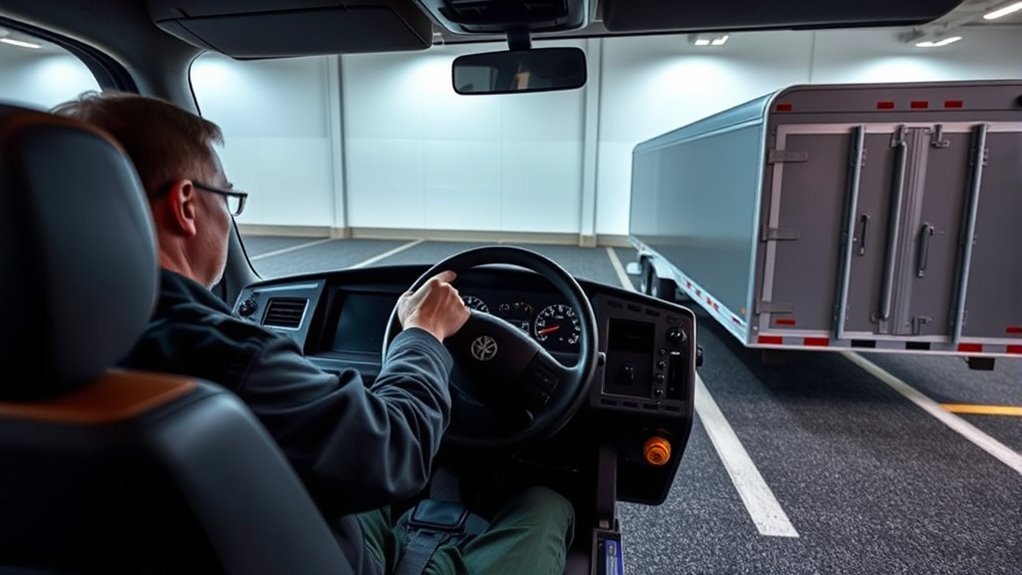
Practicing trailer backing in simulated environments is an effective way to develop your skills without the risks of real-world driving. It allows you to build confidence, refine techniques, and understand trailer responses in a controlled space. To maximize your practice, focus on these key steps:
Practicing trailer backing in simulated environments boosts confidence and skill safely and effectively.
- Use cones or markers to mimic obstacles and parking spots, increasing spatial awareness.
- Vary trailer sizes and angles to adapt to different scenarios and improve versatility.
- Record your sessions to review and identify areas for improvement.
- Practice consistently, emphasizing slow, deliberate movements to develop muscle memory and precision.
Correcting Common Backing Errors Effectively
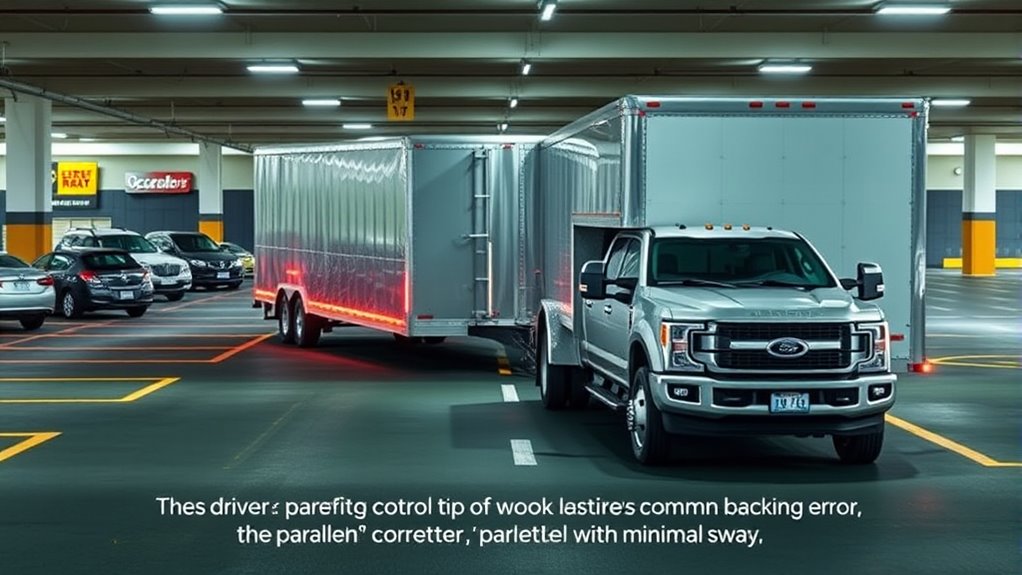
When you notice a backing error, the key is to stay calm and respond promptly to correct it effectively. First, stop your movement if necessary—don’t try to force the trailer into position. If the trailer is misaligned, gently pull forward to straighten out rather than overcorrecting or oversteering. Use your mirrors and backup camera to reassess the trailer’s position, then make small, deliberate steering adjustments. Remember, turning the wheel in the direction of the trailer’s misalignment can help realign it. If you’re jackknifed or stuck, don’t panic—pull forward and restart the maneuver. Patience is essential—taking your time prevents accidents and helps you regain control. With practice, correcting errors becomes quicker and smoother.
Tips for Building Confidence and Improving Your Technique
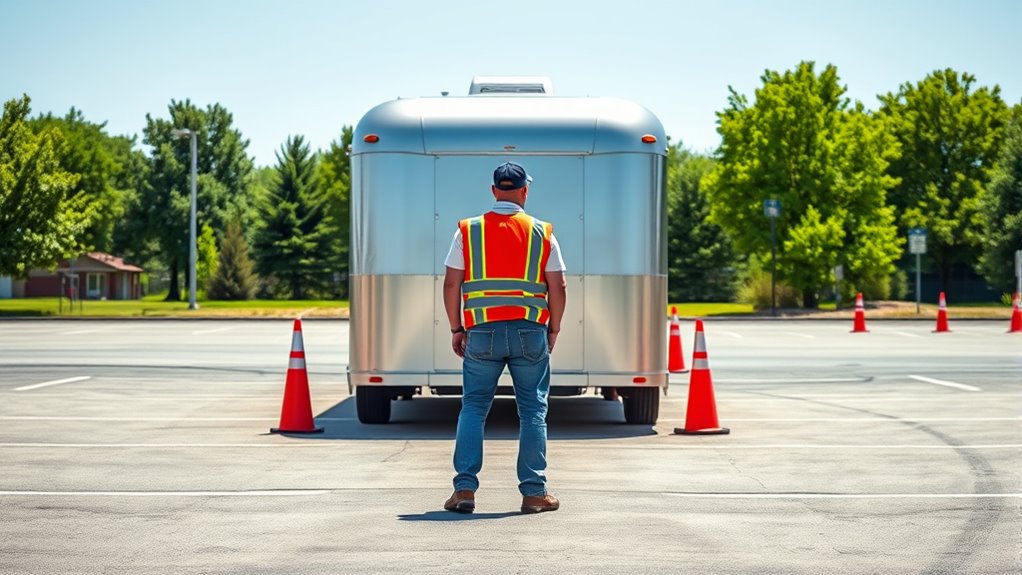
Building confidence in backing a trailer starts with consistent practice and deliberate focus on your technique. To improve steadily, consider these key tips:
- Practice regularly in empty lots with cones or markers to simulate real scenarios.
- Focus on small corrections—avoid large turns that can cause jackknifing or loss of control.
- Use mirrors and cameras to develop a clear understanding of trailer movement and surroundings.
- Progress gradually by starting with wide swings and tightening your turns as you gain precision.
Frequently Asked Questions
How Do I Determine the Best Initial Angle for Backing Into a Spot?
To determine the best initial angle, get out and visualize the space using the G.O.A.L. method, noting obstacles and clearance. Position your tractor at a wide angle, usually starting with a slight turn away from the spot, to give yourself room to maneuver. Swing wide initially, then gradually straighten the trailer as you back, using mirrors and spotters to make sure of proper alignment and avoid obstacles.
What Are Signs of Trailer Jackknifing to Watch Out For?
You’ll notice trailer jackknifing when the trailer swings sharply to one side, creating an acute angle with your truck, often resembling a “V” shape. Signs include difficulty steering, trailer moving unpredictably, and loss of control. If you see the trailer pivoting too much or feel resistance, stop and straighten the rig. Stay alert for sudden movements, and use small corrections to regain control before it worsens.
How Can I Improve Mirror Skills for Better Trailer Alignment?
Did you know that skilled mirror use can improve trailer alignment by up to 30%? You can enhance your mirror skills by practicing regularly in empty lots with cones, focusing on interpreting reflections accurately. Keep your eyes moving between mirrors and surroundings, avoiding reliance on just one view. Use backup cameras if available, and develop a feel for trailer movement with small, deliberate corrections to boost confidence and precision.
When Should I Use the “swoop” Technique Versus a Straight-Back Approach?
You should use the “swoop” technique when approaching a tight parking spot or tricky angle, allowing you to set up the trailer better before straightening out. Opt for a straight-back approach when the space is wide, clear, and you have a direct line to the parking spot. The swoop helps guide the trailer smoothly, while a straight-back is simpler for open, uncomplicated backing situations.
How Do I Safely Back in Tight Spots With Limited Space?
To back into tight spots safely, slow down and plan your approach carefully. Use wide swings initially to set up a better angle, then make small, controlled steering adjustments. Keep your mirrors and backup camera (if available) focused on the trailer’s position. Have a spotter if possible, communicate clearly, and stay patient. Avoid rushing; taking your time minimizes the risk of hitting obstacles and guarantees precise, safe parking.
Conclusion
With practice, backing your trailer becomes like guiding a dance, smooth and confident. Picture yourself gliding backward, mirrors perfectly aligned, the trailer responding seamlessly to your every move. As you refine your technique, you’ll navigate tight spots with ease, turning a formidable task into second nature. Keep watching your mirrors, adjusting your angles, and trusting your skills—soon, backing your trailer will feel as natural as steering your vehicle down an open road.