TL;DR

Get business pricing on garage and car supplies
- Business-only prices and quantity discounts
- Tax-exempt purchasing
- Multiple users, one account, clear invoices
A report on home energy systems finds that bidirectional EV charging during a grid outage remains difficult to achieve: several automakers offer home backup, but their systems may not let a car recharge while the grid is down. The author identifies Tesla’s Cybertruck with Powershare as the clearest current example of the combined capability, while Enphase has said its planned charger is targeting volume production in late 2026. Availability, vehicle compatibility and timing remain uncertain.
A review of available home energy systems finds that few current electric-vehicle setups appear able to both power a home and recharge the vehicle from solar during the same grid outage. The report’s author says Tesla Powershare paired with a Cybertruck is the only option they could identify that supports that combination, leaving households weighing vehicle-specific equipment against a separate home battery.
The report distinguishes ordinary vehicle-to-home (V2H) backup from bidirectional operation that can support both directions of power flow during an outage. Several manufacturers offer systems that let an EV run household circuits after safely disconnecting the home from the grid. But the author says those products generally treat outage operation as a discharging-only mode: the vehicle supplies power, but does not recharge from the home’s solar panels until grid service returns.
As one example, the report cites GM Energy Home Hub documentation describing the system disconnecting the home from the local grid and sending power from the GM Energy Inverter. It says the documentation describes the EV ending its discharge session and beginning to charge once grid power returns, but does not describe recharging the car during the outage. The author also says Ford’s Charge Station Pro, which was required for automatic backup with the F-150 Lightning, is no longer for sale; they do not believe the setup supported charging the vehicle during an outage.
The report identifies Tesla’s Cybertruck Powershare as a configuration that can recharge from solar during an outage if the solar system is included in the backup circuit and the system meets stated conditions. It also discusses Wallbox’s Quasar 2 for Kia vehicles, but says compatibility and simultaneous solar charging and V2H operation are limitations. These are the author’s findings from product information, not a full independent test of every system or installation.
Why Outage Charging Changes Backup Plans
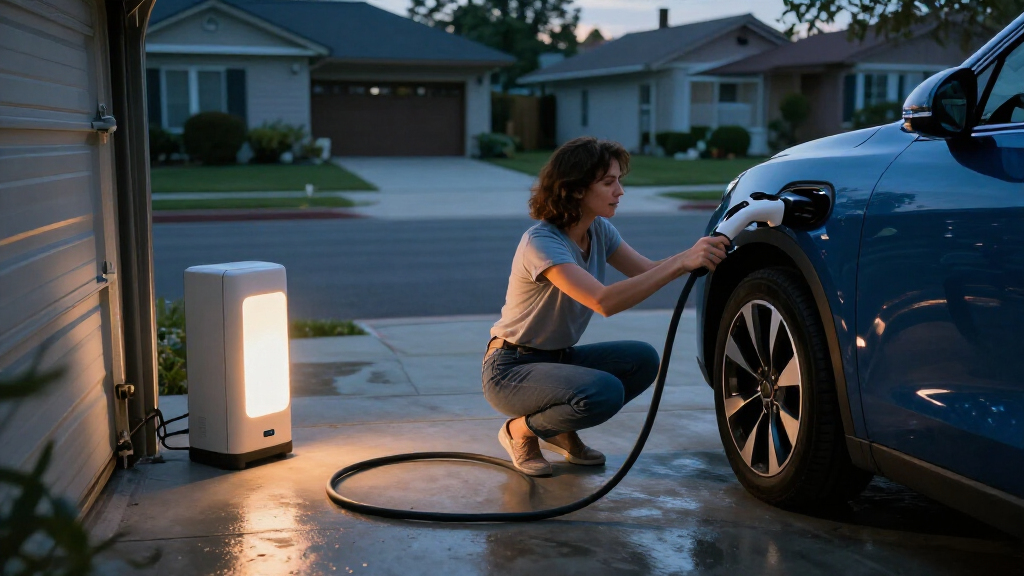
For households with rooftop solar, the distinction affects how long an EV can contribute to emergency power. A vehicle that only discharges may provide a large initial supply, but cannot take advantage of daylight solar to replenish its battery while the grid remains down. A system that supports both functions could let the home use solar to serve household loads and restore some energy to the vehicle, subject to equipment limits and the household’s power needs.
The practical choice is not just between different chargers. It can involve vehicle compatibility, backup hardware, electrical work and cost. The report’s author says buying a Cybertruck specifically to gain the capability would cost more than the smaller emergency battery they are considering. They plan to install a separate battery rather than wait for a broader EV solution, illustrating why the promise of a large vehicle battery does not automatically replace dedicated home storage.
Products Worth Considering

DEWALT 20V MAX 1/4-Inch Impact Driver Kit with Battery and Charger (DCF787D1)

Autel MaxiCharger AC Home Level 2 EV Charger, 50A, Hardwired J1772, Wi-Fi, 25-Foot Cable

Innova 5610 OBD2 Bidirectional Scan Tool
As an affiliate, we earn on qualifying purchases.
How Current V2H Systems Differ
In a standard grid outage, a grid-tied solar system usually cannot simply keep operating as if the grid were present. A backup arrangement must isolate the home from the utility network and manage power safely. The report describes V2H systems built around that separation, but says the ability to discharge a vehicle into the house is not the same as being able to charge the vehicle from solar while islanded from the grid.
Enphase is another possible future route. The report cites a February 2, 2026 announcement that the company was targeting volume production in Q4 2026 for a bidirectional EV charger. Enphase’s stated caveat, as quoted in the report, is that projected vehicle compatibility and bidirectional functionality depend on automaker enablement, vehicle software, applicable standards and final specifications. The author expects delays and says regional availability could come later, but those are their expectations, not confirmed company timelines.
“During a power outage, the GM Energy Home Hub safely disconnects your home from the local power grid and enables backup power to flow from the GM Energy Inverter throughout your home.”
— GM Energy Home Hub documentation, quoted in the report
Compatibility and Timelines Remain Open
The report is a homeowner’s assessment of product documentation and availability, not a comprehensive market survey or a controlled comparison. It does not establish that no other systems can provide the same functionality, and individual installations may depend on vehicle model, software, inverter and backup-panel configuration, local rules and equipment availability.
Enphase’s Q4 2026 target is a stated production goal, not confirmation that compatible products will be available to every household then. The report gives no confirmed date for Massachusetts availability or a definitive list of supported vehicles. It also does not establish whether the cited Wallbox limitations will change for future models or software updates.
Watch for Product and Vehicle Support
The next concrete milestone identified in the report is Enphase’s targeted start of volume production in Q4 2026. Buyers will need to check later announcements for final specifications, supported vehicles, certification and regional availability; the company’s quoted caveats leave those details unresolved.
For households making decisions sooner, the report’s author says they will likely proceed with a smaller battery for emergency backup rather than wait for a compatible EV charging system. Anyone comparing options should confirm directly with the automaker, charger maker and installer whether a system can both isolate the home from the grid and recharge the specific vehicle from solar during an outage.
Key Questions
What does bidirectional charging during an outage mean?
It means a system can send power from an EV to a home and also use available sources such as solar to recharge the EV while the home is disconnected from the grid. The report says many V2H products support the first direction without clearly supporting the second during an outage.
Which setup does the report identify as supporting both functions?
The author identifies Tesla Powershare with a Cybertruck as the clearest current option they found. The report says the solar system must be included in the backup circuit and that system conditions apply; it does not claim to provide an exhaustive survey of every available installation.
Can GM EVs charge from solar during an outage under the setup described?
The report says the GM Energy Home Hub documentation describes backup discharge during an outage and charging after power is restored. The author did not find documentation confirming that the vehicle can recharge from solar while the grid is down.
When could Enphase’s bidirectional charger arrive?
The report cites Enphase’s target of beginning volume production in Q4 2026. That is a production target, not a confirmed date for local availability or a guarantee of compatibility with a particular EV.
Does a home battery avoid these vehicle-compatibility issues?
A separate home battery does not rely on an EV’s bidirectional charging support, though its capabilities depend on the battery and installation. The report’s author says they are considering a smaller emergency battery rather than waiting for a suitable EV setup.
Source: jefftk.com