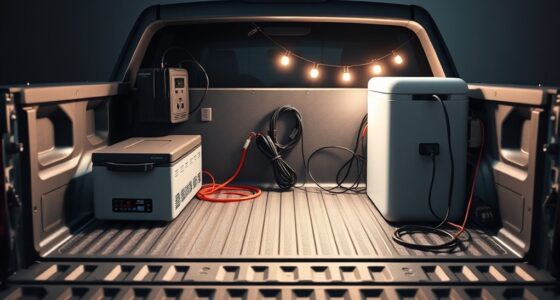
To plan power in your truck bed setup, start by listing all tools and their wattage needs, then calculate your total peak power. Consider solar panels to recharge batteries during use, choosing weatherproof options that match your daily energy goals. Pick a battery with enough capacity, add a reliable inverter and charge controller, and organize your wiring with safety in mind. Testing the system guarantees everything runs smoothly—continue exploring to learn more about optimizing your setup for dependable energy on the go.
Key Takeaways
- Identify all tools/devices and their power requirements to determine total energy needs.
- Calculate available sunlight hours and match solar panel wattage to generate sufficient daily energy.
- Select batteries and inverters that support peak power demands with safety margins.
- Incorporate proper wiring, fuse boxes, and safety features to ensure organized, safe power distribution.
- Test the system thoroughly and monitor performance to optimize reliability and efficiency.
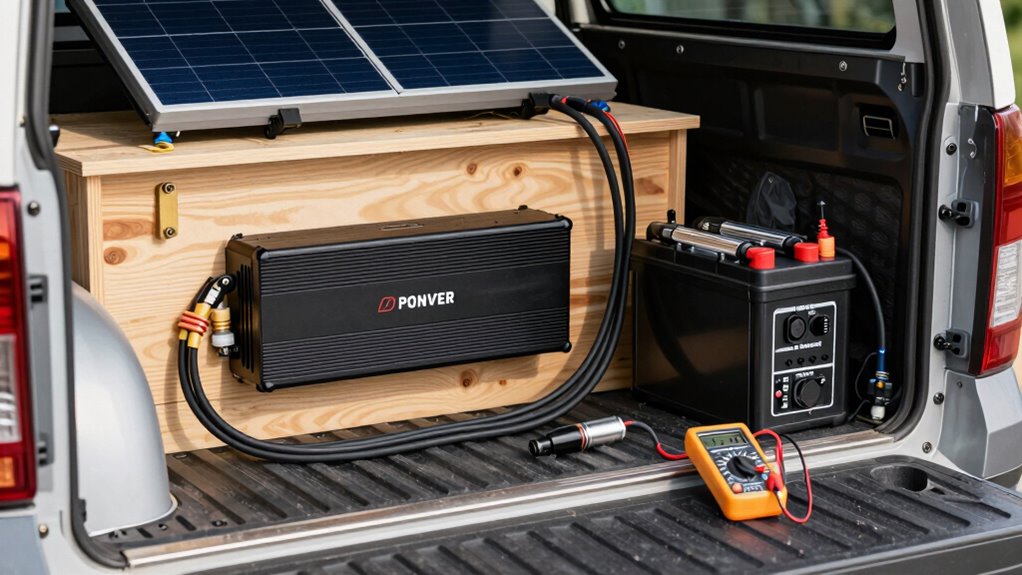
Planning your power usage in a truck bed setup is essential to guarantee you have enough energy for your tools and devices without overloading your system. The first step is to assess your energy needs. Make a list of all the tools and devices you’ll use regularly, noting their power requirements in watts. This helps you determine the total wattage you’ll need at peak usage. Once you know your power demands, you can choose a battery capacity that comfortably supports these needs, with some extra margin for safety or unexpected use. Remember, a larger battery capacity means more stored energy but also adds weight and cost, so find a balance that suits your setup.
Assess your tools’ wattage needs to choose the right battery and ensure balanced, reliable power for your truck bed setup.
Next, consider how solar integration can maximize your power system’s efficiency. Solar panels are a great way to recharge your batteries during the day, especially if you’re working in remote locations. When planning solar integration, calculate the average sunlight hours in your typical working area and match that with the wattage of your panels. This will help you estimate how much energy you can generate daily, supplementing your stored battery power. Proper solar setup ensures your system remains charged without relying solely on the battery, extending your operational time and reducing dependency on external power sources. Additionally, understanding solar panel standards is crucial for selecting reliable and weatherproof equipment, especially in varied outdoor conditions.
After selecting your battery capacity and planning for solar integration, focus on your power management system. Use a high-quality inverter to convert stored DC power to AC, suitable for your tools. Incorporate a reliable charge controller to regulate solar input, protecting your batteries from overcharging and prolonging their lifespan. It’s also wise to include a distribution panel or fuse box, ensuring safe and organized power distribution throughout your truck bed setup.
Finally, test your entire power system before heading out into the field. Run your tools and devices to see if your battery capacity and solar input are sufficient for your needs. Monitor battery levels and solar input during operation, making adjustments if necessary. This step helps you identify potential issues and fine-tune your setup. By carefully plan your power usage, selecting the right battery capacity, and integrating solar effectively, you ensure your truck bed setup provides reliable energy, keeps your tools running smoothly, and allows you to work efficiently no matter where you are.

BELTTT 2000W Pure Sine Wave Inverter, Inverter 12V DC to 120V AC for Solar, RV, Truck, Outdoor, Power Inverter with Dual AC and 20A Socket, 5V 2.1A USB, Surge 4000W, Hardwire Port, Remote Controller
【POWERFUL DC to AC CONVERTER】: This solar inverter delivers 2000W of continuous battery DC 12V to AC 110V…
As an affiliate, we earn on qualifying purchases.
As an affiliate, we earn on qualifying purchases.
Frequently Asked Questions
What Types of Batteries Are Best for Truck Bed Setups?
You should choose deep cycle batteries, like AGM or lithium types, for your truck bed setup. These Battery types provide reliable power and are designed for repeated discharge and recharge cycles, making them ideal for power management. Lithium batteries are lighter and have higher capacity, but AGM offers a more affordable option with good performance. Select the right battery based on your power needs and budget to guarantee efficient and safe operation.
How Do I Prevent Power Surges in My System?
To prevent power surges in your truck bed system, focus on proper battery maintenance and install surge protection devices. Regularly check your batteries for corrosion and guarantee connections are tight. Use surge protectors or voltage regulators to shield your system from sudden spikes. This proactive approach keeps your setup safe, prolongs battery life, and prevents damage to sensitive equipment, giving you peace of mind while on the road.
Can I Run a Refrigerator Continuously From My Truck?
Like a knight with a trusty steed, you can run a refrigerator continuously from your truck if you manage your power wisely. Focus on battery maintenance and efficient power management to prevent draining your battery. Use a high-capacity, deep-cycle battery, and consider installing a solar charger or inverter. Regularly monitor your power usage to guarantee your fridge stays cool without risking power loss or damage.
What Safety Precautions Are Necessary for Electrical Wiring?
You should prioritize grounding techniques to prevent electrical hazards, guaranteeing all wiring is properly grounded to avoid shocks or shorts. Use appropriate insulation methods, such as high-quality electrical tape or heat-shrink tubing, to protect wires from damage and moisture. Always double-check connections and avoid exposed wiring. These safety precautions help maintain a secure setup, reduce risks, and ensure your electrical system functions reliably during continuous use or emergencies.
How Do I Upgrade Power Capacity in the Future?
To upgrade your power capacity, you should consider installing a higher-capacity battery or adding a secondary one to extend your battery lifespan. Upgrading wiring and using more efficient components can improve power efficiency. Regularly check your system’s performance, and consult a professional to guarantee compatibility and safety. This approach guarantees your setup can handle increased demands while maintaining ideal power efficiency and prolonging battery lifespan.

Renogy 100W Solar Panel 12V, Flexible Solar Panel 100 Watt 22% High-Efficiency, 240° Ultra Lightweight Solar Panels for Marine RV Cabin Van Car Boat Camping Curve Surfaces, Black
High Power Output – The flexible solar panel can provide an average of 500 Watt-hours of electricity per…
As an affiliate, we earn on qualifying purchases.
As an affiliate, we earn on qualifying purchases.
Conclusion
By carefully planning your power setup, you guarantee your truck bed remains efficient and reliable. Think of it like designing a city’s electrical grid—you want just enough power to keep everything running smoothly without overloading. Visualize your power needs as a flowing river, balanced and steady, preventing floods or droughts. With a clear plan, you’ll enjoy a seamless, safe power supply for all your truck bed adventures, making every trip both enjoyable and dependable.
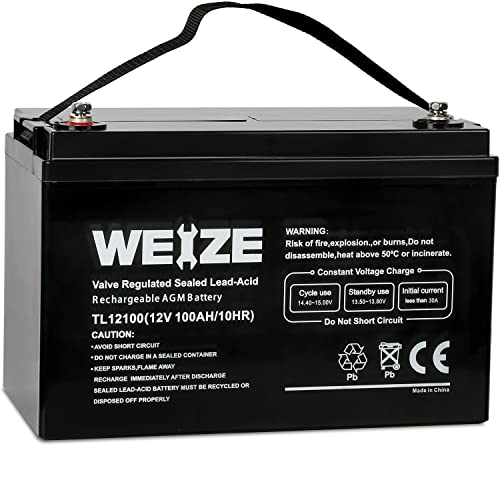
Weize Deep Cycle AGM 12 Volt 100Ah Battery, Maintenance-Free, 3% Self-Discharge Rate, 1150A Max Discharge Current, Perfect for RV, Solar, Trolling Motor, Wind, Marine, Camping and Off-Grid System
MAINTENANCE FREE: 12.99x 6.73x 8.43 inches. Weize 12v 100Ah sealed lead acid battery is manufactured with absorbent glass…
As an affiliate, we earn on qualifying purchases.
As an affiliate, we earn on qualifying purchases.

Champion Power Equipment Pro Grade OSHA Compliant Power Distribution Box, 50-Amp Twist Lock Inlet, Six 120V GFCI Duplexes, One 120/240V 30A Locking Outlet, 30A and 50A RV Adapters
Our high-capacity box features one 50A twist-lock inlet, six 120V GFCI-protected duplexes and one 120/240V 30A locking outlet…
As an affiliate, we earn on qualifying purchases.
As an affiliate, we earn on qualifying purchases.